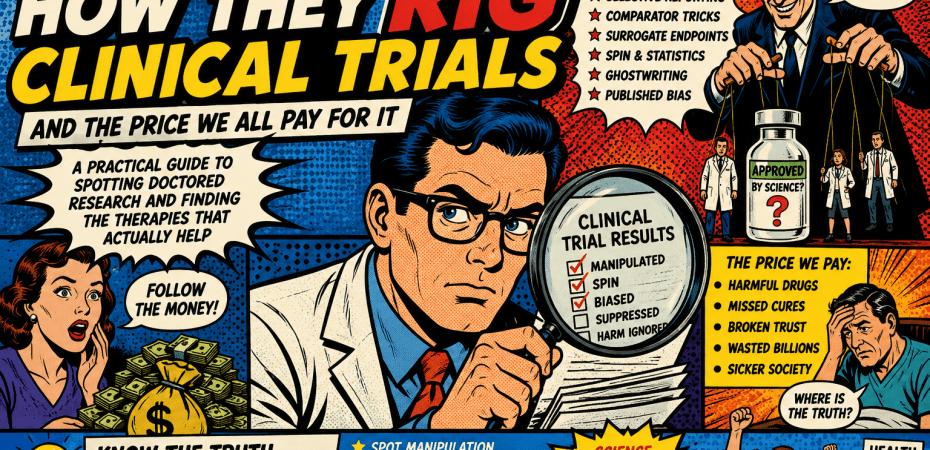
A Midwestern Doctor. The Forgotten Side of Medicine: How They Rig Clinical Trials and The Price We All Pay For It. The Forgotten Side of Medicine (Substack), 3 June 2026. Reader-supported online publication.
There is a comforting myth that science always corrects itself. It contains enough truth to be persuasive. Science has, after all, transformed human life beyond recognition. Antibiotics, modern surgery, vaccination against many diseases, imaging technology and countless other advances are genuine achievements. One would be foolish to deny them.
This being said, reality is more complicated than the myth. Science corrects itself eventually, but often only after long periods during which careers, reputations, financial interests and institutional prestige combine to resist correction. Galileo was hardly the last person to discover that an establishment can defend error with remarkable determination. This long essay by A Midwestern Doctor is best read in that spirit. It is not really an argument against science. It is an argument against scientific bureaucracy.
One sentence near the beginning captures its central thesis:
“Scientific research has provided immense benefit to society, but as its success earned it power, prestige and enormous financing, incentives shifted from advancing humanity to protecting the status quo and ensuring vast profits for the pharmaceutical industry.”
Whether one accepts that conclusion entirely or not, it is difficult to deny that incentives matter. Medicine today is inseparable from enormous financial structures. Clinical trials are expensive. Drug approvals determine fortunes. Universities depend on grants. Regulators often recruit from the industries they regulate before many return there afterwards. None of these facts automatically implies corruption, but they certainly create opportunities for it.
One of the strengths of the article is that it avoids relying purely upon anecdote. Instead it repeatedly cites criticisms made by respected figures within mainstream medicine itself. Former New England Journal of Medicine editor Marcia Angell, Ben Goldacre, Peter C. Gøtzsche, Malcolm Kendrick and John Ioannidis all appear, each having criticised aspects of pharmaceutical research from rather different perspectives. That immediately distinguishes the article from much of the internet’s medical commentary. It is engaging with an existing literature rather than inventing one.
The most persuasive section is the catalogue of methods by which clinical trials may be manipulated without anyone literally falsifying the data. Comparator selection, surrogate endpoints, selective publication, outcome switching, subgroup analysis, relative rather than absolute risk presentation, publication bias and ghostwriting, have all been documented elsewhere. Seeing them assembled together is sobering.
The author observes:
“Because so much money rides on each trial, perverse incentives always exist to doctor the results so a positive outcome is guaranteed.”
That is probably stronger than the evidence allows. “Always” is an ambitious word. Yet the broader point—that large financial incentives distort research—is hardly controversial. Economics has taught us for centuries that incentives shape behaviour. It would be extraordinary if biomedical research somehow escaped that general law.
The discussion of randomised controlled trials is also more nuanced than critics sometimes acknowledge. The article explicitly concedes that RCTs possess genuine strengths:
“RCTs are an incredibly useful tool for deducing truth, but the moment you rely upon them as the only tool for discerning truth and guiding clinical decisions, many medical problems will rapidly become unsolvable.”
Here I found myself largely in agreement. Medicine is an applied science rather than pure physics. Individual patients differ greatly. Clinical judgement still matters. The modern tendency to treat statistical hierarchies almost as theological hierarchies has occasionally produced absurdities in which experienced clinicians are expected to ignore obvious observations because they lack the right category of evidence. That does not mean observational evidence should replace controlled trials. It means both forms of evidence have strengths and weaknesses.
Where I become more cautious is in the article’s treatment of COVID-19. Here the rhetoric becomes considerably more confident than the underlying evidence justifies. The author writes:
“Dozens of treatments existed for the disease…”
That claim requires a higher standard of proof than is presented here. Some treatments undoubtedly deserved more serious investigation. Others probably did not. The pandemic demonstrated genuine institutional failures, but it also generated an extraordinary quantity of low-quality research, premature certainty and political polarisation from every side. It would be unfortunate if legitimate criticism of public health institutions encouraged a new form of dogmatism merely wearing different clothes.
Similarly, the discussion of DMSO is intriguing but incomplete. The author clearly believes it has been unjustly neglected and presents numerous testimonials. Testimonials, however sincere, are not equivalent to carefully gathered evidence. They may justify further investigation, but not final conclusions.
This points to what I regard as the article’s principal weakness. It sometimes moves too quickly from exposing defects within the current system to implying that neglected alternatives therefore work. These are separate questions. If one demonstrates that a judge is corrupt, one has not thereby proved the defendant innocent.
Likewise, exposing pharmaceutical misconduct does not automatically validate every suppressed treatment. Some genuinely effective therapies have undoubtedly been ignored. Others have probably deserved their rejection. Distinguishing between them remains difficult.
Nevertheless, I found the final section unexpectedly hopeful. The author argues that artificial intelligence may radically democratise scientific criticism by making it possible for ordinary people to interrogate clinical papers directly rather than relying exclusively on experts’ summaries. Whether AI ultimately fulfils that promise remains uncertain, but the idea itself is attractive. One of the great advantages of AI is its ability to examine enormous quantities of primary material without fatigue.
Perhaps the deepest issue raised by this essay is philosophical rather than medical. Who guards the guardians? Modern societies have increasingly answered: independent regulators, expert committees and professional consensus. The difficulty is that these institutions themselves eventually become centres of power.
The article therefore reminds me less of a medical textbook than of Lord Acton. His famous observation that power tends to corrupt applies no less to scientific institutions than to governments. Human nature does not change merely because those exercising authority wear laboratory coats rather than parliamentary robes. That does not justify rejecting mainstream medicine. It does justify approaching it with thoughtful scepticism.
Indeed, one of the paradoxes of genuine science is that it depends on organised doubt. A scientific establishment which discourages criticism eventually ceases to embody the scientific spirit, however impressive its credentials.
I therefore finished this essay neither persuaded of every specific claim nor inclined to dismiss it. It raises too many serious questions to be waved away. It also occasionally reaches conclusions more rapidly than the evidence seems to warrant. That, perhaps, is exactly how controversial works should be read: neither with automatic belief nor automatic disbelief, but with patient attention.
If the article encourages more clinicians, researchers and ordinary readers to examine primary evidence for themselves rather than relying entirely on institutional summaries, it will have performed a valuable service.

Discover more from The Libertarian Alliance
Subscribe to get the latest posts sent to your email.