
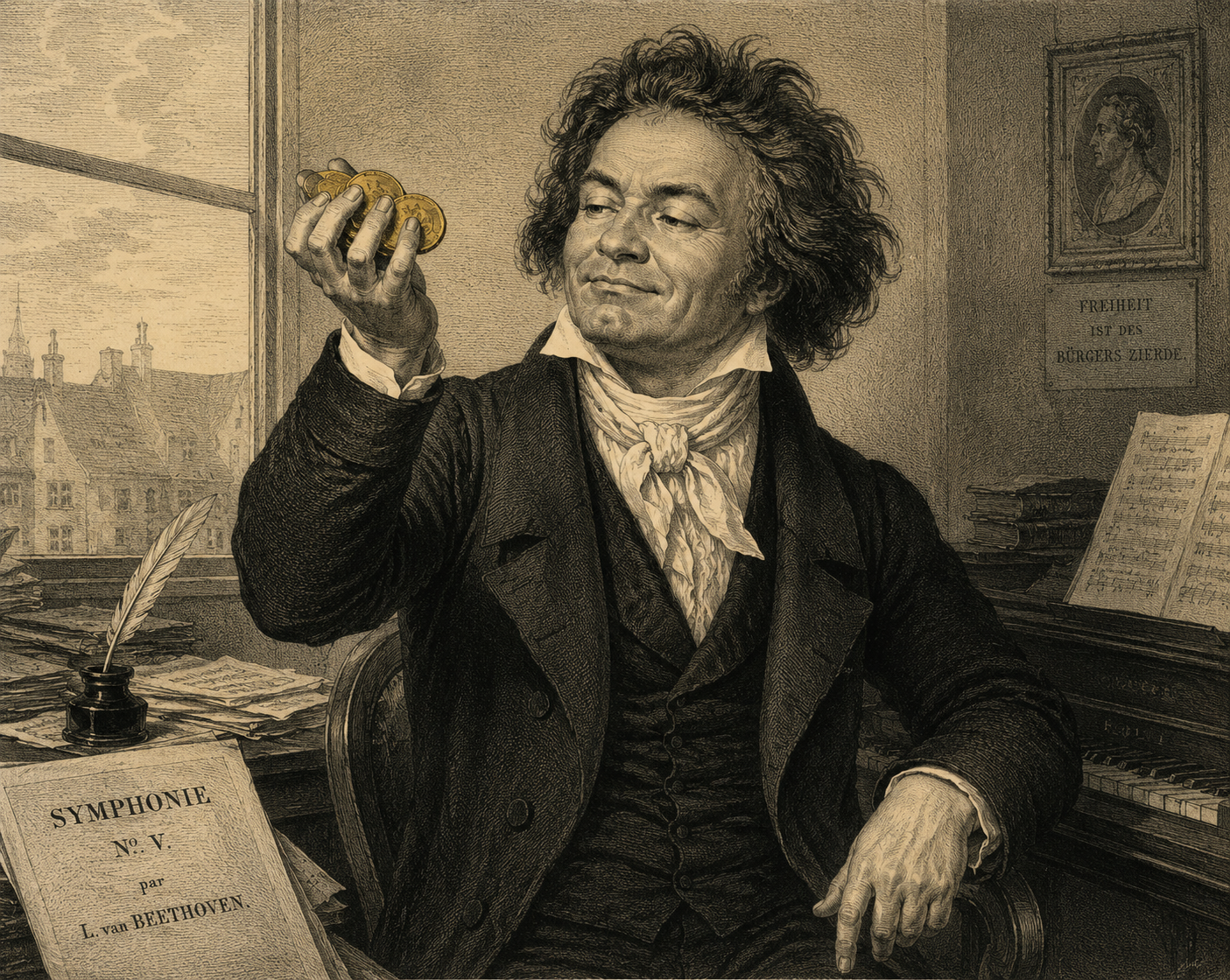
Should I apologise for a piece that has nothing to do with politics? Not, I think, unless Bryan Mercadente is brought before us all in a hairshirt, confessing his many excesses and promising never to publish again on the urgent need of everyone in his town between the ages of sixteen and twenty-four to die of cancer. For this reason, and because it is a nice afternoon, I will write about Beethoven.
He occupies a peculiar position in the history of Western music. Many great composers wrote masterpieces alongside routine commissions. Handel produced occasional odes of little lasting importance. Haydn composed innumerable divertimenti that even specialists seldom hear today. Rossini turned out operas at astonishing speed, some plainly better than others. Mozart himself occasionally wrote functional dances and ceremonial music that, while elegant, hardly stand beside Don Giovanni or the final symphonies.
With Beethoven, however, expectations are uniquely high. We assume as a matter of course that every work must be a revelation. His reputation has become so monumental that even competent craftsmanship can seem disappointing. It is therefore worth asking a question that admirers sometimes hesitate to pose. Did Beethoven write mediocre music?
The answer is yes—but only after careful qualification. Beethoven almost never wrote incompetently. His weakest works are seldom failures in the ordinary sense. Instead, they are pieces in which external circumstances seem to have constrained the imagination. They fulfil a purpose without transcending it. They entertain or commemorate, but they rarely open the emotional and philosophical depths that distinguish the greatest Beethoven.
That distinction matters. Beethoven’s occasional disappointments reveal something about the nature of artistic greatness itself.
One striking feature of his catalogue is that the least convincing works almost always belong to genres imposed by circumstance rather than inner necessity. When Beethoven writes a symphony, a piano sonata, a string quartet or a concerto, one senses a composer wrestling with ideas that demanded expression. Even the earlier works possess an energy that feels inevitable. They are not only fulfilling commissions; they are attempting to redefine what those genres could become.
The picture changes when Beethoven writes for political ceremonies, military victories, congresses, court festivities or fashionable entertainment. Here the music often becomes more rhetorical than profound. The craftsmanship remains formidable, yet the emotional centre is noticeably weaker. This should not surprise us. Even a genius must sometimes earn his living.
The obvious example is Wellington’s Victory, Op. 91. Few works better illustrate the difference between popularity and greatness. Audiences adored it. They still occasionally do. Cannons fire, military bands clash, patriotic melodies collide, and the whole enterprise delivers precisely the excitement its first listeners expected after Napoleon’s defeat. Yet the excitement rarely survives repeated listening. The work substitutes theatrical effects for musical argument. Instead of developing themes with the inexorable logic found in the Eroica or the Fifth Symphony, Beethoven relies on increasingly elaborate displays of noise. The famous battle sequence remains entertaining, but entertainment alone was never Beethoven’s highest ambition. It is revealing that modern concert programmes rarely include the piece except as a curiosity. It tells us much about the political atmosphere of early nineteenth-century Vienna, but little about Beethoven’s deepest artistic personality.
A similar fate has overtaken Der glorreiche Augenblick, Op. 136, composed for the Congress of Vienna. The occasion itself seemed momentous. Europe had emerged from two decades of revolutionary warfare. Monarchs gathered to reconstruct the political order. Beethoven naturally received a commission to celebrate the event. The resulting cantata possesses dignity, ceremonial grandeur and moments of genuine brilliance. Yet one seldom senses the inward urgency found elsewhere in his mature output. The music appears attached to an historical moment rather than driven by universal emotional necessity. Perhaps that is inevitable. Governments rarely inspire great art for very long. Once the political circumstances disappear, much of the music’s emotional force disappears with them.
Some compositions occupy a more ambiguous position. The Choral Fantasy, Op. 80, remains fascinating precisely because it refuses to fit comfortably into any category. It begins as a piano fantasia, develops into something resembling a concerto, gradually introduces orchestra and chorus, then concludes in a hymn whose resemblance to the finale of the Ninth Symphony is unmistakable. The work deserves admiration. Without it, the Ninth might never have assumed its final form. Yet admiration differs from complete artistic satisfaction. The structure feels improvised in places. Transitions occasionally appear awkward. One senses Beethoven experimenting publicly with ideas that had not yet reached complete maturity. The piece therefore belongs among those works whose historical importance exceeds their artistic perfection.
The Triple Concerto, Op. 56, is another interesting case. There is little wrong with it. This, however, may be the problem. The work is graceful and consistently attractive. The interaction between violin, cello and piano remains beautifully judged throughout. The orchestration is refined. The slow movement possesses considerable charm. Yet compared with Beethoven’s other concertos, something seems missing. The piano writing is too restrained. Dramatic confrontation gives way to polite conversation. Heroic struggle becomes civilised exchange. Instead of the elemental conflicts found in the Third, Fourth and Fifth Piano Concertos, we encounter cultivated aristocratic conversation. It is beautiful conversation, certainly, but conversation nonetheless.
The Septet, Op. 20, is perhaps another paradox. It became one of Beethoven’s greatest popular successes. Audiences loved it. Publishers welcomed it. Performers requested it repeatedly. I used to adore it. Beethoven himself eventually grew irritated by its success because the public continued demanding the Septet while neglecting the increasingly adventurous works into which he poured his greatest energies. Their preferences were understandable. The Septet is immediately attractive. Its melodies charm almost effortlessly. Its atmosphere remains sociable and optimistic throughout. It asks little of its listeners. Perhaps that is why Beethoven became impatient with it. The later quartets demanded concentration, emotional courage and intellectual engagement. The Septet merely delighted. Delight was not enough for the composer he had become.
Much of Beethoven’s lesser music belongs to categories that modern audiences seldom encounter. He wrote countless dances, contredanses, minuets and social pieces for practical occasions. He produced variation sets on popular tunes and operatic melodies because fashionable pianists required such repertoire. These works display technical fluency and occasional flashes of originality, but they rarely probe beyond the expectations of polite society. They remind us that Beethoven was not permanently inhabiting the exalted world of the late quartets. He also paid bills, or did when they were accompanied by writs and the occasional court order.
This practical side of composition often disappears beneath modern myths of solitary genius. Yet understanding it makes Beethoven appear more rather than less impressive. The extraordinary works become even more remarkable once we recognise how much ordinary professional labour surrounded them.
Beethoven’s songs are another interesting limitation. He certainly produced memorable examples. An die ferne Geliebte occupies a distinguished place in musical history. Several individual Lieder possess great beauty. Even so, song never became his natural medium. Placed beside Schubert, the difference is striking. Schubert seems instinctively to understand how melody, poetry and atmosphere belong together. Beethoven often appears to approach song as an instrumental composer adapting himself to words rather than allowing words to generate melody from within. His songs frequently impress through seriousness rather than spontaneity. Again, this is not failure. It is simply evidence that even the greatest composers possess stronger and weaker territories.
Among the larger works, Christus am Ölberge, Op. 85, perhaps illustrates Beethoven’s occasional difficulty with explicitly dramatic religious subjects. There are undeniably noble passages. Individual scenes achieve considerable emotional power. Yet the work lacks complete dramatic coherence. Compared with Bach’s Passions, Haydn’s great oratorios, or even Beethoven’s own Missa Solemnis, it seems uncertain whether it wishes primarily to be theatre or devotion. The result commands respect without entirely compelling conviction. The ambition is unmistakable. The fulfilment remains partial.
Not all Beethoven overtures occupy the same level. Egmont, Coriolan and Leonore No. 3 stand among the supreme achievements of orchestral literature. Within a few minutes they establish entire moral universes. By contrast, Namensfeier, Op. 115, feels comparatively conventional. It is expertly constructed and enjoyable, yet it never acquires the psychological urgency of Beethoven’s finest dramatic introductions. One remembers its competence more readily than its inspiration.
Perhaps the conclusion is not that Beethoven occasionally wrote secondary music. Rather, it is that his weaknesses reveal consistent patterns. He rarely disappoints when confronting purely musical problems. His imagination flourishes where emotional conflict, philosophical depth or structural innovation become central. He becomes less distinctive when responding primarily to external demands: political celebrations, patriotic commissions, court ceremonies or fashionable entertainment. In other words, Beethoven achieved greatness not simply because he possessed extraordinary technical gifts. Many gifted composers mastered technique. Beethoven became Beethoven because his imagination responded most powerfully when grappling with fundamental questions about freedom, suffering, heroism, mortality and transcendence. Remove those questions, and even his astonishing abilities sometimes produced just excellent craftsmanship.
If one had to nominate Beethoven’s least convincing substantial work, Wellington’s Victory remains the strongest candidate. This is not because it is incompetent, nor because it lacks excitement. It is instead because it represents genius temporarily subordinated to circumstance. The external occasion overwhelms the internal necessity. The public triumph displaces private artistic truth. Yet even here perspective remains important. Most composers would gladly claim Wellington’s Victory among their finest achievements. Beethoven’s “mediocre” works appear mediocre only because they stand beside the Eroica, the late piano sonatas, the late quartets, the Ninth Symphony and the Missa Solemnis. His standard of comparison is almost impossibly high.
Perhaps that is the fairest judgement. Beethoven’s failures are rarely failures of craftsmanship. They are failures of transcendence. They remind us that even genius cannot entirely escape circumstance, though few composers have escaped it so often.
Discover more from The Libertarian Alliance
Subscribe to get the latest posts sent to your email.
Related posts:
 Meyerbeer’s Le Prophete: Effects without Causes
 A Review of Satyricon (1969)
 Britain Through Xi Jinping’s Eyes
Powered by YARPP.