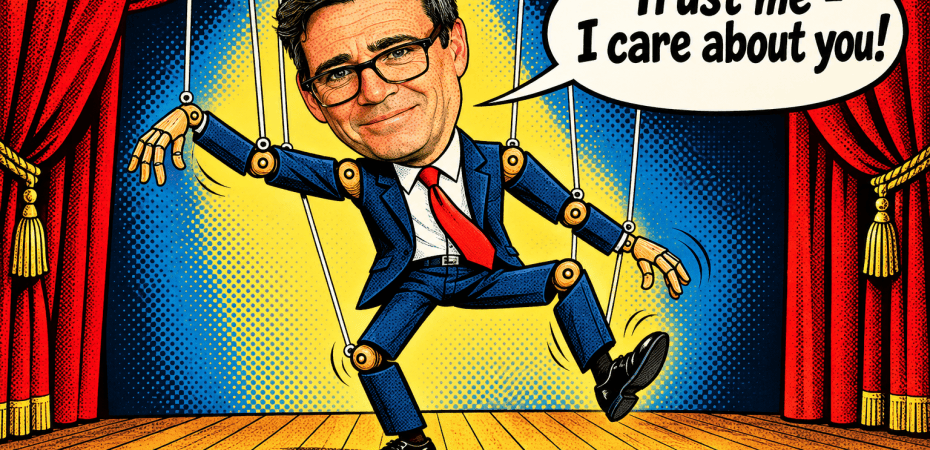
Michael Ashcroft has published a poll on Andy Burnham, the Budget, the pension triple lock, the European Union and the next election. Its findings are interesting. They are not interesting because they tell us what the British people have decided. The British people have decided nothing. They have not been told what is being proposed, and will not be told until the proposal has been endorsed by experts and placed before them as something that has already become unavoidable.
The polling is interesting because it shows that the audience is ready. Burnham is thought “likeable”, “competent”, “sensible”, “trustworthy”, “strong” and “on my side”. When respondents were asked which leader they most trusted to stand up to Vladimir Putin and defend Britain, 32 per cent chose him. Kemi Badenoch and Nigel Farage managed 15 per cent each. Offered Burnham, Badenoch and Farage as possible Prime Ministers, 44 per cent chose Burnham, against 17 per cent for Badenoch and 15 per cent for Farage. Thirty-six per cent believe he will still be Prime Minister after the next general election.
These findings are supposed to describe democratic opinion. They more nearly describe the successful introduction of a television personality. Burnham has been placed before the public, his favourable attributes have been established, and the signs above the audience are already flashing. LIKEABLE. SENSIBLE. STRONG. When the light marked TRUSTWORTHY comes on, everyone claps.
This is what passes for democracy in modern Britain. The electors are the studio audience at the recording of a programme whose script they have not seen. They are invited to cheer, groan, applaud and occasionally vote one performer off the set. The producer remains. The advertisers remain. The owners of the network remain. The next episode has already been commissioned.
The programme of the Burnham Government has already been written. I do not mean that a complete secret manifesto exists in a safe beneath Downing Street. Nothing so melodramatic is required. The important decisions arise from the settled requirements of the institutions that possess continuous power: the Treasury, the banks, the financial markets, senior officials, defence contractors, regulated monopolies, large employers, foreign-policy organisations and the wealthy interests that finance respectable politics. Their demands are translated into policy by officials and into moral necessity by the regime media. Burnham’s task is not to decide whether these demands will be met. It is to decide how their fulfilment will be sold.
We shall learn the details when the regime media is ready to tell us. There will be interviews in which presenters look troubled. There will be leaks preparing us for measures slightly worse than those eventually announced. There will be warnings about a “black hole”, though the only remarkable feature of this object will be its ability to appear whenever the governing class wants more money. There will be graphs, grave voices and economists explaining that the Government has no choice. Finally, Burnham will appear, arrange his features into an expression of reluctant courage, and announce what was going to happen in any event.
Ashcroft’s Budget findings show how thoroughly the public has been trained for this procedure. Two thirds expect taxes to rise. Most of those expecting an increase say taxes should not rise, but believe they will. Among 2024 Labour voters, 35 per cent say taxes should not go up but expect the Government to raise them.
This is not consent. It is submission rehearsed as prophecy. The public is asked what it thinks the Government will do, gives the answer it has been taught to expect, and is then cited as evidence that the measure was anticipated. We are no longer governed on the ground that taxation is justified. We are governed on the ground that resistance is childish because the robbery has been announced in advance.
The coming Budget will be presented as a contest between unpleasant necessities. It will in fact be an upward transfer of wealth. Money will be sucked from salaries, pensions, savings, small businesses, private landlords and the modest property accumulated by the middle classes. Some of it will pass through welfare departments. Much will pass through military procurement, energy schemes, public-private partnerships and consultancies. It will end in the same place: with large institutions whose relationship with the State protects them from competition and ordinary consequences. This is not socialism in any old-fashioned sense. It is not even the confiscation of wealth from the rich for the benefit of the poor. It is the stripping of people who possess a little by people who control a great deal. The man with a pension, a house and twenty thousand pounds in savings is treated as an exploiter. The fund that owns ten thousand houses, the contractor that has failed to deliver a weapons system and the regulated utility paying its executives fortunes are treated as indispensable national partners.
The pension triple lock is therefore marked for destruction. Fifty-two per cent of Ashcroft’s respondents want it kept. Only 21 per cent want pensions restricted to increases in line with inflation. Support for retaining it reaches 68 per cent among 2024 Conservative voters, 66 per cent among Reform voters and 80 per cent among people aged 65 and over.
This will make no difference if the financial interests surrounding the Government decide that pensioners possess money that should be flowing elsewhere. The media campaign will begin with stories about wealthy baby boomers. We shall be shown an elderly couple in a large house that they bought for seven pounds in 1962. Their private pensions will be described as “generous”, as if they had stolen the money at gunpoint. Young people, themselves robbed by high housing costs, insecure work, student debt and taxation, will be encouraged to blame people in their seventies whose chief offence was to have lived before the country was completely ruined.
The intergenerational grievance is real. Its proposed target is fraudulent. Younger people cannot afford homes because planning restrictions, monetary manipulation, mass immigration, landlord regulation and the preferential treatment of institutional investors have distorted the housing market. They pay too much tax because the State consumes too much. Their wages are weak because Britain has exchanged productive industry for an economy of property inflation, imported labour, public administration and financial extraction. None of this will be repaired by making an eighty-year-old woman poorer.
Today’s pensioners were compelled to pay tax and National Insurance throughout their working lives. They were promised security in old age. Those able to save were taxed while earning, taxed on investment income, taxed when spending, and quietly taxed again by inflation. Government policy made honest saving progressively less rewarding while the State insisted that its promises could be trusted. The triple lock is a clumsy and inadequate attempt to prevent those promises from being entirely destroyed. Abolishing it would be repudiation disguised as reform. It would tell people that a lifetime of compulsory contributions bought them nothing except an invitation to feel guilty for surviving long enough to collect.
The welfare budget is a different matter. Most of it should be cut, and cut without apology. Britain has no duty to provide a comfortable income to every foreigner who succeeds in presenting himself at the offices of an immigration solicitor. Entry into the country should not bring admission to the taxpayers’ purse. Foreign nationals unable to support themselves should ordinarily be expected to leave. There is nothing cruel about this. What is cruel is compelling us to maintain strangers whom we were never consulted about admitting. Nor should the able-bodied British idler be treated as the helpless victim of society. Misfortune deserves help. Disability deserves provision. Temporary unemployment may justify temporary support. But deliberate and prolonged refusal to work is not a medical condition. The professional claimant who knows every allowance, exemption and appeal procedure is not a member of an oppressed class. He is living from the compulsory labour of other people.
The welfare establishment has deliberately confused the deserving and undeserving poor because the confusion protects its budget. Every proposal to discipline habitual idleness is answered with a photograph of a disabled child. Every proposal to restrict benefits for foreign nationals is described as an attack on refugees. The exceptional hard case is held in front of an entire administrative industry like a child carried before an advancing army.
Cut the benefits of those who can work but will not. End the assumption that immigration creates an entitlement to maintenance. Then cut the departments, contractors and approved charities paid to administer dependency. But return the money to the taxpayers. Do not use the savings to purchase missiles for Ukraine or prepare Britain for war with Russia.
This is almost certainly where the fraud will appear. Welfare will be cut in the name of fiscal discipline while military expenditure is declared exempt from ordinary arithmetic. Pensioners will be told that the country can no longer afford its promises. The Ministry of Defence will be told that it may order whatever the Americans and NATO require. A grandmother’s heating allowance will be subjected to forensic examination. A defective weapons contract will be treated as an expression of national resolve.
Ashcroft finds that Burnham is the leader most trusted to “stand up to Putin and defend the UK”. The wording performs half the political work. It assumes that supporting the war in Ukraine is the defence of Britain and that the proper test of leadership is willingness to escalate.
Russia is not preparing to invade Britain. It lacks both the means and any rational motive. Britain has placed itself in danger by taking part in a proxy war against a nuclear power and by allowing ministers, military officers and broadcasters to speak as if direct conflict were a test of moral character. The greatest threat to Britain is not that Putin will land an army at Dover. It is that our own ruling class will blunder into a war it cannot control, for objectives it cannot define, under instructions it lacks the courage to refuse.
War with Russia must be utterly denounced. Not managed. Not made safer by another spending commitment. Not surrounded by pieties about international law from the same people who supported Iraq and Libya. Denounced. A British defence policy should defend the British Isles. It should secure our waters, our airspace and the physical safety of the population. It should not maintain an expeditionary military establishment designed to join every American adventure and threaten every foreign government disliked in Washington. There is no security in converting Britain into an offshore base for other people’s quarrels.
Number 10 North gives us a smaller example of the same deception. Forty per cent call Burnham’s Manchester office a good idea worth trying; 43 per cent call it a potentially expensive gimmick. Labour voters support it by 62 per cent. Conservatives and Reform voters reject it overwhelmingly. It is not devolution. Devolution means removing powers from the central State and returning them to individuals, communities and genuinely independent local authorities. Number 10 North means moving part of the central State to Manchester. The officials will have northern accents. The orders will be unchanged. There will be new buildings, security arrangements, advisers and press officers. Coffee shops in the surrounding streets may prosper. No ordinary person will become freer.
Then there is the European Union. Forty-eight per cent say Britain should rejoin, though only 36 per cent think Burnham will attempt it. He probably will not attempt it in the form of an honest application for membership. That would provoke argument, and argument allows people to say No. The more likely course is re-entry without the vulgar inconvenience of asking. Britain will align with European regulations, accept common standards, enter supposedly technical agreements and surrender powers one administrative slice at a time. Each step will be described as sensible, pragmatic and good for business. No single concession will seem large enough to justify a national quarrel. When enough concessions have accumulated, rejoining formally will be presented as recognising the facts. The method is characteristic. A democratic vote is treated as an obstacle to be digested slowly by administration. The decision is never openly reversed. It is merely emptied of meaning.
Ashcroft’s polling also shows that 41 per cent would prefer a Labour-Liberal Democrat-Green coalition after the next election, against 30 per cent for a Conservative-Reform coalition. Labour has 27 per cent of front doors open and another 23 per cent ajar. Reform finds 60 per cent closed against it. Again, this does not reveal a popular programme. It reveals the success of political conditioning. Labour, the Liberal Democrats and Greens represent variations within the permitted order. Their disputes concern the speed, presentation and allocation of managerial policy. They disagree about which approved group should receive attention and which adjective should precede the word “investment”. On the essential matters—administrative government, high spending, managed speech, alignment with supranational institutions and hostility to Russia—the differences narrow. The electors may choose the colour of the scenery. They do not choose the play.
Burnham is perfect for the next performance. He appears normal. He avoids the unsettling mannerisms of the fanatic. He can impose a policy without seeming to enjoy the imposition. He can transfer wealth upwards while speaking about fairness. He can cut pensions while praising the contribution of older people. He can restrict welfare just enough to satisfy taxpayers while preserving the administrative apparatus and diverting the savings to war. He can restore government from Brussels in the name of sovereignty through influence. Most importantly, he can make decisions written elsewhere appear to have emerged from democratic consent.
The public will not be told the programme in advance. That would risk discussion. We shall receive it as a sequence of emergencies, fiscal discoveries, security warnings and expert recommendations. Each measure will arrive separately. Each will be said to have become unavoidable because of the last. By the time the pattern is visible, every newspaper will be explaining that it is too late to change course.
Ashcroft’s poll tells us the audience is seated. Half the doors are open or ajar to Labour. Burnham has been introduced as likeable, sensible, competent and strong. The old and the middle classes are ready to be plundered. The money is ready to travel upwards. The weapons manufacturers are ready to receive their orders. All that remains is for the studio lights to dim and the illuminated sign to tell us when to applaud.
Source: Lord Ashcroft Polls, 8 September 2026.

Discover more from The Libertarian Alliance
Subscribe to get the latest posts sent to your email.
Related posts:
 Burnham’s Thermidor
 The Ministry of Truth Comes to Britain
 Britain’s Youth Exodus: Labour’s Crime, Conservative Guilt
Powered by YARPP.