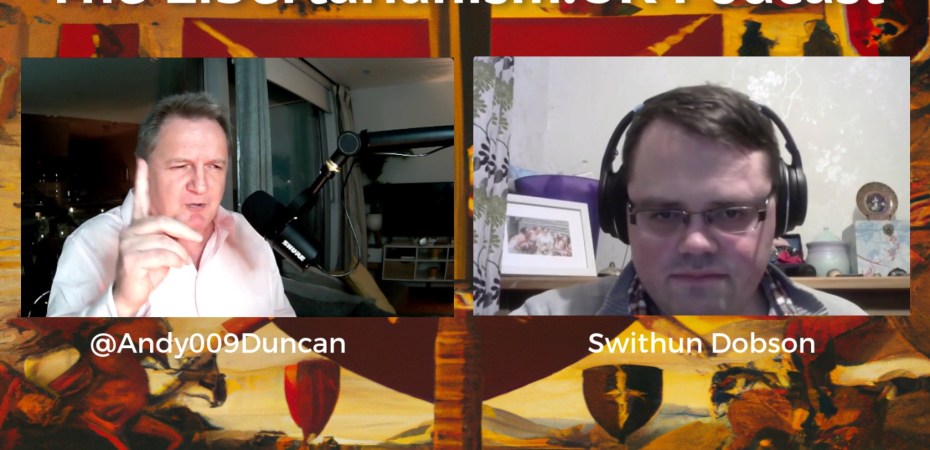
In our second Libertarianism.UK Podcast, I discuss with British economist Swithun Dobson, that most slippery of subjects, what actually is the State?
To help us grow the podcast and create more content like this, please remember to like and share the video, subscribe to the channel, and click on the notification bell.
Audio Version
 Spotify
 Apple Podcasts
Youtube Version
Rumble Version
You can listen to Swithun Dobson’s Mindcrime Liberty Show, here:
You can hire Swithun Dobson for his professional tutoring services, here:
Timecodes
- 0:00 – Intro
- 1:25 – A Technical Definition of the State
- 9:43 – Different Theories on the Origin of the State
- 13:46 – Why do People Tolerate the State?
- 18:13 – Murray Rothbard and How the State Uses Intellectuals
- 21:40 – The ‘Legitimacy’ of the State
- 22:54 – Is the State Necessary?
- 24:30 – Solving Disputes on Hoppe Island
- 26:50 – What will Stop Micro-States Becoming a One World State?
- 28:34 – Is a One World State on the Cards?
- 31:59 – How Can Individuals Reduce the Power of the State?
- 35:24 – Wrap Up
Some quotes from the Podcast:
“I would say that where the state began as an embryo version is when it becomes a monopolist over the trial function and the rendering of legitimate judgement.”
“I think specifically that what the state does is that it’s an organisation that monopolises law. That seems [to be] the essential element.”
“There’s an element within all the concepts of the state that it has overwhelming force in certain respects, but it also has ‘legitimacy’.”
“[Under J.B. Say’s class analysis], you break society down into the net tax payers and the net tax gainers.”
“One of the biggest ways [the state] influences regular people isn’t directly by [subsidising] the intellectuals, because [ordinary people] don’t read the intellectuals and don’t watch any of the stuff that they produce. What happens is that a lot of art producers and makers of films or music or whatever, are influenced ultimately by philosophy and intellectual ideas. [The intellectuals] are influencing people who make culture, who make TV, films, et cetera and this is then disseminated around the population.”
“[The state] is changing [its use of democracy as a legitimising tool] because democracy is now giving the wrong results. The [Brexit] EU referendum is the best example of that. Donald Trump’s election in 2016 is also a good example of that.”
“[The state] is moving away from democracy proper to saving the world from climate change and [also using] public health interventions.”
“You already have [a single world state] in certain respects, given the almost universal response to the corona virus with lockdown policies.”
“One of the ways in which you can lessen the power of the state is to home-educate your children, because even the private schools are basically Leftist indoctrination factories.”
Reminder
If you want to see more content like this, please remember to like and share the video on all your favourite social media sites, subscribe to the channel, and click on the notification bell.
Discover more from The Libertarian Alliance
Subscribe to get the latest posts sent to your email.
A good discussion but I must say, I think the definition given of the state is confused. As much as I may criticise his views, I would accept Neil Lock’s essential definition, which is that the state is a body with moral privilege.
To be plain about it, the state is a body that can do things that no-one else is allowed to do – e.g. confiscate property, perpetrate political violence, lock people up, and so on.
Modern states have self-checking mechanisms: there is typically a judicial branch that can rule that actions or omissions of the executive branch are unlawful or illegal, even criminally punishable; and there is a legislative branch that holds the executive to account.
In Britain, there is a wrinkle in that the Crown is separate to the state – they are not strictly the same thing – and many public bodies act under the Crown and are non-state. A classic example is the police. Most police forces are affiliated to the state (they are known as ‘Home Office forces’), but they are part of local government, rather than the state, and police officers serve the Crown, attesting an oath as such, and ultimately serve the community rather than the state. I’m not clear how these traditional arrangements fit in to an historical understanding of the state. You could argue that the state as a looming feature of English civic life is a recent innovation, starting with the Victorian expansion of parliamentary intervention, culminating in the post-War social-democratic state, and reaching its apotheosis under Thatcher-Major-Blair.
My real point here is that I think that while we can certainly define the state in neo-Lockian terms, a practical delineation is elusive, and I think this is where the purer libertarians and the purer socialists (the ones who believe in stateless socialism) go wrong. They ignore the possibility of ‘soft statehood’ or ‘contract statehood’ – which is why I sometimes call these views contract libertarianism/contract socialism.