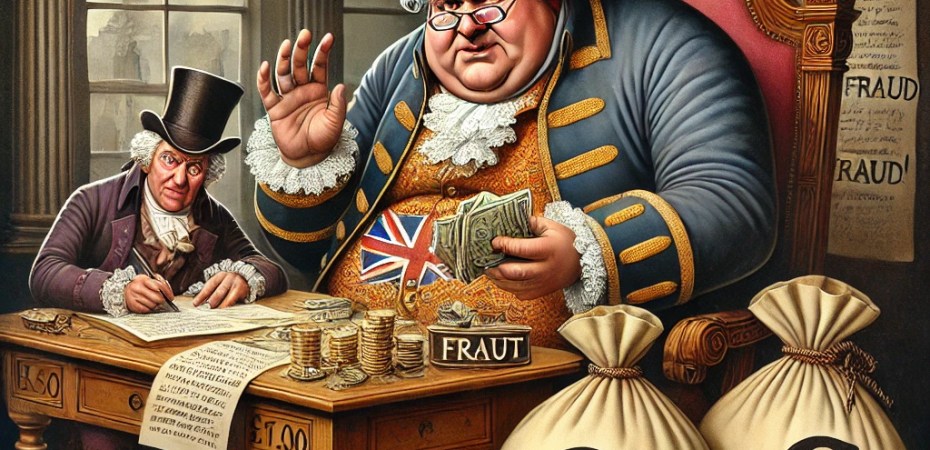
Daniel Hannan’s latest article published in The Daily Telegraph on the 11th January 2025 and titled “Nigel Farage has the power to choose Britain’s next prime minister,” is another instalment of the unconvincing dirge we have come to expect from Conservative apologists who cannot accept the deserved and inevitable demise of their party. Cloaked in his usual veneer of erudition, Mr Hannan’s piece is, at its core, a desperate plea for the preservation of a moribund institution. It is the rhetorical equivalent of applying a fresh coat of paint to a collapsing edifice and insisting it remains sound.
Mr Hannan’s argument begins by asserting that Keir Starmer’s government is doomed—a bold claim, given that Labour secured its majority less than a year ago. He then contends that Labour’s only hope for survival lies in a divided Right. This, he claims, is a function of the first-past-the-post electoral system, which punishes fragmented opposition. Yet, even if one grants his premise, it is not clear why this should concern those of us who wish to see the back of the Conservative Party. The argument is not so much a reasoned analysis as it is a thinly veiled attempt to guilt Reform Party supporters into propping up a party that has betrayed them time and again.
A Questionable Premise
Mr Hannan’s assertion that “electoral geography argues for a pact between the two right-of-centre parties” is superficially plausible but collapses under scrutiny. He points to projections suggesting that a divided Right will allow Labour to form a government on a minority vote share. However, he fails to acknowledge that the next general election need not occur until 2029. In this time, the Reform Party has every opportunity to supplant the Conservatives as the dominant force on the Right. The notion that Reform should sabotage its own momentum to rescue a dying party—a party whose failures created the very conditions for Reform’s rise—is as absurd as it is self-serving.
What Mr Hannan refuses to confront is that the Conservative Party’s predicament is entirely of its own making. It is not the result of bad luck or unfair electoral arithmetic but of systematic betrayal. Fourteen years of Conservative government have left Britain with higher taxes, uncontrolled immigration, a collapsing public sector, and a suffocating regime of political correctness. Why should voters who were lied to, betrayed, and exploited now rush to save the party responsible for their misery?
Excuses, Excuses
Mr Hannan’s attempt to deflect blame for Conservative failures is as transparent as it is tiresome. He claims that “Left-wing civil servants sabotage Right-wing policies” and that “the courts blocked immigration reform.” These excuses might have carried some weight if the Conservatives had been in office for a mere few months or even a year. But after fourteen years in power, they ring hollow. Who appointed these “Left-wing” civil servants? Who failed to reform the judiciary or repeal the legislation that empowers it to obstruct elected governments? The answer, of course, is the Conservative Party.
Then there is the Covid excuse. According to Mr Hannan, “Covid pushed up spending,” leaving the government with no choice but to raise taxes. This is an insult to the intelligence of anyone who lived through the period. The pandemic was not an Act of God; it was a crisis grossly mishandled by the Conservatives. The government’s lockdown policies—policies enforced with a zeal that would have embarrassed the Chinese Communist Party—inflicted incalculable damage on the economy while doing little to protect public health. Meanwhile, the governing elite flouted the very rules it imposed on the rest of us. To blame Covid for the ensuing fiscal carnage is an act of breathtaking dishonesty.
A Desperate Plea
Mr Hannan’s suggestion that the Conservatives are a changed party is laughable. He argues that Kemi Badenoch represents a break from the past, a new dawn for conservatism. Yet Mrs Badenoch sat in the very governments that presided over the disasters he now decries. She supported Net Zero, attended World Economic Forum meetings, and endorsed a raft of other policies antithetical to conservative principles. Her supposed “radicalisation” within the Home Office is unconvincing theatre, designed to dupe gullible voters into believing that the Conservative Party has rediscovered its backbone.
If Mrs Badenoch and her colleagues were serious about change, they would have repudiated the policies of their predecessors, apologised for their failures, and taken immediate steps to dismantle the authoritarian and economically ruinous framework they helped construct. Instead, they offer platitudes and cosmetic adjustments, hoping to cling to power without addressing the structural rot that has consumed their party. To suggest that Reform voters should abandon their party and rally behind the Conservatives is to ask them to reward failure, incompetence, and betrayal.
The Farage Factor
Mr Hannan’s analysis of Nigel Farage is more balanced, but it ultimately undermines his own argument. He acknowledges Farage’s strategic instincts, charisma, and ability to connect with ordinary voters. These qualities are precisely what make Farage’s leadership of Reform so vital. Unlike the Conservatives, who have consistently prioritised the interests of the global elite over those of their constituents, Farage has kept his party grounded in the concerns of ordinary Britons. His focus on VAT reform, opposition to Net Zero, and critique of the political establishment resonate precisely because they address the real issues facing the country.
Yet Mr Hannan accuses Farage of failing to engage with “detailed policy.” This is both unfair and irrelevant. Farage’s role is to set the agenda, to articulate a vision that inspires and mobilises. The detailed policy work can and should be delegated to capable subordinates. In any case, it is rich for a Conservative peer to criticise Farage for a lack of policy detail when his own party has spent the past fourteen years delivering vague promises and empty rhetoric.
Conclusion
Mr Hannan’s article is a transparent attempt to prop up a party that has outlived its usefulness. His plea for a Conservative-Reform pact is not a call for unity but a desperate bid to stave off electoral annihilation. The Conservative Party is a spent force, discredited by its own failures and unworthy of a second chance. Reform voters have no reason to compromise their principles or dilute their momentum to save a party that has betrayed them at every turn.
The only way forward is for the Reform Party to continue its rise, unencumbered by the dead weight of Conservative duplicity. If the Conservatives wish to remain relevant, they must earn back the trust of the electorate by addressing their past failures and fundamentally transforming their party. Until then, they deserve nothing but the oblivion they so richly merit. For those of us who have endured fourteen years of Conservative misrule, the spectacle of their collapse is not a tragedy but a long-overdue reckoning.
Discover more from The Libertarian Alliance
Subscribe to get the latest posts sent to your email.