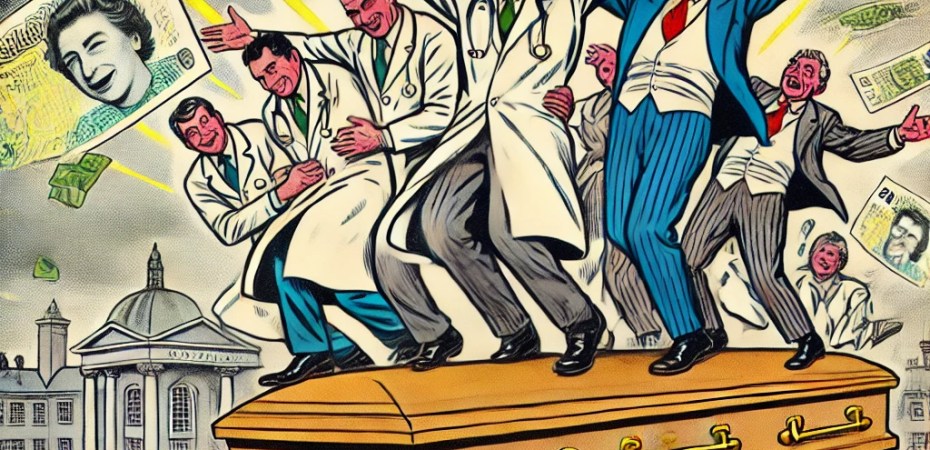
The pharmaceutical industry is not an impartial search for cures. It is a cartel—a cartel that profits from medical orthodoxy and the regulatory privilege of limited liability. You are not being treated; you are being harvested. And nowhere is this more evident than in the obscene campaign to put half the planet on statins.
The cholesterol hypothesis—this idea that blood cholesterol levels are the chief predictor of heart disease—originated in the 1950s with Ancel Keys, an American scientist whose Seven Countries Study conveniently ignored all the countries that didn’t fit his theory. This sleight of hand became gospel. Fat was demonised. Sugar was let off the hook. And cholesterol, an essential compound in the body, was recast as a sort of internal terrorist.
Since then, the narrative has hardened into orthodoxy. High cholesterol, we are told, is bad. It clogs your arteries. It kills. Therefore, statins—cholesterol-lowering drugs—are the miracle. Prescribe them to the old, to the young, to the healthy, to anyone whose numbers look a bit suspicious. One pill a day keeps the grim reaper away.
Except that’s a lie.
Statins do lower cholesterol. What they do not clearly do is save lives—at least not for the majority of people who are prescribed them. Their benefits for secondary prevention (i.e., people who already have heart disease) are modest. Their benefits for primary prevention (i.e., healthy people with no symptoms) are negligible. A review published in The Lancet admits the number needed to treat is absurd: for every 104 people taking statins over five years, only one will avoid a major cardiovascular event. The rest? No benefit—and possibly harm.
And harm there is. Muscle pain, fatigue, memory loss, and even increased risk of diabetes. There is also growing evidence that lowering cholesterol too much may be dangerous—cholesterol is essential for hormone production, nerve function, and cell repair. But these concerns are dismissed as “statin hesitancy.” Much better, apparently, to medicate the entire population than to rethink a dodgy hypothesis.
Statins are big business. Global revenues are estimated in the tens of billions. Pfizer made over £100 billion from Lipitor alone before its patent expired. That’s not profit earned in open competition. That’s a rigged market, maintained by patent law and fed by taxpayer money.
Because this is the real scam. You are taxed to fund public health campaigns that terrify you into seeing your doctor. Your doctor is trained—almost entirely by pharmaceutical-sponsored textbooks and lectures—to believe that cholesterol must be crushed at all costs. He writes you a prescription for a drug he’s told is safe and effective. The cost is absorbed by the NHS, or whatever other cartelised system you happen to live under. The manufacturer is paid. The doctor is paid. The regulator is paid. And you—the patient—are the unpaid guinea pig.
If statins are so controversial, why don’t we hear more opposition?
Because in medicine, as in politics, dissent is punished. Doctors who question statin dogma are blacklisted. Their articles are rejected. Their interviews are removed from YouTube. The British Medical Journal was pilloried in 2014 for publishing a paper that dared question statin efficacy and safety in low-risk patients. No actual error was found—but the witch-hunt was useful pour encourager les autres.
The result is a profession locked into consensus. Not because the consensus is right, but because challenging it is dangerous. And the public, bombarded by infographics and heart-healthy slogans, never knows the debate exists.
The problem isn’t profit. Profit in a free market is a reward for delivering value. The problem is cartelisation. Statins are not the product of entrepreneurial discovery. They are the product of a cronyist system where government agencies, medical schools, and corporations all collude to define the truth.
The solution is not to replace one cartel with another. It is to blow the whole system apart.
- End licensing monopolies: If anyone could practise medicine without permission from state bodies, the market would sort out the competent from the charlatans. Yes, some people would die. But people already die—quietly, in hospital wards, from treatments that nobody is allowed to question.
- End control over research: Remove the regulatory barriers to testing new theories. Let people explore. Let new drugs emerge. Let old drugs be re-evaluated. Medical science should be a battlefield of ideas, not a church with pharmaceutical priests.
- Decartelise the market: End patent monopolies. End government-backed insurance schemes that insulate drugmakers from liability. End the subsidies. Let prices fall. Let alternatives emerge. Let doctors disagree.
This does not mean abandoning the poor. State subsidies to help the genuinely needy are not the issue. The issue is that these subsidies are administered through a bureaucratic machine that rewards conformity and punishes insight.
The current system is not just inefficient. It is actively dangerous. The cult of statins is a case study in how science becomes dogma, and how dogma becomes policy. It is not medicine. It is manipulation. And it is time we treated it with the same scepticism we reserve for every other corrupt racket dressed in the robes of authority.
Reading List
Angell, Marcia. The Truth About the Drug Companies: How They Deceive Us and What to Do About It. New York: Random House, 2005.
Ravnskov, Uffe. The Cholesterol Myths: Exposing the Fallacy That Saturated Fat and Cholesterol Cause Heart Disease. Washington, D.C.: New Trends Publishing, 2000.
Smith, Malcolm Kendrick. The Great Cholesterol Con: The Truth About What Really Causes Heart Disease and How to Avoid It. London: John Blake Publishing, 2007.
Teicholz, Nina. The Big Fat Surprise: Why Butter, Meat and Cheese Belong in a Healthy Diet. New York: Simon & Schuster, 2014.
Siri-Tarino, Patty W., et al. “Meta-analysis of prospective cohort studies evaluating the association of saturated fat with cardiovascular disease.” The American Journal of Clinical Nutrition 91, no. 3 (2010): 535–546.
Rath, Matthias. “Why Animals Don’t Get Heart Attacks – But People Do!” MR Publishing, 2012.

Discover more from The Libertarian Alliance
Subscribe to get the latest posts sent to your email.
I’m glad I refused to take the damned things.