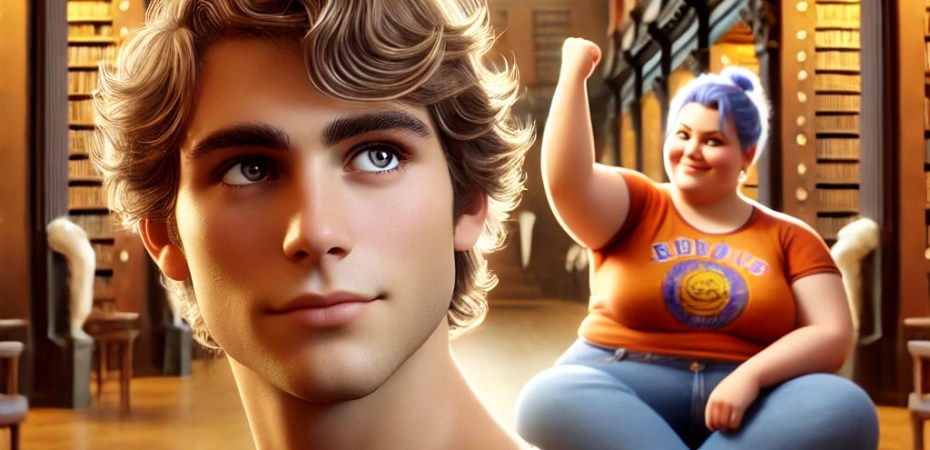
Bryan Mercadente is one of my dearest friends. He is also, as he will gladly remind you, one of the best-looking sixteen-year-olds alive. His recent essay, Your Duty to be Beautiful, is wholly in character: part sermon, part cultural critique, and in both parts philosophical provocation. In it, he argues that beauty is not merely desirable, but a moral duty. To be ugly, he claims, is to betray your nature and to submit, consciously or not, to the tyranny of the modern state.
Now, Bryan and I disagree about many things. He is a man of the Enlightenment, an enemy of all forms of weakness, and—not insignificantly—not a Christian. I am a Christian, and I believe that the body is not the self, but the temporary shell of the soul. While I believe in caring for the body, I cannot regard it as the ultimate good. Bryan, for all his ostentatious dismissal of the καλὸς κἀγαθός, sometimes forgets that a human being is more than symmetry and poise.
That said, Bryan’s dietary convictions are sincere—and often inconvenient. On his first visit to the Wang household, my mother prepared the usual elaborate welcome: steamed rice, red-braised pork belly, and her best glutinous lotus-leaf dumplings. Bryan declined the entire spread and went to bed on a plate of raw tofu, muttering darkly about carbohydrates. He can be insufferable, and I remain surprised that my mother not only tolerates but seems to adore him. But I have read the comment someone left in response to his essay, and I am reminded that, for all his extremism, Bryan may be closer to sanity than his critics.
The comment I have in mind offered a riposte so florid and baroque it deserves framing in an art gallery, or perhaps a bakery. She (I assume a “she”) announces herself as 32 stone of self-love. Here is part of her comment:
Let me be clear, Bryan: I weigh 32 stone. That’s 448 pounds, give or take a celebratory scone. And I’m glorious. I am a walking act of rebellion against the clean, tight, cold little world you’re trying to build—where men are supposed to look like Doric columns and everyone else is supposed to disappear. I take up space. I bend chairs. I order two desserts and make eye contact….
You want men to be chiselled, hard, inexpressive. You want them to be order incarnate, because chaos frightens you. But bodies are chaos. Desire is chaos. And I’m here, waddling into your marble mausoleum of thought, dropping crumbs and laughing.
… Because I may weigh 32 stone, but your soul is lighter than air. And that, darling, is the real problem.
It’s a clever piece of writing. It’s also a declaration of war on reality.
Let’s put this simply: morbid obesity is harmful. It is morbid. One can dance around the issue with metaphors about cathedrals of flesh, but no amount of theatrical self-love will change the basic facts of biology. According to the National Institute of Diabetes and Digestive and Kidney Diseases, obesity increases the risk of heart disease, stroke, type 2 diabetes, and various forms of cancer. The World Health Organisation adds sleep apnoea, gallbladder disease, infertility, and osteoarthritis. The data is not vague. It is not biased. It is not fatphobic. It is medical reality.
Of course, some writers have questioned the scale of the danger, and with reason. Scientific American once suggested the obesity “epidemic” was overstated. It probably is overstated: medical bureaucracies can never be trusted to find or to state the whole truth about anything. BMI is a crude metric, and thinness alone is no guarantee of health. But no serious physician has ever claimed that a 448-pound body is optimally functional. The dangers may be exaggerated in some cases—but they are not invented.
What worries me more than the denial of danger is the demand that we celebrate it. The American Conservative describes this as “body positivity’s big fat lie”—the notion that health, beauty, and self-worth are all independent of physical condition. It is a comforting idea. It is also a delusion. Bryan’s worst flaws—his vanity, his rigid scorn—are at least grounded in an aspiration to rise. His critic’s flaws are something darker: a desire to turn indulgence into virtue, and to punish anyone who notices the difference.
Bryan’s worldview is not without fault. He sometimes mistakes self-control for sanctity. He worships his own reflection: he does so literally, and I have more than once been treated to his expanding gallery of progress selfies. But his central argument—that beauty, properly understood, is a sign of inner balance—is not wrong.
I do not believe, as he sometimes seems to, that the ugly are necessarily wicked. But I do believe that bodily neglect is usually a symptom of despair, and often a cause of it. Our culture treats fatness as an identity. Bryan treats it as a failure. I treat it as a sadness.
He can be vicious. But the truth he points to remains: there is a point beyond which flesh is not merely soft or different. It becomes a confession of ruin. To ignore that, or to call it beautiful, is not kindness. It is surrender.
So where does the line lie? I do not share Bryan’s goal of outdoing Praxiteles in flesh. I do not think fatness is a sin. But I will not pretend that 32 stone is glorious. Nor will I pretend that its celebration is a form of liberation. It is not. It is a slow death repackaged as resistance.
The truth lies somewhere in between Bryan and his critic. Bryan’s obsession with beauty is a kind of idolatry. Her embrace of chaos is a kind of suicide. And neither of them, I think, is truly at peace. Bryan may never be satisfied with his reflection. He is chasing perfection, and perfection is an illusion. But at least he is chasing something. His critic is not chasing anything. She is settling for an early death preceded by much regret. And she is asking the rest of us to applaud her settlement.
But I know which of the two I’d rather have as a guest. I’ll take the raw tofu and the glancing in the mirror over another hymn to the glory of metabolic failure.
- Rod Dreher, “Body Positivity’s Big Fat Lie,” The American Conservative, July 17, 2023, https://www.theamericanconservative.com/body-positivitys-big-fat-lie/.
- National Institute of Diabetes and Digestive and Kidney Diseases, “Health Risks of Overweight and Obesity,” National Institutes of Health, updated August 2021, https://www.niddk.nih.gov/health-information/weight-management/adult-overweight-obesity/health-risks.
- World Health Organization, “Obesity: Health Consequences of Being Overweight,” WHO Q&A, https://www.who.int/news-room/questions-and-answers/item/obesity-health-consequences-of-being-overweight.
- Wayt Gibbs, “Obesity: An Overblown Epidemic?” Scientific American, February 2006, https://www.scientificamerican.com/article/obesity-an-overblown-epidemic-2006-12/.

Discover more from The Libertarian Alliance
Subscribe to get the latest posts sent to your email.
I’ve spotted Brian out leafletting for the Conservative Party: https://www.youtube.com/watch?v=CB5nivyN3SQ&ab_channel=ITVNews
I’ve just spotted Brian out leafletting for the Conservative Party: https://www.youtube.com/watch?v=CB5nivyN3SQ&ab_channel=ITVNews
I’m about as likely to be spotted selling my bum in the Asda carpark as leafletting for the Conservative Party
Good to hear it. That man (transgender or just transvestite?) is standing on May 1st for one of the local council seats in Lincolnshire not that far from me.