by David Webb
A free society and a great society are not identical concepts. People should be free to make their own life choices in areas that do not impinge on others. Will they always choose the best life choices? Clearly, there is no guarantee of that. As Matthew Arnold, a 19th-century conservative, wrote in Culture and Anarchy:
May not every man in England say what he likes?”—Mr. Roebuck perpetually asks; and that, he thinks, is quite sufficient, and when every man may say what he likes, our aspirations ought to be satisfied. But the aspirations of culture, which is the study of perfection, are not satisfied, unless what men say, when they may say what they like, is worth saying,—has good in it, and more good than bad. In the same way The Times, replying to some foreign strictures on the dress, looks, and behaviour of the English abroad, urges that the English ideal is that every one should be free to do and to look just as he likes. But culture indefatigably tries, not to make what each raw person may like, the rule by which he fashions himself; but to draw ever nearer to a sense of what is indeed beautiful, graceful, and becoming, and to get the raw person to like that. [Bold font added]
When people are free to do as they like, it is the culture of a society that has a strong influence on whether they choose to exercise that freedom well. There are minarchist societies around—all failed states, like Somalia—can be described as such. It turns out that Somalis, in the absence of state power, do not behave well.
I’m not sure of the origin of the phrase that “Americans (e.g. in the 1950s) had a policeman in their heads”. I think I read it in the Reader’s Digest once while waiting to see a doctor. It is quoted by Robert Reiner, a professor of criminology at the London School of Economics in the Independent. That article goes on to say, “Robert Reiner, professor of criminology at the London School of Economics, who has argued with Professor Smith in the past, says that culturally repressive societies had the advantage that citizens did not need to be coerced into behaving themselves”.
(“Culturally repressive” is, of course, a Cultural Marxist slur on traditional culture.) It is still the case that in large parts of America you don’t need to lock your doors. You can leave your car unlocked. Apparently, failure to rob your neighbours is “cultural repression”. Crime is very low in much of the so-called fly-over territory in America. This was even more the case in the 1950s. This article, some would say “mercifully”, is almost entirely not about race and immigration, but it would be deceitful not to point out that those areas of America where a low-crime and high-trust society persists are not the culturally enriched multiracial areas. I live in a small and very English town in Lincolnshire: crime is very very low here. There are minor incidents, but a policeman I met in the local gym emphasized to me that my town is nearly a zero on the crime scales, especially compared with the Manor House estate in Sheffield not a long way away.
A great society does not result automatically from an absence of state control. I have pointed out before that John Stuart Mill believed that England’s Christian culture was the foundation of liberty, or made it more likely that liberty would flourish here (see chapter 16 in On Representative Government). I would argue that England 100 years ago had a strong culture that raised all with a strong moral code and, as in America, gave everyone a policeman in his head. In the 1930s, you did not need a policeman standing by, or a CCTV camera, to know to do the right thing. A fascinating article in The Daily Telegraph last year discussed crime figures, and showed that in 1937 there were only 800 prisoners in the whole of England serving sentences longer than three years. There were serious crimes then—but their incidence was a tiny fraction of that today, something that people under 30 may not fully appreciate. By 1997, there were 23,000 prisoners serving sentences longer than three years. In that year, an immigration surge began, and in 2024 there were 55,000 prisoners serving sentences longer than three years—in a context where judges are continually enjoined not to send people to prison for racial reasons and space constraints.
A great culture has an iron moral code that you simply cannot contravene without losing your place in society. Excuses were not accepted. Of course, there were always hard cases, but even then, you had to accept your lot in life. If you were a young woman whose husband lost his legs in an industrial accident, caring for him at home, including providing and dealing with the bedpan several times a day, may not have been how you envisaged your life. But in those days, you were encouraged to get on with it, shut up about it, and be cheerful. God, it was said, had sent you a lot to try you. There was no divorce in those days, and so that was the end of the matter.
There are only a handful of bigamy convictions a year today. In yesteryear, the marriage vow bound people together “till death do us part”. What else was there to discuss? All you had to do was to get on with it. Make it work. End of discussion. Nowadays, with quickie divorces so common and no social prohibition against just living together, no-one today needs to be a bigamist—or rather, everyone is engaged is what amounts to bigamy in moral terms (violating their previous marriage vows), if not in legal terms. I’m sure you could make the case that, even in the olden days, a handful of lords and very rich people could get away with behaving like cads—there were parlours down the Strand and in Regent Street for such people. The strong social prohibition of immorality was particularly strong in the counties, but even the great and the good feared being publicly shamed for their louche behaviour. (Nowadays, it would be a badge of honour—washed-up celebrities reboot their careers by “letting it all hang out” in tell-all interviews.)
A few years ago, some Australian women who gave up their children for adoption in the 1950s posed as victims and claimed they had been forced to give up their children. Let’s look at this more carefully. There was no birth control and no abortion, and they “chose” to get pregnant out of wedlock. In the hospital, the nurses simply told them “you have no money, no husband, not a penny with which to feed the child: how will you be able to raise this child?” They weren’t forced to hand the children over. The reality of their situation dawned on them, and then they did the right thing by the children. So there were hard cases, but in any serious society, in any great society, moral behaviour is a requirement—not of the law—but of society. A free society is one of moral restraint.
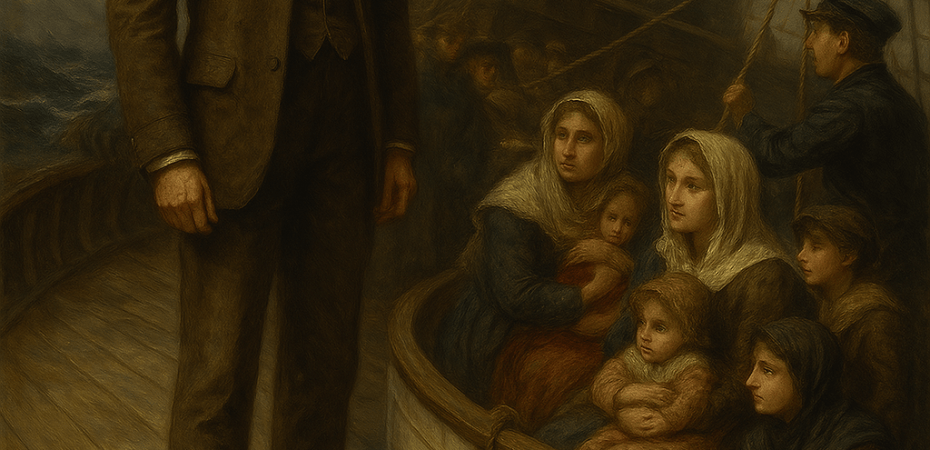
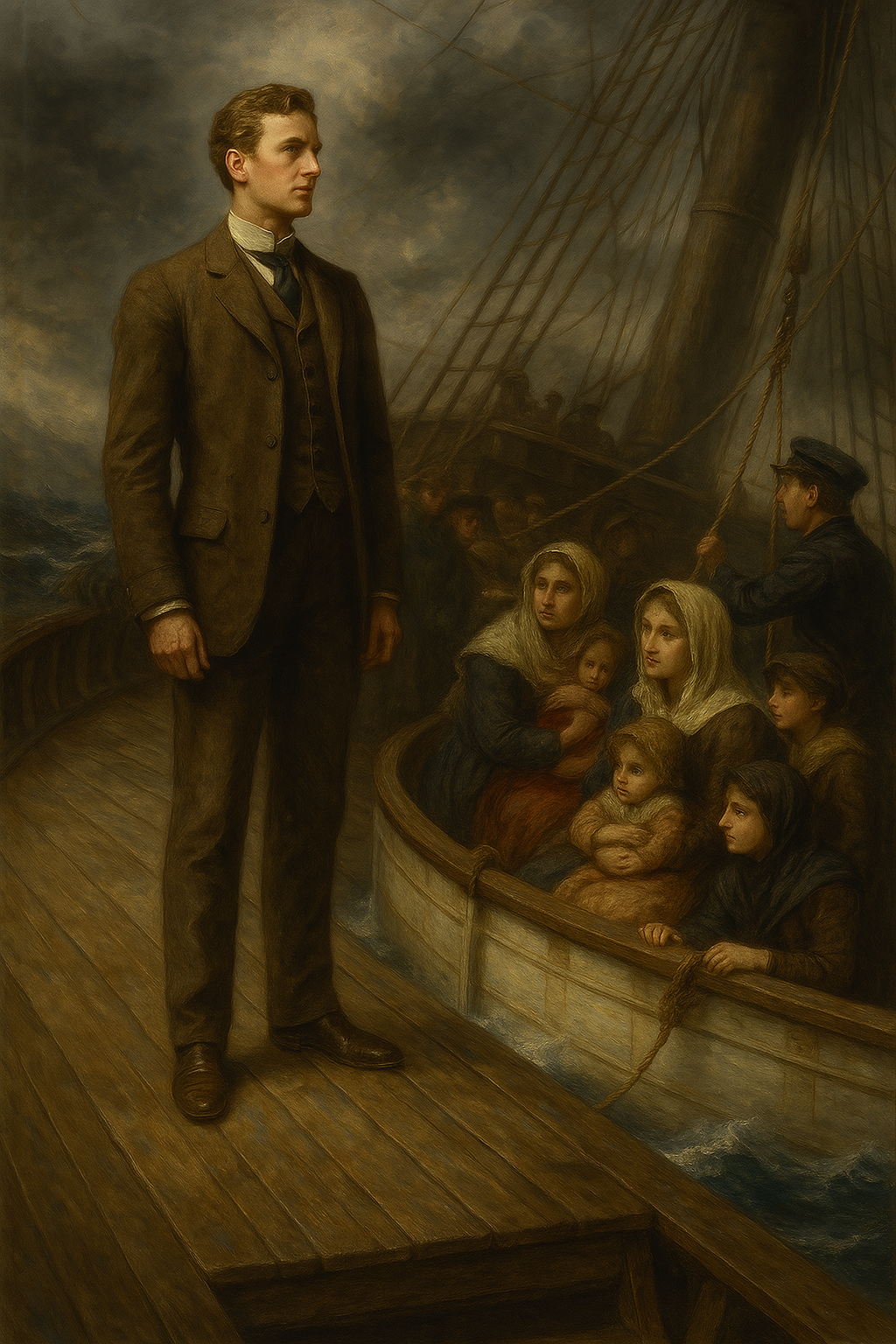
I find the example of the sinking of the Titanic interesting. Of those on board, 20% of the men survived and 80% of the women survived, and even third-class women stood a good chance of surviving. In 1912, you had to give priority to women and children in such circumstances. There was no choice about it, although the stricture was cultural, not legal. Gentlemen did not push women out of the way in order to save themselves in those days. Has anyone in England ever met anyone who would not do so and then spend the rest of his life regaling us with the excuses for that behaviour?
Bruce Ismay was the owner of White Line, which owned the Titanic. He was on board, and—spoiler alert!—he survived the sinking. As the owner of the ship, he was personally responsible for the fact that there were not enough places in the life boats for everyone. Even if every life boat had been launched full, 1,000 people would still have failed to find a place. In fact, for the first two hours after the ship struck an iceberg, the ship was horizontal and the passengers were playing games on deck. It was hard to convince them to get in the life boats, as it looked like the ship might remain afloat until help came. Only in the last five minutes did the ship go vertical. Bruce Ismay explained that everyone near him on the deck had got in the life boat nearest to him, and there was no one else to call to get in, and so he thought “why waste a space? why not survive rather than letting a life boat with empty spaces be launched and lose my own life?” And so he got in, and survived.
That was not the England or America of today, with their excuses, compensation culture and Marxist-inspired synthetic outrage. Ismay was condemned in the London and New York press and was shunned in high society for the rest of his life. The logic was simple: you owned the ship, you’re the last off. And that is where any possible discussion ended.
I think that in 2024, nearly everyone in society has in some way breached what would once have been seen as civilized behaviour expected of all. Have you abandoned your wife? Or abandoned your wife and children? Or did you cheat on your wife? Did you abort your children because you didn’t feel like falling pregnant? Have you moved your parents into old people’s homes because you don’t want to care for them, while demanding that you inherit their property assets? (Most people are eventually at some point in their lives covered by at least one thing on this list of possible transgressions.) I, of course, have not comported myself at all times like a gentleman of 1912 either—that is not the point of this article. Have you harried someone at work over a politically incorrect remark? Did you remain silent when someone you knew was being treated like this? Do you support your society (your team, in effect)? Or are you a supporter of immigration and foreign rule by the EU? Are you responsible, to a small degree, for the gang-rape of 12-year-old girls by Pakistani rape gangs? And for the blowing up of children in the Manchester Arena? (Note: if you are one of those who would condemn those highlighting the relevant issues, then you are responsible to a palpable degree, even if you share the blame with most of society.) Failure to support your own people would once have been an unthinkable blunder. Enoch Powell once made the point that those who support these causes—ultimately grounded in cultural Marxism—are scoundrels. As you can see, the number of people who behave in a caddish manner in one way or another is close to 100% of English society today.
It is true that, as the libertarians say, most of these causes have been pushed by the state, and have ultimately obtained their purchase on every single organization and workplace by state legislation. But a cultural revival is required to make liberty a meaningful concept. Without it, the problems created by social decay simply demand state intervention, thus by a kind of circular logic keeping the state in. A difficult point to make is that a cultural revival needs to be a movement of forgiveness: as everyone has behaved in a once-unacceptable fashion, you need to allow people to step over their past and see it in the context of malevolent state propaganda and the cultural influence of social activists, and build a society with strong moral values. How can we arrive at a type of society where people behave decently most of the time without compulsion? That is the key problem we face.
Discover more from The Libertarian Alliance
Subscribe to get the latest posts sent to your email.
Related posts:

Powered by YARPP.
“those areas of America where a low-crime and low-trust society persists” should read “low-crime and high-trust”.
Fixed – thanks for spotting
Thank you both.
If I were to develop the topic further, I think the emphasis now on “bringing your whole self to work” disturbing. A company I freelance for sends out these emails to its workers, and the meaning is that if you are homosexual, you should announce it at work, and join the official network for such people at work (there is apparently a network), and talk about it at work. I think people can burn their bridges by outing themselves in this regard. You can permanently pigeon-hole yourself, whereas you could have just done what you had to do privately. It is as if they want everyone to permanently nail their colours to the mast of social and cultural decay in a way that means there can be no way back. Instead of a “bring your whole self to work” day, I’d like to institute a “leave your dildos at home” day, for a change…
The point about Mill believing that the foundation of English liberty was Christianity may be mistaken because I could find no mention of it in the book referred to. It also doesn’t sound to me like the sort of thing Mill would say, albeit that, to stay on specific topic, Mill’s views on Christianity have always seemed a bit muddled and wishy-washy to me. I’m still glad I looked it up because it has reminded me what an exhilarating read Chapter XVI of ‘Considerations on Representative Government’ is. You will rarely find a more succinct and articulate expression from a classical liberal of the necessity and inevitability of nationalism.
I am not sure that the goal of culture as expressed in David Webb’s essay is sufficient, but I am undecided. Arnold says that the goal of culture is to bring society, through its individuals, ever closer to beauty, grace and attitudes and behaviour that are becoming of these, but what if by encouraging these finer qualities we are weakening society and making our culture more vulnerable to long-term erosion and destruction?
Islamic culture has its sophisticated aspects but also has a militant, aggressive, proselytising spearhead in regard to which more cultured Moslems exercise deniability.
You will hear so-called “moderate” Moslems say, “That’s not the real Islam”, “Those aren’t real Moslems”, etc., when in reality the “extremists” are real Moslems and do represent real Islam at least as much as the watered-down version. One could go further and propose that the extremists are the moderates and the moderates are the extremists. After all, what is a culture if not for the reproduction and advancement of a people? Otherwise, what is its point? Culture cannot exist outside of people. There are pyramids in present-day Egypt built by people who had nothing to do with the present-day Egyptians. It’s a different, alien culture to theirs and they are not capable of reproducing it because they are not the same people. I suppose the point I am making is that the extremists are right when they say that the cart cannot be put before the horse. What is the idiomatic expression? Fine words don’t butter parsnips.
In our culture, we have the marginalisation of the majority population, war mongering politicians, feminisation of public discourse, transsexuals, various other crackpots, unpatronised “candy stores”, Turkish barbers, and frankly less-than-capable people occupying positions of prominence in various important fields, especially politics. I could go on with the list. I would suggest to you that it may be that these things are the result of Christian culture that weakened Western societies and allowed its enemies a vector of attack. Admittedly, I will concede David Webb’s point that the decline of Christianity in this country has weakened society’s moral fences and brought ugliness and other problems, but I regard this as a secondary problem, and it could also be that this was necessary to pave the way for a healthier replacement culture that doesn’t have us apologising for existing.