Sanitation, Latrines and Intestinal Parasites in Past Populations
Edited by Piers D. Mitchell
Ashgate, 2015. 278 pages. ISBN 9781472449078. £95.00 (hardback).
When people think about history, they usually imagine battles, kings, revolutions – the glamorous side of things. Hardly anyone spares a thought for toilets, or for what happened to the mess left behind. Yet Sanitation, Latrines and Intestinal Parasites in Past Populations, edited by Piers D. Mitchell, makes a convincing case that if you really want to understand past societies, you have to look at their filth. More precisely, you have to look at what they did with it – and what it did to them.
At first glance, a book about ancient sanitation doesn’t sound promising. But this volume is much more interesting than the title suggests. It brings together research from archaeology, biology, medicine, and history to examine how different societies dealt with waste and what sort of parasites they lived with. It turns out that parasites – things like roundworms, whipworms, and all the other stomach-churning creatures that live in intestines – are one of the best clues we have about daily life in the past. They show up in ancient latrines, in the soil of old settlements, and even in the guts of mummified bodies. By studying them, researchers can tell us who had good sanitation, who didn’t, and how disease spread across cities and empires.
Dr Mitchell’s introduction sets the tone. He explains that although we like to think of civilisation as a story of steady improvement, the truth is much messier. Many societies developed impressive sanitation systems – and then lost them. Paleoparasitology (the study of ancient parasites) is still a young science, but it is already revealing how fragile progress can be. Hygiene, like everything else, has to be built, maintained, and defended. When it isn’t, people start dying in large numbers, often from things they can’t even see.
For me, the most gripping part of the book is Craig Taylor’s chapter, A Tale of Two Cities: The Efficacy of Ancient and Medieval Sanitation Methods. It compares the sanitation systems of imperial Rome and mediaeval London. The contrast is both fascinating and depressing.
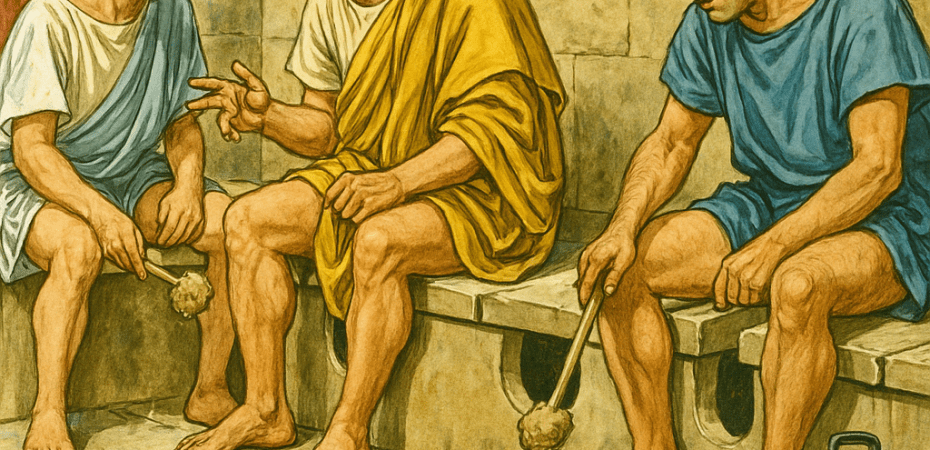
In Roman times, cities like Rome itself had public latrines, extensive sewer networks, and street cleaning crews. Not every house was connected to the main sewer, but there was a real attempt to manage waste systematically. The Romans even had public toilets with rows of seats – basically ancient communal bathrooms – built over flowing water channels that carried the waste away. It wasn’t perfect: parasites like whipworm and roundworm were still common. But for the time, it was astonishingly advanced.
London in the Middle Ages, by comparison, was a step backwards. After the end of Roman rule in Britain, the sewers gradually broke down. By the twelfth century, Londoners were dumping waste directly into the Thames and the streets. Bathing became rare, partly because the water was so foul that washing might actually make you sicker. The public baths that did exist were treated with suspicion – they were associated with immorality and disease rather than health. In short, Londoners in 1200 AD lived in worse conditions than Romans in 200 AD.
Taylor’s chapter shows that it’s not enough for a civilisation to achieve good sanitation once. You have to preserve the knowledge and the infrastructure, or it disappears. Looking at mediaeval London, you realise that even in a wealthy, growing city, people could live ankle-deep in their own filth simply because the necessary systems had been forgotten.
This brings me to the question libertarians might find most interesting: how do societies organise themselves to deal with the unglamorous stuff like sewage and parasites? The chapters in this book offer quiet but telling examples. Roman sanitation was often built and maintained by private associations, local magistrates, or tenant-funded latrines. The best public toilets weren’t always government-run – they were built by rich individuals for reputation or piety. In contrast, when responsibility became overly centralised (as in late Rome or mediaeval London), services often declined. State officials deferred action, money vanished into the void, and cesspits overflowed.
None of this proves that libertarian solutions always work. But it does show how brittle public health becomes when it depends entirely on top-down systems. Rome worked when its sanitation was partly decentralised – when people had the freedom and incentive to manage their own waste, literally. London failed when local parishes were left powerless and the Crown did nothing. Bureaucracy alone didn’t clean the streets. Voluntary cooperation, responsibility, and innovation did – when allowed.
The biological chapters of the book are harder going – there’s a lot of technical discussion about parasite eggs found in ancient soil samples. But even here, the bigger story comes through. It’s striking that human societies have always been plagued by the same basic parasites: roundworm, whipworm, tapeworm, and so on. They are ancient enemies, adapting to every new attempt to defeat them. Flushing toilets, clean water supplies, soap – these are not luxuries. They are weapons in a long, slow war against nature’s nastier side.
The volume does have flaws. Cornelis van Tilburg’s review rightly points out that it could use more maps, especially when describing locations in London and York. There are also annoying inconsistencies in the notes and some typos. But the scholarship is generally strong, and the interdisciplinary approach – combining archaeology, history, biology, and medicine – makes the findings much more powerful than if it were just a catalogue of toilets and latrines.
In a strange way, studying ancient sanitation makes the past feel more human. When you read about kings and generals, it’s easy to think of them as almost mythical figures. When you learn that even the mightiest Roman emperor had to deal with the same parasites as the lowest soldier, history feels more real. We all have the same basic needs. How well we meet them is the difference between flourishing and squalor.
There’s also something almost funny about the details. Roman public latrines didn’t have toilet paper, of course. Instead, people used a sponge on a stick, rinsed in running water. You were supposed to rinse it well between uses – but given the levels of infection, it’s pretty clear that “well” was a relative term. Mediaeval Londoners often did even worse. In poor areas, people dug cesspits under their homes. These were emptied irregularly – and sometimes not at all, leading to houses literally collapsing into the stinking void beneath them.
None of this is discussed in a sensationalist way in Mitchell’s book, which is to its credit. But the facts are there, quietly horrifying and faintly ridiculous at the same time. Reading about ancient latrines makes you grateful for small things you normally don’t even notice – soap, tap water, bin collections.
Above all, the book is a reminder that history is not a straight line of progress. The Romans had flush toilets. The Londoners of 1300 AD didn’t. Civilisation is a balancing act between knowledge, resources, and social cooperation. Lose one, and you quickly end up wading through filth.
And when you do, it’s worth asking: was the problem really that no one had the power to clean it up – or that too many people thought it was someone else’s job?

Discover more from The Libertarian Alliance
Subscribe to get the latest posts sent to your email.