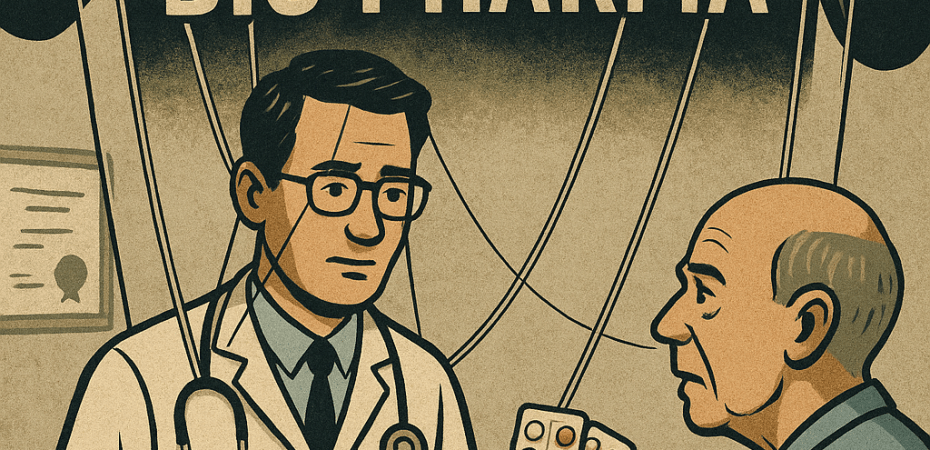
Spend ten minutes scrolling through mainstream health news, and you will encounter a torrent of cheerful lies. High blood pressure? Statins and beta-blockers for life. Mild back pain? Have some pregabalin. Feeling tired? An antidepressant will perk you up—after flattening your libido and clouding your mind. The common theme is obvious: your body is defective by nature, and only a rolling cocktail of patented chemicals can save you.
But recent studies—and a few brave dissenters—have begun to peel back the mask. The reality is that modern pharmaceutical medicine is not designed to heal. It is designed to manage decline, maximise dependency, and extract profit from human frailty. The evidence is no longer subtle. It is overwhelming.
A major study published in Brain and Behavior (2024) has introduced the concept of a “cognitive footprint”—a measure of how different medications subtly, but consistently, affect brain performance across entire populations. Using more than 163,000 participants from the UK Biobank and validating results in two other large groups, researchers found clear patterns.
Certain medications, especially antiepileptics like valproic acid and antidepressants like amitriptyline, were associated with slower processing speeds, impaired memory, and reduced attention. Even paracetamol (acetaminophen)—taken daily by millions—showed a small but reliable negative effect on cognitive performance when scaled across the population .
This is not a fringe finding. It is a direct assault on the public mind—quiet and plausibly deniable. In a culture already losing its grip on critical thought, the idea that mass medication may be dragging average cognitive function even lower is nothing short of catastrophic.
A Surrey neurologist recently issued a stark warning about pregabalin (Lyrica), a drug originally developed for epilepsy but now widely prescribed for everything from anxiety to fibromyalgia. Pregabalin, he noted, may significantly raise the risk of memory loss and dementia.
How was pregabalin allowed to flood the market so freely? Because the regulatory bodies supposedly set up to protect us have long since been captured by the industries they are meant to oversee. Approval processes are rigged by selective trials, ghostwritten articles, and financial conflicts of interest at every level.
It is easier to get a drug rubber-stamped than to get a new herbal supplement legally sold.
Then there is the ongoing scandal of statins—those little pills hailed as life-savers for anyone whose cholesterol is deemed “too high.” Yet the actual benefit for primary prevention (i.e., for people who have no existing heart disease) is minuscule. According to data compiled by the Cholesterol Treatment Trialists’ Collaboration, treating 100 people with statins for five years prevents one heart attack.
In the meantime, millions endure side effects: muscle pain, fatigue, increased risk of diabetes, and—as several studies now show—cognitive impairment.
Even the so-called “cholesterol hypothesis” itself—the idea that lowering LDL cholesterol reduces mortality—has been openly questioned by numerous independent researchers . But the machinery grinds on, fed by public ignorance and professional cowardice.
Modern medicine is no longer about healing the sick. It is about defining ever more people as “sick” and then offering them expensive, lifelong treatments. The tools of this racket are simple:
- Redefine normal as pathological. Lower the threshold for hypertension. Expand diagnostic criteria for depression. Medicalise grief, aging, and normal human variation.
- Flood the culture with fear. Every deviation from the “ideal” blood test is a ticking time bomb.
- Offer simple chemical solutions to complex social and personal problems—while quietly normalising the side effects.
The result is a chemically dependent population, increasingly incapable of questioning the system that feeds on it.
Against this system, the only real antidote is scepticism—and, where possible, rejection. Every medication must be assumed guilty until proven innocent. That means personal research, not blind trust. It means reading the primary literature, not the NHS website or a Pfizer press release. It means asking whether the real risk of your condition outweighs the risks and hidden costs of the proposed treatment.
Doctors, trapped in the best practice treadmill, cannot be trusted to think critically. Regulators cannot be trusted to protect you. Pharmaceutical companies cannot be expected to tell the truth. The responsibility lies with you.
This does not mean rejecting all drugs out of hand. Some medications save lives. Some antibiotics cure infections that would otherwise kill. Some painkillers are necessary for humane end-of-life care. But the bulk of the modern prescription catalogue is designed not to cure but to maintain—the patient as a customer, indefinitely.
Health is not the management of symptoms with chemicals. It is the absence of need for chemicals. True health is a strong mind in a strong body—something no statin, no SSRI, no “preventative” injection can ever provide.
The pharmaceutical industry has one goal: to convince you that your body is broken and that only they can fix it. The truth is that the vast majority of people could achieve greater health through diet, exercise, discipline, and scepticism than they ever could through swallowing another pill.
Every day, you must choose whether to be a sovereign being or a managed asset. Choose wisely. Your mind—and your freedom—depend on it.
References
- de Brouwer, S., Fawns-Ritchie, C., Hagenaars, S. P., et al. “Cognitive footprints of medications: associations between commonly used medications and cognitive performance in large cross-sectional cohorts.” Brain and Behavior 14, no. 4 (2024). https://doi.org/10.1002/brb3.70200 .
- “Neurologist says common drug millions of Brits are prescribed could cause memory loss and dementia.” Get Surrey, April 2024. https://www.getsurrey.co.uk/news/health/neurologist-says-common-drug-millions-31500177 .
- Light, Donald W., and Joel R. Lexchin. “Pharmaceutical Research and Development: What Do We Get for All That Money?” BMJ 345 (2012): e4348. https://doi.org/10.1136/bmj.e4348 .
- Cholesterol Treatment Trialists’ (CTT) Collaboration. “Efficacy and safety of LDL-lowering therapy among men and women: meta-analysis of individual data from 174,000 participants in 27 randomised trials.” Lancet 379 (2012): 139–150. https://doi.org/10.1016/S0140-6736(11)61378-4 .
- DuBroff, Robert, and Michel de Lorgeril. “Cholesterol Confusion and Statin Controversy.” World Journal of Cardiology 7, no. 7 (2015): 404–409. https://doi.org/10.4330/wjc.v7.i7.404 .
- Ravnskov, Uffe. The Cholesterol Myths: Exposing the Fallacy That Saturated Fat and Cholesterol Cause Heart Disease. Washington, D.C.: New Trends Publishing, 2000 .
Further Reading
Cholesterol Treatment Trialists’ (CTT) Collaboration. “Efficacy and Safety of LDL-Lowering Therapy Among Men and Women: Meta-Analysis of Individual Data from 174,000 Participants in 27 Randomised Trials.” Lancet 379 (2012): 139–150. https://doi.org/10.1016/S0140-6736(11)61378-4.
de Brouwer, S., Fawns-Ritchie, C., Hagenaars, S. P., et al. “Cognitive Footprints of Medications: Associations Between Commonly Used Medications and Cognitive Performance in Large Cross-Sectional Cohorts.” Brain and Behavior 14, no. 4 (2024). https://doi.org/10.1002/brb3.70200.
DuBroff, Robert, and Michel de Lorgeril. “Cholesterol Confusion and Statin Controversy.” World Journal of Cardiology 7, no. 7 (2015): 404–409. https://doi.org/10.4330/wjc.v7.i7.404.
Light, Donald W., and Joel R. Lexchin. “Pharmaceutical Research and Development: What Do We Get for All That Money?” BMJ 345 (2012): e4348. https://doi.org/10.1136/bmj.e4348.
Ravnskov, Uffe. The Cholesterol Myths: Exposing the Fallacy That Saturated Fat and Cholesterol Cause Heart Disease. Washington, D.C.: New Trends Publishing, 2000.
“Neurologist Says Common Drug Millions of Brits Are Prescribed Could Cause Memory Loss and Dementia.” Get Surrey, April 2024. https://www.getsurrey.co.uk/news/health/neurologist-says-common-drug-millions-31500177.

Discover more from The Libertarian Alliance
Subscribe to get the latest posts sent to your email.