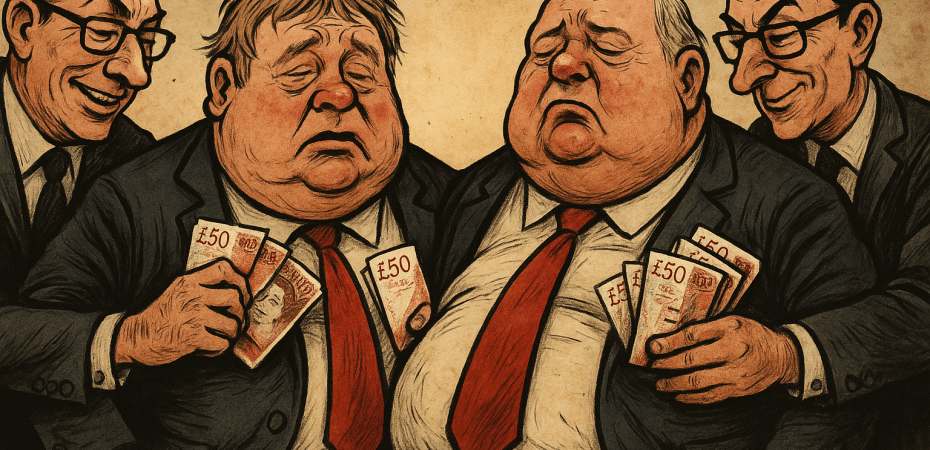
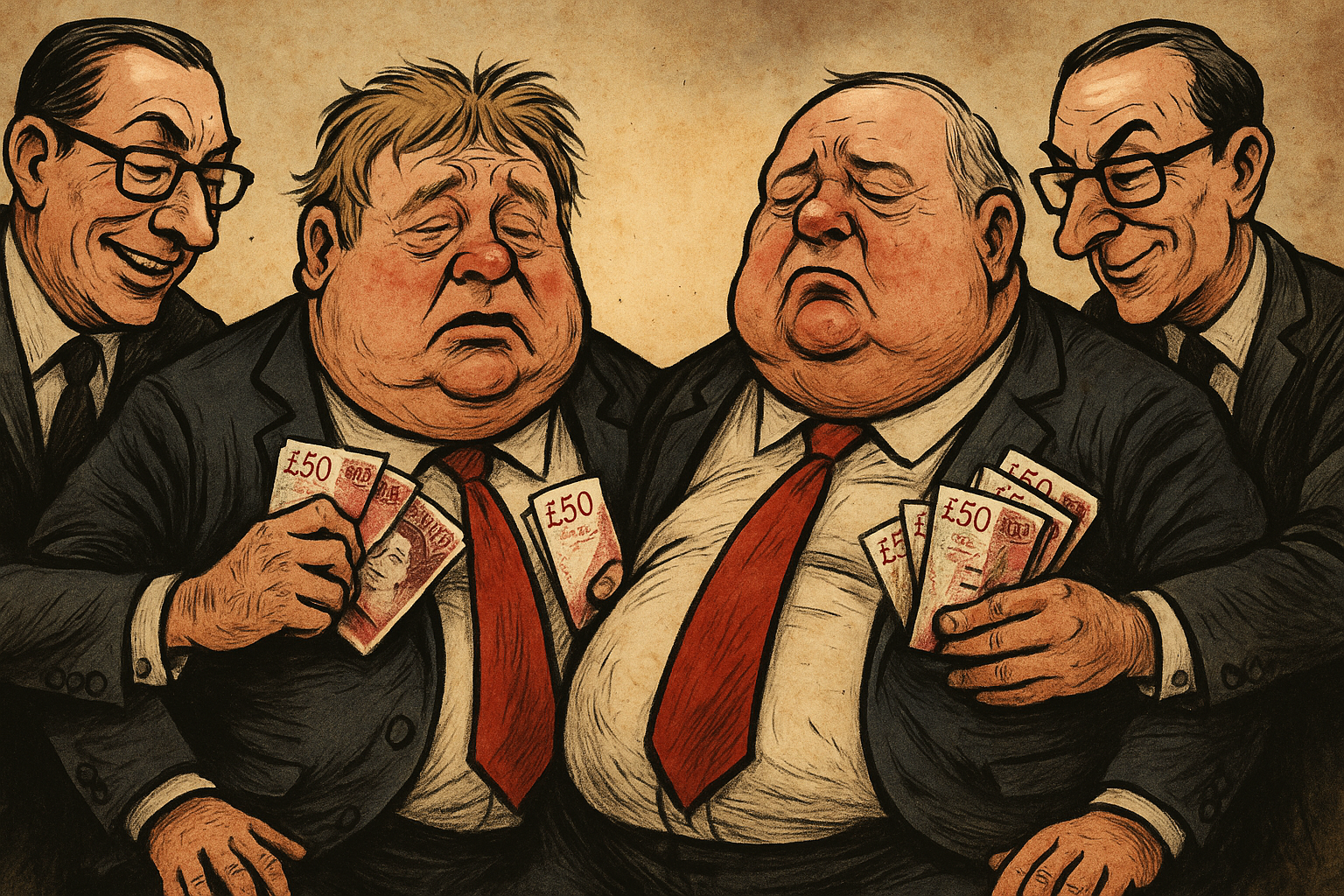
Banking ought to be dull. That is not a criticism. It is a statement of sound principle. A sound banking system should be as exciting as plumbing—predictable, unglamorous, and quietly indispensable. But what we have instead is a racket: an opaque, dishonest enterprise backed by law, flattered by journalists, and sustained by a ruling class determined to stop anyone asking what a bank actually is.
That question—what a bank actually is—has largely disappeared from public discourse. And this is not accidental. For if the British public ever grasped that modern banking is neither prudent nor honest, but a scam built on broken promises and hidden leverage, they might begin to ask why so many of our so-called “financial institutions” are still allowed to operate.
Banking in its original form grew out of the goldsmith’s trade. Goldsmiths kept precious metals for their clients. They offered receipts—“notes”—that could be redeemed for actual gold. Over time, these receipts began to circulate as money, and the goldsmiths began lending out a portion of the gold, confident not everyone would ask for it back at once.
This was the birth of fractional reserve banking. And from a moral standpoint, it was fraud.
A sound bank must distinguish between time deposits and demand deposits. A time deposit is a loan from the depositor to the bank, repayable later and with interest. The banker may lend this out. A demand deposit, by contrast, is like paying a warehouse to guard your gold. You pay a fee for safekeeping. The money must be there on demand. It is not a loan. It is a trust.
To lend out what you’ve promised to hold safely is not merely risky. It is dishonest. It is no different from a storage company renting out your furniture, or a museum quietly pawning its exhibits. And yet that is the basis of the modern British banking system. Every major retail bank in this country operates on this deceit—offering instant access to funds they no longer possess, having long since lent them to someone else. HSBC, Barclays, Lloyds—all do it. And they are encouraged to do it by the Bank of England, which promises to bail them out when the con begins to wobble.
We are told the Bank of England exists to promote “stability”. In truth, it exists to promote the illusion of solvency. When banks overextend, the Bank of England steps in with emergency liquidity. It prints money—electronic or otherwise—buys up government bonds, and inflates away the consequences. This is what “quantitative easing” means in practice: using fake money to pretend the real money hasn’t gone missing.
The mechanism is not obscure. It is simply not discussed. Fractional reserve banking, combined with fiat currency, allows banks to create credit out of nothing and earn interest on it. That is how your bank “makes money”. Not by investing wisely. Not by prudent lending. But by pyramiding credit on top of promises it cannot keep.
In a free country, this would be called fraud. In Britain, it is called finance.
When this system fails, the failure is national. The 2008 crash showed what happens when leverage outpaces credibility. And yet no lessons were learned. The banks were bailed out. No directors were imprisoned. Bonuses were paid. Laws were changed to allow more intervention, not less. The British state now guarantees up to £85,000 per depositor per bank under the Financial Services Compensation Scheme. This sounds generous. But as of 2024, the FSCS has total funds of under £10 billion to insure deposits in excess of £2 trillion. The actual coverage rate is about 0.5%. If there were ever a real crisis, the money would be “found” by creating more pounds—further devaluing what remains.
This is not insurance. It is theatre. It is designed to make depositors feel safe while exposing them to systemic risk. And again, it is deliberate.
Ask yourself who benefits from this. Not the ordinary saver. Not the pensioner. Not the young family trying to buy a home. The beneficiaries are those who operate near the source of credit creation: investment banks, private equity firms, government contractors, and the financial bureaucrats who shuttle between Treasury and City. This is the real role of the Bank of England: to serve as the protector of the class that profits from artificial money. It is not politically neutral. It is not “independent”. It is the engine room of the modern British oligarchy.
The same people who keep interest rates near zero while house prices triple in a decade are the ones who write Guardian columns about inequality. They do not care if you can’t afford a mortgage. They care that no one questions the process by which money is created. And if they need to print £895 billion in asset purchases (as they did during COVID) to protect their portfolios while you lose your job—so be it.
This is not a malfunction. It is the design. The solution is straightforward, though the resistance to it will be fierce.
First, every institution that receives deposits from the public must be required to redeem them in physical gold at a fixed rate. This alone would eliminate the illusion of infinite credit. It would make savings meaningful again.
Second, the directors of any deposit-receiving institution must be held personally liable for defaults. No more limited liability fraud. No more hiding behind corporate shields. If your bank takes in gold and lends it out against its promises, you go to prison. Or you lose everything.
These are not utopian demands. They are the minimum requirements for honesty in banking. They were once normal. Only in the last century has it become radical to suggest that money should mean something and promises should be kept.
Britain’s collapse has many causes. But at the root of it lies a financial system that punishes thrift and enriches those closest to the printing press. The City of London, once a centre of global commerce, is now a parasite that extracts value from the productive classes and launders it through lobbying and legislation.
This is not capitalism. It is oligarchy.
A state that cannot print money must live within its means. A bank that must redeem in gold cannot lend what it does not possess. And a ruling class that cannot hide its frauds must give way to one that does not need to.
Until that happens, Britain will continue to decay. It will inflate, tax, and legislate its way further into collapse—while the real decisions are made on the upper floors of those ugly buildings in the City.
Discover more from The Libertarian Alliance
Subscribe to get the latest posts sent to your email.
What would be the economic effect of your proposals?
Would we maintain our standard of living?
A very good article.
The stock market is no different, alas.
Market makers allow “authorised participants” to create shares and swaps at will manipulating stock prices to the benefit of themselves and to the cost of shareholders.
The level of fraud is quite unconscionable.
I was genuinely shocked when I discovered the depth of the criminality and the degree to which the SEC, FINRA, the DTCC and the banks collude in their malfeasance.
[…] good explanation as to how the banking system works today. Not just in Britain […]