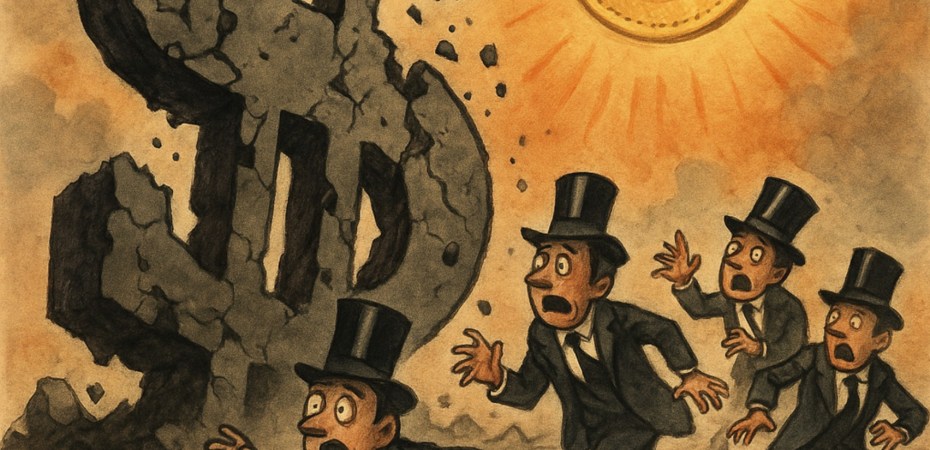
In his article “The Problem Is the Weaponization of the Dollar, Not the US National Debt” (29th May 2025), Paul Craig Roberts urges Americans not to worry about their country’s national debt. So long as the dollar remains the world’s reserve currency, he argues, America can print its way out of any obligation. The debt “is not a problem,” he insists—except insofar as it might threaten the dollar’s dominance. The real threat, he says, comes from using the dollar as a political weapon, which might drive other nations to seek alternatives.
This is half right. The weaponisation of the dollar is a serious geopolitical mistake. But the rest of Roberts’s argument borders on the silly. His economic reasoning is a warmed-over blend of post-Keynesian confusion and soft-money apologetics. Worse, it defends the very mechanism—monetary debasement—that has hollowed out the American economy, while funding an imperial state whose moral legitimacy is now visibly collapsing. Let us examine his case.
- Roberts’s Main Argument: Don’t Worry, We Can Print It
Roberts writes:
Those who worry that the US cannot pay off the bonds representing its national debt do not understand that the US debt is denominated in US dollars and can be easily paid by the Federal Reserve creating dollars to redeem the bonds.
This is the voice of a man who has forgotten that debt is not a matter of numbers but of purchasing power. Yes, the US can pay its debt in dollars—just as Weimar Germany could pay its debt in marks. But printing money to extinguish obligations does not pay the debt. It shifts the cost to everyone holding dollars, either at home or abroad. It is a theft from the prudent, a punishment for those who try to build for the future. Roberts seems to believe that so long as the bonds are redeemed in nominal terms, there is no harm. But what is the use of a bond being paid in full if the currency in which it is repaid is worth half—or a tenth—of what it was when lent?
Inflation is not painless. It distorts every signal in a market economy. It reallocates wealth arbitrarily—from the poor to the asset-rich, from workers to speculators, from savers to debtors. It breaks the essential trust between citizen and state. In a healthy society, money is a reliable store of value. In Roberts’s vision, it is a disposable convenience—a number that can be adjusted to serve the needs of the regime.
- The True Cost of Debt Is Not Repayment, But Service
Roberts claims:
The US deficit is not a problem as long as the US dollar is the world reserve currency.
But the debt must still be serviced. Even if the principal is rolled over forever, the interest must be paid. As interest rates rise—and they are rising—servicing costs balloon. In 2024, the US Government’s net interest payments surpassed defence spending. This is not a theoretical concern. It is a fiscal trap. Either taxes must rise or spending be cut—that, or the currency must be debased. All options are unpleasant. Yet Roberts assures us that we needn’t worry—because the Federal Reserve can just create the dollars. This is not economics. It is monetary astrology.
III. Economic Growth Does Not Require Money Printing
Roberts writes:
With more reserves (US debt held in US Treasuries), central banks can expand their country’s money supply and the country can grow.
This is a classic fallacy. Economic growth does not come from an expanding money supply. It comes from savings recycled into investment, and therefore into greater productivity. Printing money creates the illusion of growth—more cash chasing the same goods—but no real increase in wealth. In fact, it introduces distortions: malinvestment, speculative bubbles, and debt-driven consumption. The result is a hollow economy where capital flows into financial engineering, not productive enterprise.
Under a stable money regime, growth can happen with a fixed money stock. Prices simply fall gradually as productivity increases. This was the case in 19th-century Britain and America. The idea that growth requires inflation is a Keynesian superstition that real economists have been refuting since the 1930s. Roberts should know better.
- Reserves or Liabilities? The Mirage of Happy Central Banks
Roberts claims:
As US debt rises, so does the reserves of the world’s central banks, and everyone is happy.
But are they? The dollar’s status as reserve currency is built on confidence. Central banks hold US Treasuries not because they enjoy holding IOUs from a government $35 trillion in debt, but because they have had little choice. The US system has been dominant and stable. But that stability is now fraying. When the US seized Russia’s dollar reserves in 2022, the world noticed. China, India, Brazil, and even France began calling for alternatives.
If Roberts were correct—if central banks were truly “happy” to hold endlessly expanding US liabilities—there would be no rise in gold purchases, no demand for yuan swaps, no BRICS initiatives. But the world is slowly decoupling. The dollar is not being rejected overnight. It is being hedged against. That is a vote of no confidence, and it is accelerating.
- On the Weaponisation of the Dollar: Agreement, but a Missed Opportunity
Roberts’s one sound point is this:
What is threatening America’s ability to finance its debt are the US sanctions that have caused the rise of BRICS and the search for alternative payment methods to the US dollar.
Here he is right. The use of sanctions and asset seizures as tools of foreign policy is not only unjust, but foolish. It teaches the world that dollar reserves are not safe. That undermines the whole basis of the dollar’s dominance. But Roberts misses the opportunity this creates: the collapse of dollar hegemony should not be feared. It should be welcomed.
Why? Because it would force a return to honest money. That means gold. Governments would no longer be able to fund deficits with printing presses. They would have to tax transparently or spend less. Private savers would not see their earnings vaporised. The monetary system would regain credibility. The end of fiat privilege is the beginning of financial sanity.
- Britain’s Decline Was Not Due to Reserve Loss
Roberts concludes with a comparison:
When Great Britain lost the role [of reserve currency] to the US after World War II, the British transitioned from riches to rags.
This is historically false. Britain declined because of war and socialism, and the inflation that funded both. The pound lost reserve status after the country had been bankrupted by two world wars and had embraced state control of everything from coal to dentistry. The end of sterling as a reserve currency was a symptom, not a cause. America is following the same path—not because its currency is being dethroned, but because it has squandered the trust on which that throne rested.
Conclusion: A Theology of Inflation, Not a Policy of Prudence
Paul Craig Roberts is right to criticise the weaponisation of the dollar. But his defence of unlimited debt and money printing is reckless and false. A government that borrows without limit, spends without discipline, and prints without restraint is not strong. It is decadent. And an economy based on illusions will not endure.
Inflation is not a neutral tool. It is a form of theft. It destroys savings, conceals the cost of government, and punishes the poor. The sooner the world is rid of this system, the better. Roberts should stop defending it.

Discover more from The Libertarian Alliance
Subscribe to get the latest posts sent to your email.