
Eleanor Dickey, Learning Latin the Ancient Way: Latin Textbooks from the Ancient World
(Cambridge University Press, 2016)
To the modern reader, Latin is the badge of classical literacy—an elite pursuit, almost monastic in its isolation. Yet Eleanor Dickey’s Learning Latin the Ancient Way opens a vivid and humanising window into a world where Latin was not the first language, but the second. In this meticulous and engaging study, Dickey presents us not only with an array of ancient textbooks but with the voices and struggles of learners—Greek-speaking students in a Roman world—trying to master a language that had not always been theirs. The result is as much a history of language as it is of empire, identity, and ambition.
For much of the twentieth century, scholars believed that the Greeks showed little interest in Latin. The assumption was that, although the Romans imitated Greek civilisation, the cultural flow was mostly one way. Greece retained her pride, her language, and her sense of superiority. But Dickey’s work proves that this picture, while once accurate, needs updating. The key shift came in the fourth century AD, when Constantinople became the imperial capital and Latin—the language of law and bureaucracy—offered career opportunities for educated Greeks. As Dickey shows, Latin may not have been loved, but it was learned, often competently and sometimes with enthusiasm.
This learning was functional, not ornamental. Unlike Latin speakers, who studied Greek as part of a gentleman’s education, Greek speakers rarely learned Latin for its literature. Instead, they acquired it as young adults to access government posts, military roles, and legal careers. Libanius, the fourth-century Greek rhetorician, lamented that his students were deserting the classics for Latin instruction—a sign, if ever there was one, of changing priorities.
The core of Dickey’s book is her analysis and translation of the Colloquia, a set of bilingual Latin-Greek dialogues dating from the Roman Empire. These were not written for the leisured aristocrat dabbling in Cicero, but for serious learners needing basic competence—soldiers, merchants, lawyers. The texts present realistic scenes: a boy goes to school, greets his teacher, recites grammar, and passes his tablets to the assistant. Another learns to navigate a bath-house or a courtroom. In some passages, students read aloud parts of Virgil and Cicero, practise pronunciation, and correct each other’s syntax.
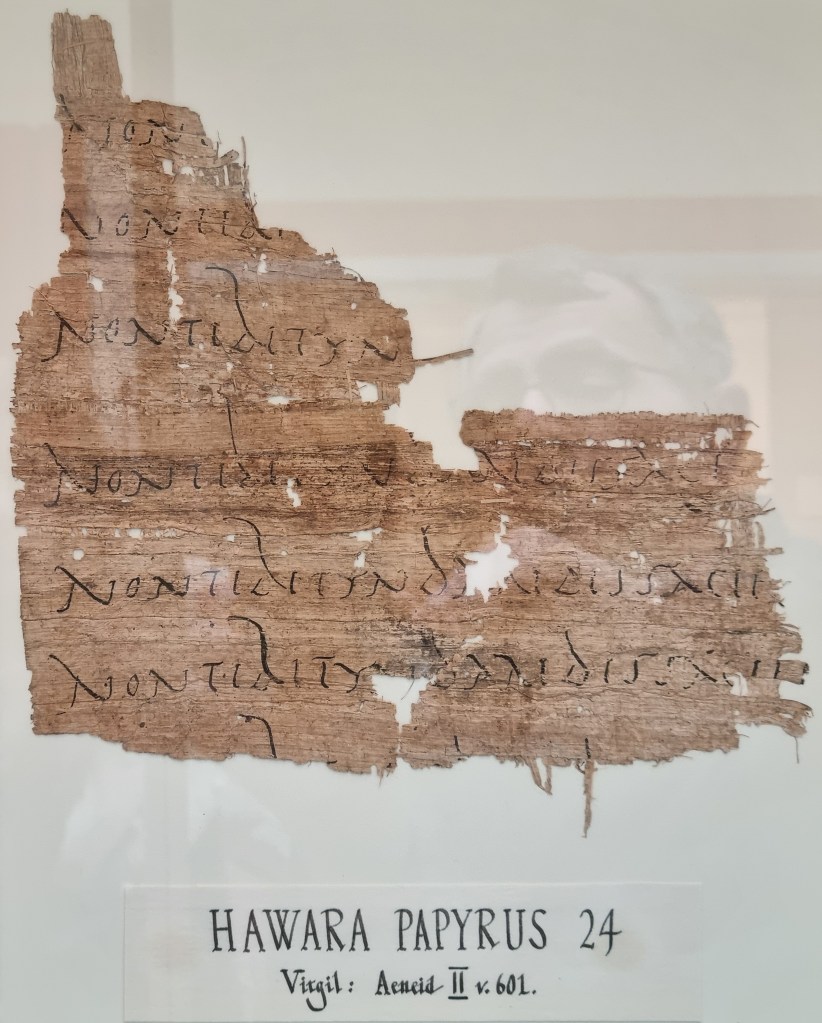
The format is striking: line-by-line translations, narrow columns, and no punctuation or word spacing. Dickey makes clear that ancient learners were not just facing new grammar—they were decoding a new script. The Latin alphabet was foreign, and evidence from Egypt shows that Greek speakers often struggled with it. Some resorted to writing Latin in Greek letters in the hope of acquiring oral fluency without mastering the written form.
It is a reminder that learning Latin was hard. Mistakes in glossaries were frequent. Many teachers were not native speakers, and some introduced more confusion than clarity. But there is also evidence of good teaching, of students who composed Latin fables with competence, and of grammarians who took real care in producing materials. Indeed, the survival of paradigms and exercises on papyri and ostraca, many written in the Hellenised schoolrooms of Egypt, shows just how widespread and serious Latin education could become.
As a Chinese student of Latin and Greek, I couldn’t read Dickey’s book without feeling a personal connection to the struggles of those ancient Greek learners. Though my first language is English—a fortunate advantage—I cannot ignore the structural gulf between the Indo-European languages and my ancestral tongue. Latin is a thing of inflection, of word endings that signal case and tense. Chinese, by contrast, is analytical and positional. There are no conjugations, no declensions, no genders. Meaning is context-driven, word order is paramount, and ambiguity is resolved by tone and syntax rather than morphology. For someone whose mind is shaped by Chinese structures, Latin can feel like wrestling with a kind of grammatical machinery that never stops shifting.
This makes the achievements of modern Chinese students in mastering both Latin and Greek all the more impressive. It is not mere aptitude but discipline and a willingness to inhabit an entirely alien logic. I say this not only out of ethnic pride—though there is some of that—but also to highlight the continuity of effort across centuries. Just as fourth-century Greeks pushed themselves through Latin for access to law and office, so now do Chinese students press through Cicero and Thucydides for a different kind of advancement: intellectual respect and a determination to understand the foundations of western uniqueness.
Dr Gabb, who now spends much of his time in Chinese universities, has said more than once that the best classicists he teaches today are Chinese. Not because they are born to it, but because they approach it with method and a refusal to be intimidated. It is, in a way, the same mentality that allowed my ancestors to memorise thousands of ideographs and master calligraphy through agonising precision. We did not invent the Greek alphabet—but we respect the genius that did.
What Dickey has done, subtly but effectively, is to reframe how we think about Latin in the eastern Roman Empire. It was not a mark of culture but of bureaucratic utility. It was not learned in childhood but at university age, not for social prestige but for imperial employment. It had no glamour. It was the code of the conqueror, but also the language of law, power, and advancement. This makes the Greek decision to adopt it all the more remarkable.
And adopt it they did—sometimes grudgingly, sometimes practically, but increasingly. Over time, even the Greek elite in Athens began to accept Latin’s importance. Though never a literary equal in the Greek imagination, Latin became one of two classical languages, and its acquisition, in many cases, a prerequisite for social mobility.
Eleanor Dickey’s Learning Latin the Ancient Way is a book of quiet but profound importance. It corrects a scholarly misconception. It introduces readers to ancient learners who, in many ways, resemble modern ones—struggling with grammar, fumbling with pronunciation, and occasionally despairing at bad teaching. It also reminds us that Latin was not just the voice of Rome but the tool by which that voice was understood in the provinces.
By placing these bilingual textbooks back into the hands of readers, Dickey has done more than preserve a historical curiosity. She has reminded us of what it meant to learn a language not for love but for necessity, not in youth but in hope—and of how empires, in the end, live not just through conquest, but through grammar.
Image: A Greek schoolboy’s effort to copy non tibi Tyndaridis facies invisa Lacaenae (British Museum: Dr Gabb photograph)
Discover more from The Libertarian Alliance
Subscribe to get the latest posts sent to your email.
Related posts:

Powered by YARPP.