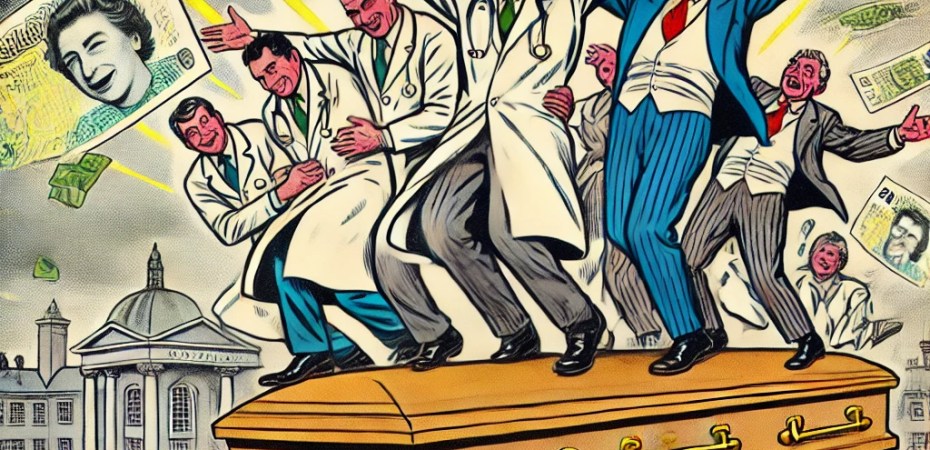
In a previous article, I expressed my own scepticism about the still-current claims that elevated cholesterol is the primary cause of cardiovascular disease and that statins are a near-universal solution. That critique was grounded in data, but also in a broader concern: that medical authority has become unmoored from empirical caution and increasingly shaped by institutional inertia and commercial incentive. What I did not anticipate was that one of the most compelling confirmations of this suspicion would come from a writer whose work I have elsewhere approached with caution.
“The Great Cholesterol Scam and the Anti-Cholesterol Crusade,” published by “A Midwestern Doctor,” is an astonishing piece—not because it tells us something wholly new, but because it gathers decades of dissent, overlooked studies, clinical wisdom, and cultural memory into a single, powerful indictment. It is, frankly, one of the best essays yet written for a general audience on the collapse of the cholesterol consensus. It does what the best essays always do: it retrieves what has been hidden and makes the familiar suddenly appear absurd.
I do not accept all of its conclusions. There are moments where the argument slips into overstatement or too easily equates dissent with truth. But if a single document were to be handed to a curious patient beginning to question why he has been prescribed a statin for the rest of his life, this might be it.
Unmaking the Narrative
The article opens with an observation that deserves to be read slowly:
As I’ve come to study how flawed much of our scientific literature is and how frequently the medical establishment deceives the public, I’ve repeatedly found myself asking: how did all of this get started?
This question—so apparently simple—frames the entire essay. It is not merely about cholesterol. It is about epistemology. How do beliefs take hold? How do they persist when evidence crumbles beneath them? The author traces the answer back to one of the most famous (and infamous) figures in modern nutrition: Ancel Keys.
Keys’ role in establishing the lipid hypothesis has been dissected before, including by me. But the author’s account here is both more patient and more damning:
Keys made his case using cherry-picked data from only seven countries out of the 22 that were available to him—countries that showed a correlation between fat consumption and heart disease.
This is not hyperbole. It is historical fact. Keys ignored data from France, Germany, and Sweden—nations with high fat consumption and low heart disease—and instead selected countries that fit his model. His “Seven Countries Study” became the cornerstone of modern nutritional guidelines, not because it was methodologically superior, but because it arrived at the answer public health officials were desperate to believe.
Once entrenched, the theory metastasised. The author notes:
The cholesterol theory of heart disease… became dogma. Doctors who questioned it were attacked. Studies that disproved it were buried. And as always, pharmaceutical companies recognised an opportunity.
This moment—where flawed science meets commercial opportunity—is where the history of statins begins. The author provides a clinical and financial timeline that is hard to dismiss. Statins, introduced in the late 1980s, became the most profitable class of drugs in history. Lipitor alone made Pfizer over $150 billion. These drugs were marketed not as treatments for disease, but as tools for the mass management of risk.
The Numbers That Matter
What gives this article its force is not the author’s indignation, but the data. And the author does not deal in vague generalities. Instead, he focuses on absolute risk reductions—the numbers that matter to real patients, not just statistical models.
On statins for primary prevention (that is, people with no prior heart attack), the author writes:
The number needed to treat (NNT) to prevent one heart attack over five years is between 60 and 250, depending on the population. That means for every one person helped, between 59 and 249 take the drug with no benefit.
He continues:
The NNT to prevent a single death? Often over 1000. These are not wonder drugs. These are marginal interventions applied to whole populations.
This distinction is key. Relative risk reductions—30% here, 25% there—sound impressive. But when the actual risk is low to begin with, the effect is often negligible. And that would be tolerable if the drugs were entirely benign. But they are not.
The author presents an alarming account of side effects, which mirrors what others have long observed in practice:
Many patients report severe muscle pain, cognitive fog, fatigue, and even depression. Yet when they complain, doctors are trained to dismiss these symptoms.
Worse, most statin trials actively excluded participants who experienced early adverse effects. The author quotes a 2006 review in The Lancet showing that only highly compliant patients were enrolled in follow-up studies—thus artificially lowering the reported incidence of harm.
This kind of design bias is not accidental. It is systemic. The author does not flinch:
Modern trials are not designed to discover the truth. They are designed to produce a publishable p-value.
This alone deserves a full investigation.
A Plausible Alternative
Importantly, the article does not merely tear down. It proposes an alternative model of heart disease—one centred on inflammation, metabolic dysfunction, oxidative stress, and vascular damage.
Atherosclerosis does not begin with fat clogging an artery like grease in a pipe. It begins with inflammation, endothelial damage, and a dysfunctional immune response.
This accords with decades of findings, including the now-famous failure of CRP-lowering drugs that didn’t affect inflammation, and the success of lifestyle interventions that normalise insulin levels, reduce stress, and improve sleep.
The author further observes:
Cholesterol is present at the scene of the crime—but that does not make it the criminal. It is more like the firefighter. Blaming cholesterol for heart disease is like blaming firemen for fires.
This is well said. Cholesterol is involved in cell repair, hormone synthesis, and brain function. It increases after surgery and in response to trauma. To treat it as an enemy, especially in older adults, is likely to do more harm than good. Several studies have shown that low cholesterol is associated with higher mortality in the elderly. The idea that one can never have “too little” LDL is increasingly absurd.
Where the Case Overreaches
Yet the article is not without its flaws. One of its assertions—that statins cause widespread neurodegeneration—is plausible but not yet definitively proven. The author writes:
There is a growing body of evidence linking statins to cognitive decline, Alzheimer’s, and Parkinson’s.
There are studies suggesting this. But there are also others, even if they are often industry-funded, which find no effect or even small protective ones. This ambiguity should be acknowledged more explicitly.
A more serious overreach comes in the suggestion that statins are never warranted. This is not said outright, but the tone implies it. For example:
There are almost no patients who genuinely benefit from these drugs. Most would do better improving their diet, sleep, and mental state.
This may be true in principle, but real-world compliance with lifestyle changes is low. And in patients with known coronary artery disease—particularly those who are metabolically compromised—statins do reduce cardiovascular events, if not always mortality. The problem is not that statins have no effect. It is that they are wildly overprescribed to populations who do not need them.
Finally, the article occasionally slides into a slightly conspiratorial tone. It refers to medical institutions as if they were monoliths, devoid of dissent or good faith. But there are many doctors—more each year—who are beginning to question the dogma. The author might have acknowledged them as allies, not cowards.
A Moment of Clarity
Despite these quibbles, the piece remains a major achievement. It succeeds not because it is perfect, but because it reminds us that the burden of proof lies with those who want to medicate hundreds of millions of people for the rest of their lives. That burden has not been met.
To quote the author again:
The anti-cholesterol crusade is not science. It is theology. It does not welcome contradiction. It punishes heresy.
And this, perhaps, is the most chilling truth of all. When ideas become entrenched, they are no longer tested. They are enforced. And medicine ceases to be a science and becomes a dogma.
If nothing else, this essay invites us to look again. Not just at cholesterol, but at everything we’ve been told by institutions that no longer deserve our unquestioning trust. We might also care to look harder at all those policy institutes in London that supposedly preach free market economics while receiving large donations from the pharmaceutical companies. This, however, is a matter for another essay.
Further Reading
Books and Articles:
- Ravnskov, Uffe. The Cholesterol Myths. New Trends Publishing, 2000.
- Kendrick, Malcolm. Doctoring Data. Columbus Publishing, 2014.
- Diamond, David M., and Uffe Ravnskov. “Statins and the Risk of Diabetes.” Expert Review of Clinical Pharmacology, 2015.
- Ioannidis, John P.A. “Why Most Published Research Findings Are False.” PLoS Medicine, 2005.
- Redberg, Rita F. “Controlling the Risk Factors for Heart Disease: Can We Trust the Guidelines?” Archives of Internal Medicine, 2012.
- Taubes, Gary. Good Calories, Bad Calories. Knopf, 2007.
- Teicholz, Nina. The Big Fat Surprise. Simon & Schuster, 2014.
Data and Oversight Critiques:
- The NNT (www.thennt.com): A site compiling evidence on the actual benefits and harms of common treatments, including statins.
- BMJ Open: “Clinical Trial Transparency and the Pharmaceutical Industry: Who Gets to See the Evidence?”

Discover more from The Libertarian Alliance
Subscribe to get the latest posts sent to your email.
I’m glad I refused to take them. And the COVID vaccines, too.