
I do not chant “Death to the IDF.” Nor do I wave placards calling to “Free Palestine.” These are not slogans I would ever shout at a music festival or indeed anywhere else. I was raised, as many of us were, to believe that political conflicts—especially foreign ones—deserve careful thought, not loud theatrics. I am wary of anyone who finds it exciting to take sides in wars they do not fight and do not understand. But this is precisely why I find the current political reaction to Glastonbury so dishonest and so theatrical.
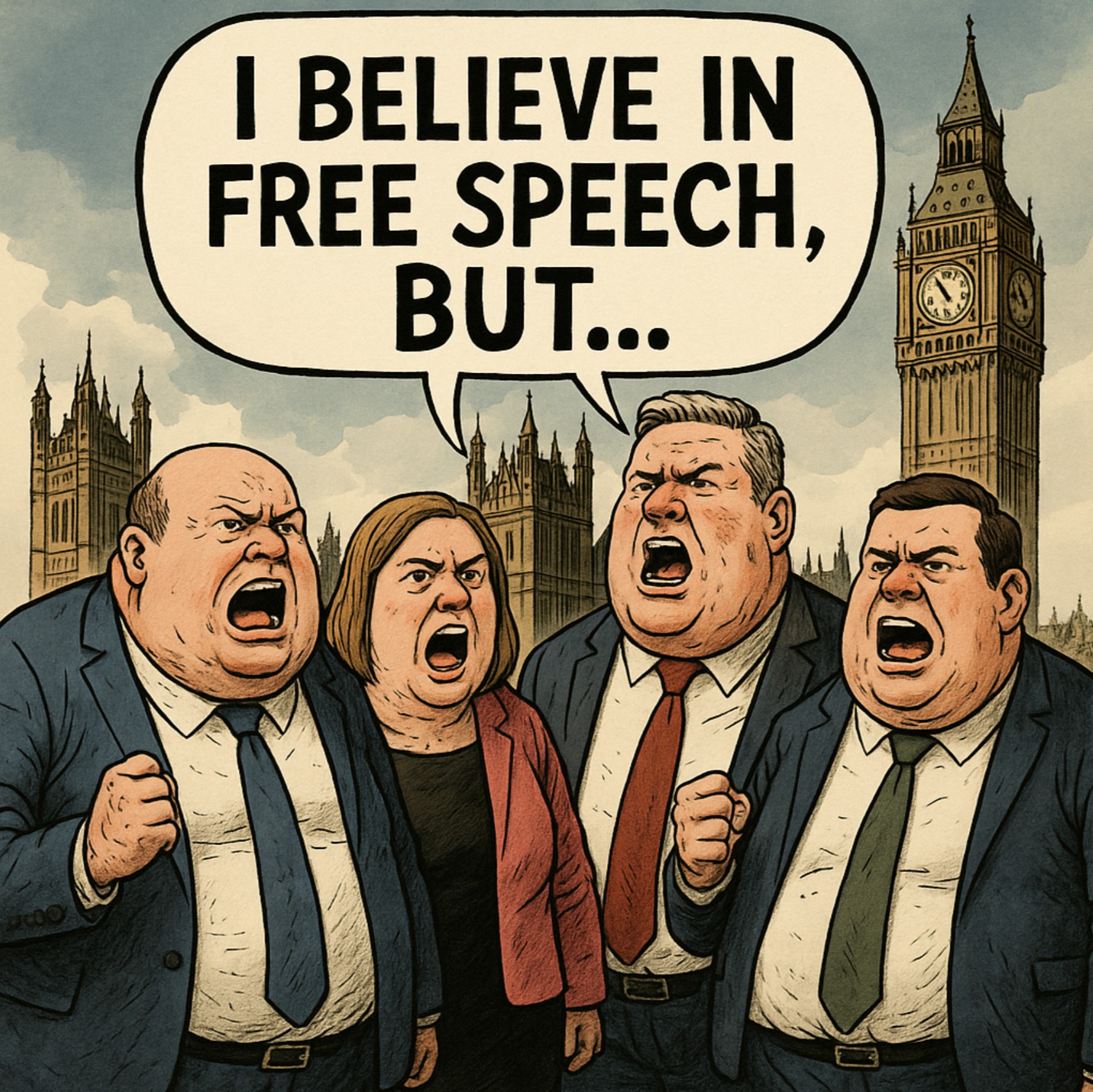
According to a report in The Independent (“Starmer: BBC must explain how ‘appalling IDF hate speech’ was aired at Glastonbury,” Monday, 30th June 2025), a performer named Bob Vylan led chants of “Death to the IDF” during his Glastonbury set. Another act, Kneecap, made vague references to “starting a riot” before immediately denying any intent to do so. These comments, predictably, triggered a wave of hysterical condemnation. Keir Starmer called the broadcast “appalling hate speech.” The Conservative chorus followed with dreary uniformity. Kemi Badenoch, who seems incapable of distinguishing between political rhetoric and literal violence, called the event “grotesque.” And the shadow work and pensions secretary Helen Whately offered up what has become the standard disclaimer: “I mean, yes, I believe in free speech, but…”
Let’s pause there. “I believe in free speech, but…” That phrase deserves close attention. It is the calling card of every censor. Nobody who actually believes in freedom of speech says this. He simply believes in it, even when—especially when—the speech in question is disagreeable. Those who reach for the “but” are saying, quite plainly, that their belief ends the moment it becomes inconvenient. In Ms Whately’s case, her objection is that such statements “incite violence.” But chanting “Death to the IDF” is not an instruction to kill anyone. It is not a targeted threat against individuals. It is a political expression, one that may be crude or misguided, but that is not an act of violence. If shouting this is incitement, then so is the British Government’s repeated call for “Ukraine to defeat Russia”—a message heard in Parliament, on the BBC, and in every newspaper from The Times to the Guardian.
There is a name for the view that public discourse should accommodate unpleasant or controversial views. It is called liberalism. Not liberalism in the degenerate modern sense of flag emojis and mandatory drag story hour, but in the classical sense: that the citizen in a free country has the right to speak his mind—even, and especially, when others do not like what he says. Under that standard, “Free Palestine” is not hate speech. Nor is “Death to the IDF.” They are both political positions about an ongoing war—positions which, however unwise or offensive they may seem to some, are entirely within the bounds of fair comment.
For the record, I believe the Israeli military is committing atrocities. The siege of Gaza is not a war between two armies but a sustained bombardment of a trapped civilian population. This is not my opinion alone. It is the assessment of Human Rights Watch, the UN, Amnesty International, and Israeli journalists such as Gideon Levy. The Prime Minister of Israel is a wanted war criminal: he risks arrest if he steps foot outside his own country. Saying so is not “anti-Semitic.” It is not incitement. It is a description of reality. The only British policy response that makes sense—morally or strategically—is neutrality in act, condemnation in words. We should not send weapons to either side. We should not take sides. A government that cannot stop knife crime in Birmingham has no business intervening in Gaza.
But neutrality is not what we are getting. What we are getting instead is a show trial of national morality, where anyone who departs from the official script is labelled an extremist. The BBC is now being asked to explain why it broadcast a live performance from a music festival. Glastonbury, once a place of half-naked hippies and leaky tents, has been rebranded as a staging ground for terrorism. It would be funny if it weren’t so sinister. The Culture Secretary is now involved. The police have been “asked to investigate.” A parliamentary committee may call the BBC to give evidence. All of this because one man with a microphone shouted something vulgar about a foreign army.
The absurdity here would be laughable were it not part of a larger trend. British law is being reshaped—not to protect the public from danger, but to protect the state from embarrassment. The idea that chanting against the Israeli Defence Forces is criminal, but marching under a “Trans Rights or Else” banner is protected speech, tells us all we need to know. It is not “hate” that is being policed. It is dissent.
And what of the Conservative Party? Their job, in theory, is to stand for British traditions. Yet their only contribution to this episode is to echo Labour’s language and demand more censorship. Lucy Frazer, Roger Bolton, and Kemi Badenoch compete to see who can be most offended. It is as if they know they are about to lose the next election and are auditioning for jobs on Ofcom panels. They will not be remembered as defenders of liberty. They will be remembered as the dull chorus who sang backup while the last of Britain’s free institutions were dismantled.
I do not support public chanting of “Death to the IDF.” But I will defend someone’s right to say it. If we surrender that right—if we continue to redefine offensive speech as criminal—we are not heading towards peace or decency. We are heading towards a regime in which every view outside the approved orthodoxy is punished by the police, or by the press, or by the banks, or any other organ of the ruling class. We shall become a country where no one dares say anything at all.
We are almost there already.
Discover more from The Libertarian Alliance
Subscribe to get the latest posts sent to your email.
I’ve always said that the BBC can say what it likes – I can change channels with ease.
What I object to is being required to fund them. Please, someone, anyone, abolish the TV Licence fee, and cut off all state funding for broadcasters – the BBC, or any other broadcaster receiving a public subsidy. Let them say what they want – provided I don’t have to pay them to do so.
I don’t chant any of those slogans, or indeed any slogans at all. But in the context of a genocide to chant Death to the IDF (=the genocidaires) is not hate speech at all, if there even is such a thing. You don’t have to like the Israeli Army, and to dislike the Israeli Army is not the same as hating all Jews simply because they are Jews (an absurd notion, and not one I am sure even exists).
The fact that British politicians are offended by musicians using their platform to highlight the Israeli genocide of Palestinians simply shows who is getting paid by the Israeli lobby.
The point is, I would be better not to have ‘hate speech’ laws at all, but if they must exist they should be applied impartially. They are not. All the rest is hot airThe point is, I would be better not to have ‘hate speech’ laws at all, but if they must exist they should be applied impartially. They are not.
Laurence Hughes.
In view of all this, I just hope I’m not going to end up in trouble for all my past jokes at Sebastian Wang’s expense about his Chinese associations. It gives me a cold shudder just to recollect. One does not want to end up before the beak.
Something tells me that Sebastian has never considered reporting you to the pigs for this or anything else you may have said.
[…] The Limits of Outrage: Hate Speech and Taking Sides on Gaza […]