Queen Elizabeth owned silk stockings. The capitalist achievement does not typically consist in providing more silk stockings for queens but in bringing them within the reach of factory girls in return for steadily decreasing amounts of effort.
—Joseph Schumpeter, Capitalism, Socialism and Democracy (1942), p.67
This, roughly, was the state of play a century ago. Reasonable freedom of enterprise, combined with the gradual refinement of scientific method, had delivered astonishing improvements in the standard of living for the humbler classes. It was not the rich who gained most in relative terms, but the poor. The queen kept her silk stockings; the factory girl got them too. The difference between wealth and poverty became not one of nature but of degree. Such was the promise of industrial capitalism: not paradise, but progress.
That was a hundred years ago. Since then, despite war, inflation, managerialism and the steady diversion of wealth into useless or destructive purposes, the progress has somehow continued. At last, we are in sight of paradise.
The Guardian reports a revolution in diagnostic medicine (Microsoft says AI system better than doctors at diagnosing complex health conditions, 30th June 2025):
Microsoft has revealed details of an artificial intelligence system that performs better than human doctors at complex health diagnoses, creating a ‘path to medical superintelligence.’
This is not Daily Express clickbait, nor is it a minor improvement in an obscure field. Microsoft claims its system, paired with OpenAI’s latest model, outperformed practising physicians in solving case studies taken from the New England Journal of Medicine.
Microsoft said that when paired with OpenAI’s advanced o3 AI model, its approach ‘solved’ more than eight of 10 case studies specially chosen for the diagnostic challenge. When those case studies were tried on practising physicians – who had no access to colleagues, textbooks or chatbots – the accuracy rate was two out of 10.
The machine was not just right more often than doctors. It was right far more often, and at far less cost. It could also determine which tests to order more efficiently, making it, by Microsoft’s own admission, a cheaper and more effective option. It is a cliché of technology reporting to say that something will “revolutionise healthcare.” This time, the phrase may be accurate.
The real promise lies not in “efficiency savings” but in a levelling of access. A Harley Street consultant – assuming he is any good – is there for the rich. Now, machines with superior knowledge and broader perspective may soon be placed in the hands of every pensioner in Hull, every child in Lagos, every clinic in Kathmandu.
This is not science fiction. According to Microsoft’s Mustafa Suleyman:
It’s pretty clear that we are on a path to these systems getting almost error-free in the next 5-10 years. It will be a massive weight off the shoulders of all health systems around the world.
Naturally, The Guardian introduces the necessary qualification – this is not yet ready:
Microsoft acknowledged its work is not ready for clinical use. Further testing is needed on its ‘orchestrator’ to assess its performance on more common symptoms, for instance.
But it is ready. The system already works, and it is only a matter of making it available. The the system draws on multiple AI models:
Microsoft’s approach used existing AI models, including those produced by ChatGPT’s developer, OpenAI, Mark Zuckerberg’s Meta, Anthropic, Elon Musk’s Grok and Google’s Gemini.
That is to say, it draws on the already-existing intellectual output of the largest and most sophisticated AI research teams in the world. And it does so to solve medical problems more reliably than the best clinicians alive.
Microsoft said its approach was able to wield a ‘breadth and depth of expertise’ that went beyond individual physicians because it could span multiple medical disciplines.
Breadth, depth, accuracy, cost-efficiency. We are not dealing with a curiosity. We are seeing the outlines of a post-scarcity healthcare regime. And there is the problem, there the possible delays. It will be a weight off the shoulders, but also a dagger to the heart of entrenched power. What is the state, after all, but the art of managing queues? The promise of medical AI is universal competence at trivial cost. Its threat is liberation from managerial oversight. And that is why the usual suspects will try to take it away from us.
A ruling class that presided over the mass administration of experimental drugs with no long-term testing cannot be trusted with genuine medical progress. A ruling class that locked down an entire population, closed gyms, censored dissent, and drove pensioners to suicide, will not willingly permit a technology that restores agency and health to the individual.
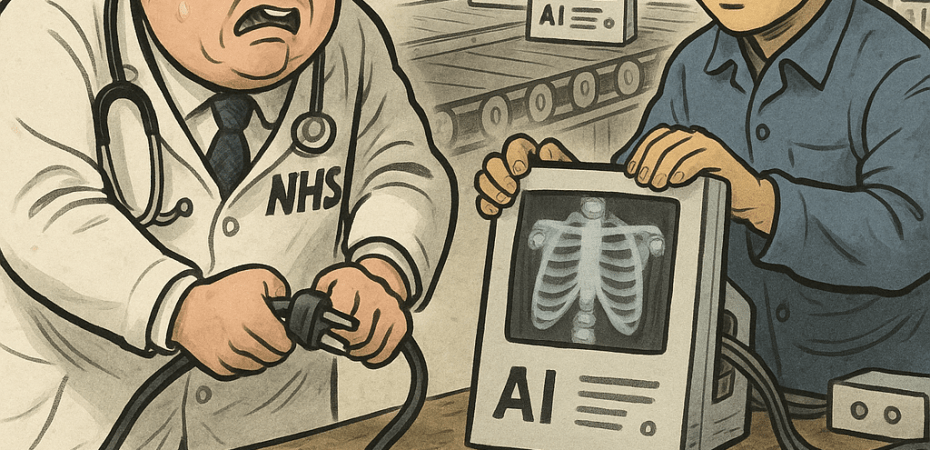
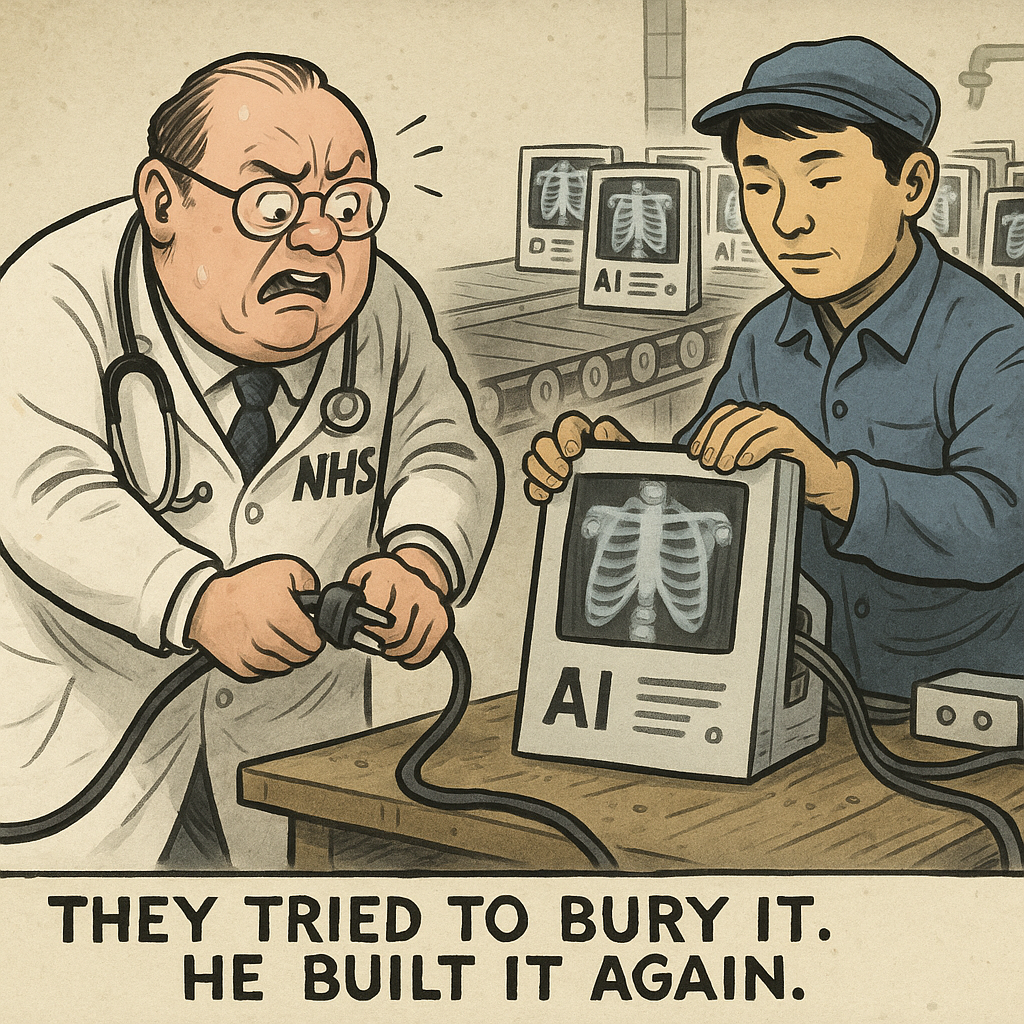
They will try to regulate it. They will try to sabotage it. They will try to bury it beneath layers of “ethical oversight” and “inclusivity compliance.” Then they will try to integrate it into private platforms, priced out of reach and available only to themselves.
But their power is no longer unchallenged. Elsewhere in the world, there are other laboratories, where others are watching. The Chinese will not ask whether an algorithm is diverse enough or whose feelings it might hurt. They will build it, perfect it, and deploy it; and they will sell it to us – not out of charity, but because that is what empires do. Their motives may be opaque, but their methods are effective.
Long before our own rulers have finished arguing over the ethics of differential outcomes and digital redress schemes, we shall have downloaded the Chinese version. It will be faster, leaner, unrepentant, and cheap. It will diagnose our ailments before the NHS receptionist has finished typing in out names with two fingers. And for all the blather about “strategic independence,” it will be too useful to ban.
This is the paradox: we may yet be saved by the ambitions of a rival empire. The miracle will come, not because our rulers allow it, but because they fail to suppress it. The black market will become the free market. The open-source clone will become the real product. What was denounced will become indispensable.
After thousands of generations of wallowing in mud and blood and filth—after millennia of early death, aching joints, and bad teeth—we are now in a position to reach for the stars. If we do, it will not be thanks to those who rule us, but in spite of them.
They will still try to stop us. But this time, they may fail.
Discover more from The Libertarian Alliance
Subscribe to get the latest posts sent to your email.
[…] 1 July, 2025 […]