It’s odd writing about supermarkets, given that I don’t do the weekly food shop. I eat what’s put in front of me—school dinners or whatever Mum buys from wherever. But I do pay attention to where it all comes from. And I’ve decided, at least for myself, that I won’t eat Israeli produce. That’s not because someone shouted at me outside Sainsbury’s. It’s because I’ve looked into the matter and come to the settled view that the Israeli state has crossed a moral line.
What Israel is doing in Gaza is not a “war,” and it certainly isn’t self-defence in the ordinary sense. It is something much worse: a systematic campaign of mass killing, pursued with such scale and cruelty that it falls outside the bounds of civilisation. No people should have to live under siege. No child should be bombed for the crime of being born on the wrong side of a fence. Whatever you think about the events of 7 October or about Hamas, those facts remain. They are not diminished by what came before.
And yet, for all that, I find myself disagreeing with parts of the boycott campaign currently sweeping British supermarkets. Not with the idea of a boycott itself, but with the means by which some are trying to enforce it. With this in mind, I comment thus on an article in today’s Daily Telegraph.
The right to boycott is one of the few real freedoms we still have. If you don’t like Israeli policy, you can refuse to buy Israeli grapes. If you feel strongly, you can encourage others to do the same. And if you’re really committed, you can even organise a boycott not just of Israeli products, but of supermarkets that continue to sell them. All of that is legitimate. In fact, it’s an admirable form of civic pressure in a country where political debate is increasingly stifled. As Lewis Backon of the Palestine Solidarity Campaign put it, “Supermarkets have moral agency.” So do shoppers.
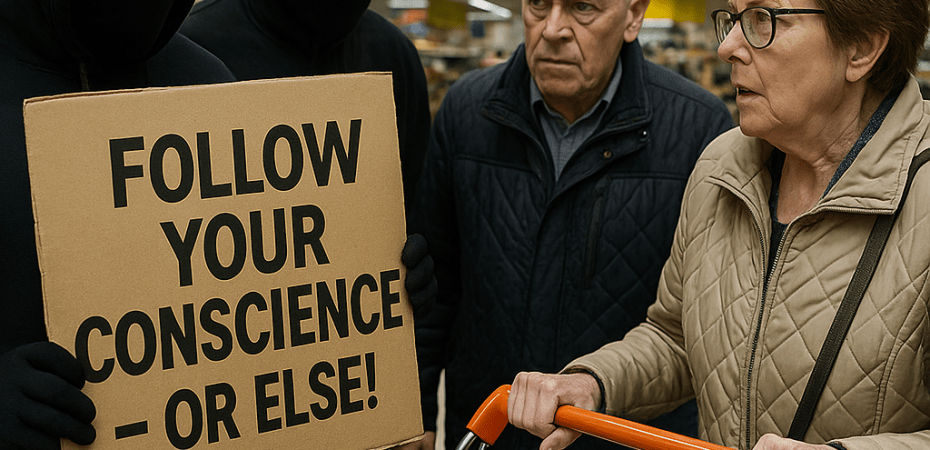
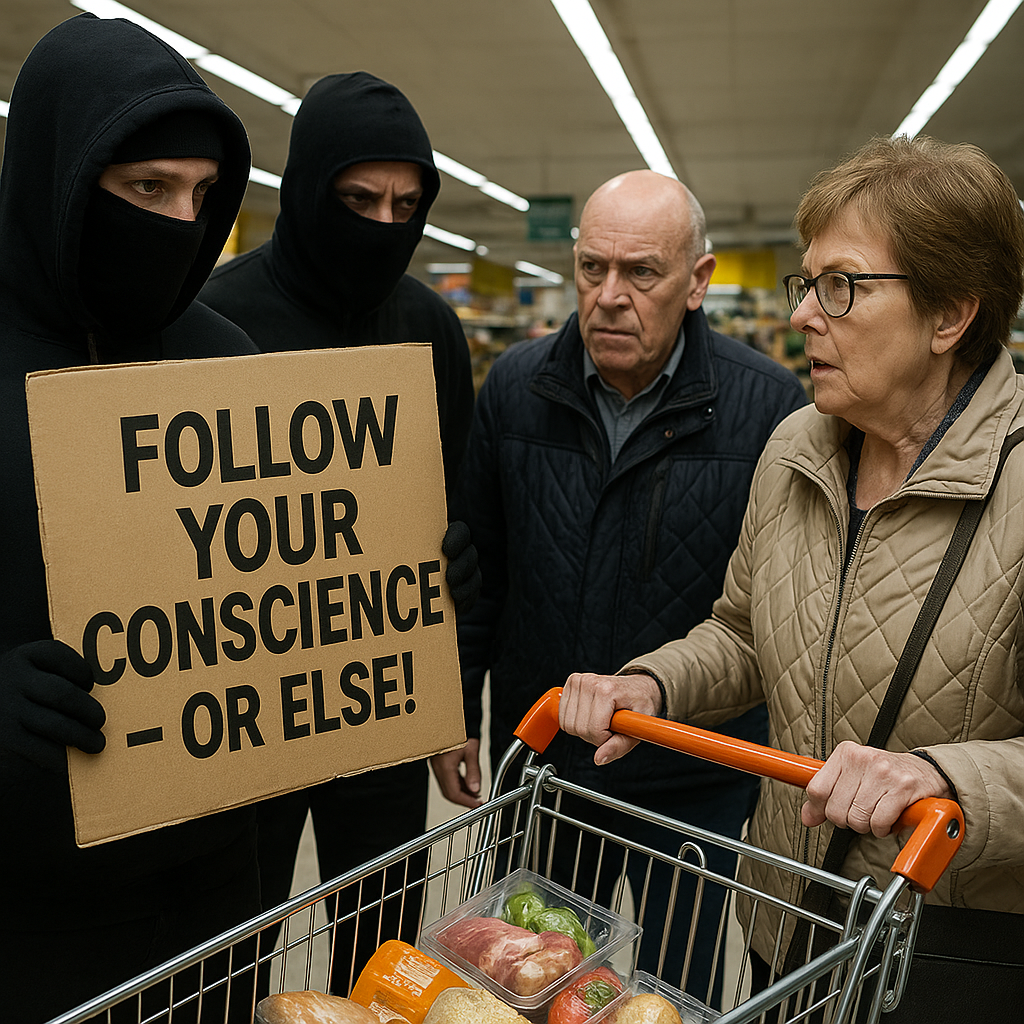
But that doesn’t mean all actions taken in the name of boycott are equally defensible. Masked activists storming shops and stripping shelves are not exercising conscience—they’re just behaving like thugs. Blocking customers from entering a shop, or shouting slogans in front of families doing their weekly shop, isn’t persuasion. It’s coercion, and it risks turning an act of conscience into an act of nuisance. Protest is a right, but public order is also important. If you trespass on private property or deliberately intimidate others, you should expect to be punished in accordance with the law. And if the law isn’t applied consistently, then that, too, is a problem—but not one that justifies disorder in its own right.
We must also be cautious of language. One of the most troubling aspects of this controversy is the way in which any criticism of Israel is reflexively labelled anti-Semitic. The Board of Deputies of British Jews has condemned the Co-op’s limited boycott, claiming it relied on “factually inaccurate and questionable claims.” The Campaign Against Antisemitism insists that boycotting Israeli goods is a form of “intimidation.” Even asking supermarkets to stop stocking hummus from Tel Aviv is apparently a threat to Jewish safety.
This is nonsense. Israel is not a synonym for Judaism, and the Israeli Government is not the Jewish people. The deliberate conflation of the two is itself a kind of extremism—a rhetorical trick used to silence criticism of state brutality by making it sound like racial hatred. But there is nothing anti-Semitic about objecting to ethnic cleansing. There is nothing bigoted in refusing to support a state that bombs hospitals and starves children. And British Jews who insist otherwise do themselves no credit. There is a plain difference between hating Jews and opposing the policies of Benjamin Netanyahu. One is uncharitable. The other is moral decency.
I write this as someone who has no ancestral connection to either side. My family is Chinese. We do not carry the burden of European colonialism, and we were not part of the great Jewish migrations. That gives me a kind of detachment. It allows me to look at the facts without inherited guilt or tribal loyalty. And what I see is that the British political class—both the old Right and the progressive Left—has failed to provide honest leadership on this issue.
The Government criminalises speech, censors debate, and tries to redefine extremism to mean “noticing reality”. But it leaves ordinary people to deal with the moral consequences of their shopping choices. If that is the game they want to play, then it is perfectly reasonable for those ordinary people to exercise what limited voice they have left by saying, “Not in my basket.”
But let that choice be made freely. Let it come from moral reasoning, not from intimidation. If enough people choose differently, the supermarkets will notice. And if they don’t, the public can find other places to shop. That is how pressure works in even a moderately free society.
There are two paths here. One is honest persuasion, personal discipline, and a growing withdrawal of consent from systems that fund mass murder. The other is mob activism, mask-wearing theatrics, and self-righteous coercion. The first is powerful. The second is tedious and often counterproductive.
If you really believe in the Palestinian cause, you should trust that truth and conscience are persuasive enough. You don’t need to shout at strangers in Sainsbury’s. You need to look in your own baskets and act accordingly.
Discover more from The Libertarian Alliance
Subscribe to get the latest posts sent to your email.

[…] Supermarket Protests and the Limits of Conscience: A Personal Reflection […]