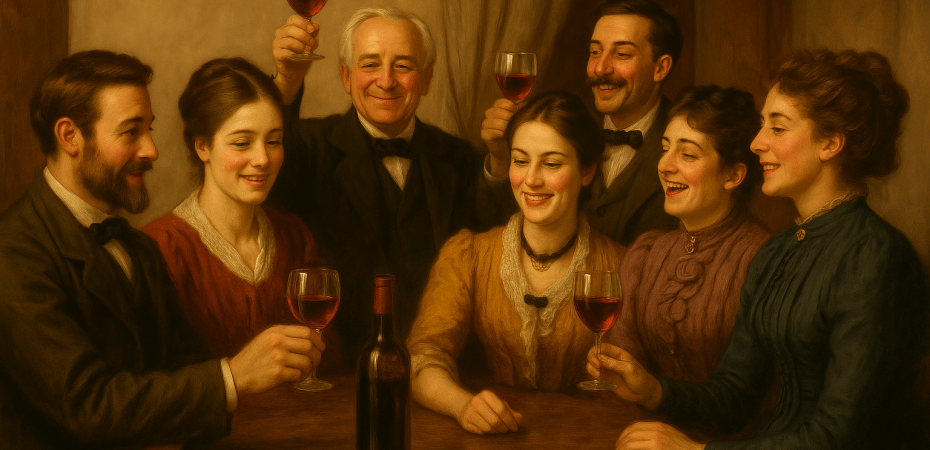
My friend Bryan Mercadente refuses to drink alcohol. He also refuses tea and coffee. It’s not for religious reasons—or not unless you widen the definition of religion to include self-worship—nor is he recovering from anything. He simply believes, with the zeal of an ascetic, that all these substances cloud the mind and sap the body’s perfection. Health and beauty, he claims, are incompatible with stimulants and toxins. On most days I admire his discipline. On others, I suspect he is missing out on three of the great blessings of civilisation.
To Bryan’s credit, the article published by Dr Mercola on 4 June 2025 offers some sobering evidence in support of his position. Drawing on recent studies—including a large-scale Japanese MRI dataset—the piece links even low levels of alcohol consumption to adverse changes in brain structure, specifically white matter lesions and microstructural degradation. It is a carefully written and strongly sourced piece. The claim that “no level of alcohol consumption is safe” is not made lightly; it is grounded in data, including a study from JAMA Network Open that analysed the brains of over 25,000 individuals. The findings were troubling: “The more you drink, the more you shrink,” summarises one of the lead authors. No sensationalism there—just a clear conclusion from empirical observation.
To be fair, I think Bryan would be right to read that and say: “See? Told you so.” But I cannot help but feel that the article, for all its scientific weight, risks tipping into something else entirely: a sort of puritanical absolutism dressed in epidemiological caution. What begins as a medical discussion ends in a sweeping moral judgement, one that borders on cultural pessimism. Let me explain.
Wine, beer, and spirits are not incidental to human society. They are among its oldest, most resilient features. From the libations of Homeric heroes to the Burgundy of mediaeval monks, fermented drink has accompanied rituals of love, loss, laughter, and learning. One might as well condemn the use of fire for causing burns. Of course alcohol has risks—but so does sunlight, so does childbirth, so does rowing a boat. We rank these risks in the context of what they enable: growth, joy, beauty, and depth.
The idea that the only safe level of alcohol consumption is zero might be true in a narrow, neurophysiological sense. But it cannot be the final word in cultural or moral reasoning. The same study that shows minor brain lesions in casual drinkers does not prove that they live shorter or unhappier lives. Nor does it show that moderate drinkers suffer a decline in memory or moral insight. Brains can be imperfect without being diseased.
The larger error—common among those who worship at the altar of “evidence-based living”—is to think that statistical correlation always implies normative consequence. A slightly smaller hippocampus may be a biological fact. It is not necessarily a tragedy. We do not live as disembodied neuroanatomical renderings. We live as men and women, who sometimes enjoy a glass of red while quoting Virgil. That is not decadence. That is civilisation.
Still, I do not want to dismiss Dr Mercola’s warnings. His reporting on the MRI data is clear and persuasive. The finding that women are disproportionately affected by alcohol-induced lesions is particularly concerning. So too is the cumulative impact of even small daily consumption—especially when combined with other neurological stressors such as poor sleep, statin use, or constant EMF exposure (topics Mercola often covers). There is a prudence here that deserves respect.
I also appreciate that he avoids the lazy assumption that only “alcoholics” are at risk. The myth of the harmless social drinker has been challenged by enough medical literature now to deserve serious scrutiny. If someone drinks every day, even a little, their risk profile likely rises—not just for dementia but for liver disease, cancer, and depression.
But to go from this to the conclusion that “any level of alcohol is toxic to the brain and should be entirely avoided” is a leap—not necessarily unjustified, but culturally disruptive. It removes the human from the picture and replaces him with a statistical ideal. A brain without lesions. A body without risks. A life without imperfection.
There is, I think, a conservative argument to be made here—not against alcohol, but against the modern obsession with its elimination. A society that rejects alcohol “for your health” is not a healthy society. It is a scared one. It sees only threats where tradition once saw sacraments. What matters is not that some wine might slightly shrink your brain. What matters is whether that wine was shared with family, savoured with roast lamb, or raised in a toast to enduring things.
The real threat to brain health is not a weekly pint—it is the nihilism that comes from empty social rituals, screen-addicted evenings, and hyper-processed foods consumed in isolation. A small brandy with a friend does not diminish the soul. TikTok might.
Dr Mercola deserves credit for presenting complex findings in accessible language, and for encouraging readers to think critically about substances long assumed to be safe. For those who drink routinely, even in moderation, the data is a prompt to reconsider.
But I do not think it justifies the abandonment of alcohol altogether. Health is not measured solely in MRI scans. It is also measured in cultural continuity, spiritual clarity, and the ability to share a beautiful moment without fear. If alcohol can be abused—as all good things can—it can also be redeemed. Used sparingly, in celebration or contemplation, it need not be a poison. It may still be a gift.
Discover more from The Libertarian Alliance
Subscribe to get the latest posts sent to your email.
Related posts:

Powered by YARPP.
[…] 7 July, 2025 […]