
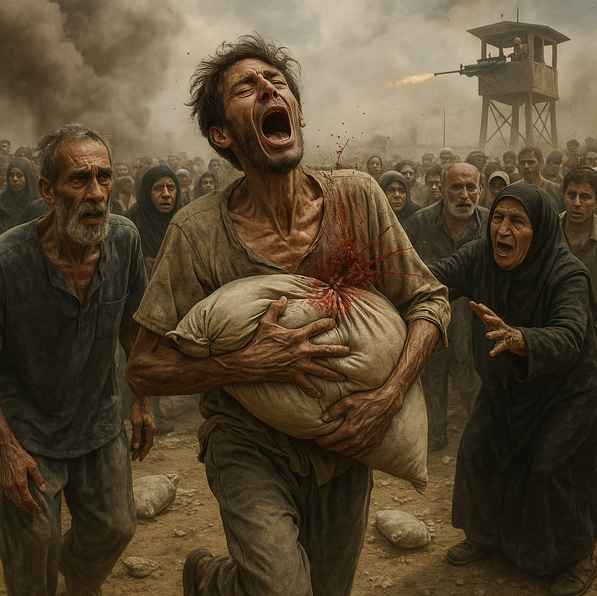
On the 27 June 2025, the Israeli newspaper Haaretz published a report that should have closed any remaining pretence that the war in Gaza is being conducted according to civilised standards. The article’s headline was unambiguous: ‘“It’s a Killing Field”: IDF Soldiers Ordered to Shoot Deliberately at Unarmed Gazans Waiting for Humanitarian Aid.’ The text that followed contained eyewitness testimony from serving Israeli soldiers describing the routine killing of civilians queuing for food. One reservist stated: “Where I was stationed, between one and five people were killed every day.” The tone was flat, almost procedural. The system, he made clear, was functioning as designed.
And what did the “newsmen” at the BBC do with this material? They airbrushed it beyond recognition. At best, they played stenographer to state power. At worst, they collaborated in a cover-up of what Haaretz itself plainly called a massacre. This isn’t a matter of bias. It is settled policy. the BBC knew exactly what was in the Haaretz report. Piers Morgan, Jeremy Vine, and dozens of major journalists discussed it. Social media exploded with excerpts. A conscientious editorial team could have quoted directly from serving Israeli soldiers. Instead, the BBC chose to reframe every aspect that made Israel’s conduct appear criminal.
This is not a failure of journalism. It is a success of policy. The BBC is not independent. It has never been independent. It exists to shape perception in line with the interests of the British ruling class. When Israel acts with genocidal intent—when it turns food distribution into a trap and live ammunition into a language—the BBC is not neutral. It is loyal. It is obedient.
It protects the British government from embarrassment. It protects Israel from scrutiny. And it does so with the money taken by threat of law from every British household.
But let me go to the facts. According to Haaretz, the Gaza Humanitarian Foundation (GHF)—an Israeli- and US-backed aid system—opened four food distribution sites in Gaza at the end of May. These are open for one hour per day. Civilians do not know in advance which site will open. If they arrive too early or too late, they risk death. A soldier quoted in the article explains the rules:
“They’re treated like a hostile force – no crowd-control measures, no tear gas – just live fire with everything imaginable: heavy machine guns, grenade launchers, mortars. Then, once the center opens, the shooting stops, and they know they can approach. Our form of communication is gunfire…. We open fire early in the morning if someone tries to get in line from a few hundred meters away, and sometimes we just charge at them from close range. But there’s no danger to the forces…. I’m not aware of a single instance of return fire. There’s no enemy, no weapons.”
No one in the article claims there was any return fire. “There’s no enemy, no weapons,” the same soldier says. Another reservist put it more bluntly: “The loss of human life means nothing. It’s not even an ‘unfortunate incident,’ like they used to say.”
A tank commander recalled being told to fire a shell at a group waiting near the coastline. Technically it was supposed to be a warning shot, but:
“Lately, firing shells has just become standard practice. Every time we fire, there are casualties and deaths, and when someone asks why a shell is necessary, there’s never a good answer. Sometimes, merely asking the question annoys the commanders.”
The total reported toll: 549 killed and over 4,000 injured since the system began.
By contrast, here is how the BBC reported the same events, nearly a week later. Under the cautious headline “Gaza aid contractor tells BBC he saw colleagues fire on hungry Palestinians”, Lucy Williamson introduces the key incident as follows:
A former security contractor for Gaza’s controversial new Israel- and US-backed aid distribution sites has told the BBC that he witnessed colleagues opening fire several times on hungry Palestinians who had posed no threat, including with machine guns…. On one occasion, he said, a guard had opened fire from a watchtower with a machine gun because a group of women, children and elderly people were moving too slowly away from the site.
Note the structure: the story is pinned on a single anonymous source, his claims qualified with layers of distance—“he said,” “witnessed colleagues,” “on one occasion.” The BBC then pivots instantly to ambiguity:
A Palestinian man dropped to the ground motionless. And then the other contractor who was standing there was like, ‘damn, I think you got one’. And then they laughed about it.
The next sentence leaves the incident unresolved:
GHF managers had brushed off his report as a coincidence, suggesting that the Palestinian man could have ‘tripped’ or been ‘tired and passed out’.
What the BBC offers here is not journalism. It is a refusal to investigate. Whereas Haaretz produced multiple named soldiers, several quotes from officers, and a clear pattern of fire orders from above, the BBC offers one ex-employee’s anecdote, surrounded by caveats and denial.
Two days earlier, the BBC had quoted Juliette Touma of UNRWA calling the GHF’s aid mechanism “a killing field.” But even then, the article left it to implication. It noted:
GHF’s aid system has been condemned by UN agencies. There have been repeated incidents of killings and injuries of Palestinians seeking aid.
Yet the article does not state who is doing the killing. Incredibly, it moves straight from UN criticism to a defence from GHF boss Johnnie Moore, who insisted that the deaths “are being attributed to close proximity to GHF” but that this “was not true.”
Compare that with this from Haaretz:
“Why have we reached a point where a teenager is willing to risk his life just to pull a sack of rice off a truck? And that’s who we’re firing artillery at?”
Or this:
They talk about using artillery on a junction full of civilians as if it’s normal… What concerns everyone is whether it’ll hurt our legitimacy to keep operating in Gaza. The moral aspect is practically nonexistent. No one stops to ask why dozens of civilians looking for food are being killed every day.”
These are not ambiguities. They are not “allegations.” They are accounts of deliberate killing, reported by the soldiers involved. The BBC had access to this information. It chose to report something else. It did not lie in the conventional sense. It lied by omission. It lied by making sure that the only version of the Haaretz report quoted by name said the following:
Unnamed Israel Defense Forces (IDF) soldiers said they were ordered to shoot at unarmed civilians near aid distribution sites to drive them away or disperse them.
That is from BBC journalist Helen Sullivan. It is not an accurate summary. In fact, it is barely related to what Haaretz published. She then follows the quote with this:
Israel’s Prime Minister Benjamin Netanyahu strongly rejected the report, calling the allegations ‘malicious falsehoods’.
As if the role of the BBC is to balance atrocity with a government press release.
This is not error. It is consistent editorial policy. When British soldiers were accused of war crimes in Iraq, the BBC used the word “allegations” 34 times in one day. When a police officer was cleared of wrongdoing after beating a handcuffed protester, the BBC called it “a difficult situation.” When an ally of Britain bombs hospitals, the BBC calls it “a contested claim.” When Russia does it, the word is “atrocity.” What happened here is simply the latest episode in a long-running campaign of deception.
Since the Haaretz report, the BBC has stopped covering the food aid shootings altogether. Its “Israel-Gaza War” page no longer features daily death counts. It is as though the killings have stopped. But B’Tselem reports otherwise: 130 killed in Gaza on 3 July, 104 killed on 4 July, 86 killed on 5 July, 120 killed on 6 July and 89 killed on 7 July. These numbers are not contested. They are not disputed by UN agencies. The BBC simply no longer reports them.
Gideon Levy, writing in Haaretz, concluded his article thus:
Gaza is not a parallel universe… What happens in Gaza defines Israel in the world, and what happens in Gaza will define Israeli society for many years to come.
What the BBC says about Gaza will define Britain too. When history judges this war, it will not only judge the IDF or the Israeli government. It will judge the institutions that enabled them. The British public deserves to know that their national broadcaster chose to act not as a voice of conscience, but as a mouthpiece for atrocity.
And the people who run the BBC—those who knew the truth, and chose not to publish—must never be allowed to pretend they did not know.
Discover more from The Libertarian Alliance
Subscribe to get the latest posts sent to your email.

It’s worth remembering there is a significant minority of American Jews who are appalled at what is happening in Gaza. Here is a clip of the actor Mandy Patinkin (who was in Homeland) getting emotional over what is happening in Gaza: https://www.youtube.com/watch?v=KVZYKPe0L64
[…] The BBC and the Gaza Massacres: Silence as State Policy […]