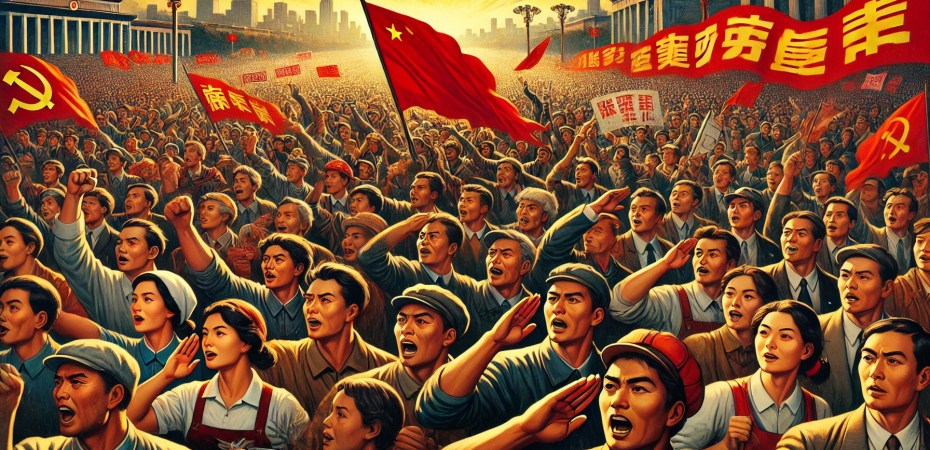
Tiananmen Square, 1989. Ask most people in the West what happened, and they’ll tell you a simple story: the Chinese government massacred thousands of peaceful students in the square, crushing a pro-democracy movement with tanks and bullets. It’s a powerful story, one that has been repeated for decades. But the truth is more complicated.
Now, Mr Bickley has asked me to write about what I see as the truth. But here are my problems. Because, I am Chinese, whatever I write about China will be seen variously as pro-China propaganda or as an exercise in ethnic self-hate. Add to this the following: this alleged massacre took place before I was born; it happened in a country I have visited rarely; it is discussed by Chinese people, if at all, in code—and in a language in which I do not think and which I can read only with much guessing. But Mr Bickley is insistent, so here is what I can say.
The protests were real. So was the government crackdown. People did die. But the idea of a “Tiananmen Square Massacre”—where thousands were gunned down in the square itself—isn’t supported by the evidence. Even reports from the U.S. embassy at the time confirm that no mass killing happened there. Most of the violence took place in other parts of Beijing, in clashes between the army and protesters—some of whom were armed and had already attacked soldiers. The Western media, either out of ignorance or with an agenda, took these events and reshaped them into a story of one-sided slaughter.
That doesn’t mean the Chinese government is innocent. The protests were a mix of students, workers, and others with different demands—some wanted more democracy, others were angry about corruption and economic problems. The government had a choice: it could have tried dialogue, but instead, it sent in the army. Even if no massacre happened in the square, people still died. The state still used overwhelming force to silence opposition. And then it made sure no one could talk about it.
Western Hypocrisy
The West treats Tiananmen as proof that China is uniquely evil. But look at what Western governments do when faced with their own unrest. In 1970, U.S. troops shot unarmed students at Kent State University. In 1993, the American government killed dozens of civilians, including children, at Waco. In 2019, French police violently crushed the Yellow Vests protests. In 2020, British police arrested people just for criticising lockdown rules online. We are still living with the oppression that followed the 2024 protests in the North of England. The difference is that the West pretends it stands for freedom, while China makes no such claims.
Western governments don’t care about human rights in China. They care about controlling the narrative. If they can paint China as a brutal dictatorship, it justifies their own policies of containment and aggression. It also distracts from their own problems.
China’s Police State: Different, not Better nor Worse
None of this means China’s government should be given any softness of treatment. It runs a police state. People can be arrested for criticising the government. The internet is censored. There are cameras everywhere. The government controls what people can say and do, and those who step out of line can disappear. It’s a system built on control.
But it’s not the same kind of police state as in the West. In China, the government suppresses threats to its own power, but mostly leaves people alone if they don’t challenge it. In the West, the system is less direct but just as restrictive—people are pressured to conform, not by the government, but by corporations and the media. Say the wrong thing, and you might lose your job, or your bank account. China censors speech by banning it outright.
Which system is worse? That depends on what you fear more—an open dictatorship, or a hidden one.
Conclusion
The story of Tiananmen is not simple. It wasn’t a massacre in the way people think, but it was still a violent crackdown. The Western narrative is shaped by propaganda, but so is China’s attempt to erase the event from history. Both sides manipulate the truth for their own reasons.
China is not the innocent victim of lies, nor is it the uniquely evil dictatorship the West makes it out to be. It is a powerful, authoritarian state that, like all governments, will do whatever it takes to stay in control. The real lesson of Tiananmen is not that China is uniquely bad, but that ruling classes—whether in Beijing, Washington, or London—will always protect themselves first.

Discover more from The Libertarian Alliance
Subscribe to get the latest posts sent to your email.
Related posts:
 The Illusion of War, the Reality of Debt: America’s Fiscal Collapse and the Implications for Britain
Powered by YARPP.
My reply here disappeared or was deleted. Maybe there is an explanation. Whether people died directly on the square is of course the least important part of the discussion. Maybe it is erected as a smoke screen. I think we should get out of “supervision” of other countries and acknowledge that sometimes when a country is in an extreme tussle for power, things will be fought to a conclusion. This is a fact. It is not an ideal state, but reality is not an ideal state either. The British embassy cables show that the students were lured off the square via supposed safe routes down side-roads leading off the square. That is where the killing took place in the main: the “safe routes” were routes where machine-gun nests were prepared to take out the students. The party elite had no interest in leaving the job of defeating the students undone. Maybe US and UK interests were involved in organising the protests in the first place. The role Britain plays in destabilising other countries is disreputable. The claimed “human rights” angle also leaves the West unable to respond properly to real political destabilisation, such as the BLM riots in the US in which people did die and property was destroyed–any serious country would have responded to that with real force.
You have not been censored. If you have said something in breach of our standards, I’d have told you privately. For the avoidance of doubt, your right to freedom of speech here is limited only by our need not to get into trouble with the powers that be.
It is important to point out that, while directly challenging the Party leadership will definitely get you arrested and imprisoned, China does not have a broad gamut of cultural causes on which it seeks compliance in all social settings. There is no pressure on Chinese people to support transgenderism, or immigration, or feminism, or the climate change narrative. On nearly all cultural issues, free speech in China is much broader than in the West. I put it this way: Chinese is a one-party dictatorship, but living in Chinese cities this fact has little impact on your life, as the limits of free speech are extremely broad, and so it is a dictatorship, but not so that you would actually notice it. The UK is a multi-party democracy, but once again, it’s not that you could actually notice democratic norms by living in British society, with a constant shrill background of political campaigns enforced in every workplace and indeed every private social setting too.