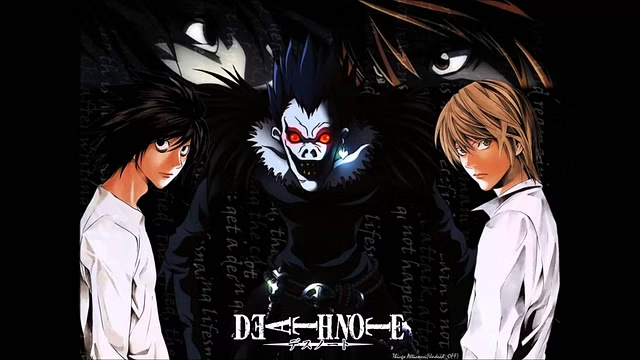
It was a birthday present. I was eight. I’d already seen the anime—rather, I’d binged the anime—when I was seven, and loved every minute. And by “every minute,” I include the bits where people are talking about justice and morality like they’re reading lines off the back of a cereal box. Even that didn’t spoil things, because the main idea is perfect. You write a name; you imagine its owner’s face; he dies. Clean. Precise. Effective. I was given a replica Deathnote notebook, bound in faux leather—ominous and wonderful. Of course, I didn’t believe it would work. But I still felt a twinge of disappointment when I wrote down the first name and no one dropped dead. Not even a nosebleed.
Still, I’ve been obsessed ever since. Manga, anime, live-action films, spin-offs, that unmentionable Netflix thing—they’re all on the list. And the more I rewatch, reread, and re-immerse, the more convinced I become that Deathnote is the most inventive and darkly comic cultural product Japan has given the world this century. It is a teenager’s philosophical sandbox—a place where questions of power, justice, and death play out with theatrical flair and zero moral clarity. Naturally, I loved it.
Let’s get the basics out of the way. The Deathnote is a supernatural notebook dropped by a bored Shinigami—death god—called Ryuk. Anyone whose name is written in it dies, provided the writer has seen his face. You can specify cause of death. You can orchestrate events. If not, it defaults to heart attack. There are pages of rules, many of which were clearly added so the writers could build increasingly convoluted traps. But the principle remains beautiful in its simplicity: Name. Face. Death.
Light Yagami, our adolescent anti-hero, finds the notebook and uses it to clean up the world. At first, it’s career criminals. Then it’s habitual offenders. Then it’s anyone who gets in his way. The public, predictably, loves it. Crime rates plummet. Talk show hosts hail the mysterious killer—dubbed “Kira”—as a divine agent of moral clarity. And then, of course, the police, the FBI, and a Sherlock Holmes knock-off with boundary issues decide that mass, anonymous execution is somehow a bad thing.
The Deathnote manga (2003–2006) came first: twelve volumes of tightly plotted moral cat-and-mouse, drawn with exquisite menace by Takeshi Obata. The anime (2006–2007) is a near-perfect adaptation—stylish, well-paced, and blessed with a voice cast that deserves sainthood. The first Japanese live-action films (2006) were surprisingly good—especially considering most anime-to-film adaptations are like turning opera into karaoke. The two-part Death Note (2006), plus L: Change the World (2008) as a spin-off, manage to retain the psychological duel at the story’s heart while adjusting the pacing for a general audience.
And then there’s the Netflix version (2017), an American bastardisation so embarrassing it ought to be listed on a register. Directed by Adam Wingard, it turns Light into a weepy emo kid and Ryuk into Willem Dafoe trying to pay off a tax bill. I’m not against adaptations. But this was an atrocity.
The Japanese TV drama (2015), oddly enough, isn’t bad. It reimagines the characters in softer tones—more digestible for a soap-opera crowd—but keeps enough of the original to be watchable. The 2016 sequel film (Death Note: Light Up the New World) is forgettable. The musical (yes, there’s a Deathnote musical) is insane and brilliant in equal measure.
Which version would I recommend? The anime. Always the anime. It’s operatic in tone, meticulous in structure, and, crucially, never tries to soften Light. It understands he’s a psychopath—but it also understands why he’s attractive.
Now to the philosophical bit. What makes Deathnote so satisfying isn’t just the plot—it’s the fantasy. The power to kill anyone, at will, from a distance, with zero risk. No blood. No mess. No questions. Just write the name.
Obviously, I’ve got a list. Half a volume already. Probably a second one by summer. Would using it make me a bad person? Yes. Would it make the world a better place? Also yes. Because the fundamental problem with power is not that it corrupts. That’s the nonsense you hear from people who mistake Lord Acton for a serious thinker—which includes all those boring old fart conservatives Dr Gabb used to know before they dumped him or died.
Power tends to corrupt, and absolute power corrupts absolutely.
— Lord Acton, Letter to Bishop Mandell Creighton, 1887
Except it doesn’t. What Acton gets wrong—aside from being a piss-poor writer admired mainly by people who want to drop names without reading—is the direction of causality. Power doesn’t corrupt. The corrupt seek power. The worst people are the ones most eager to rule, because ruling means getting away with it. The real corruption lies not in the exercise of power, but in its acquisition.
Now, the real rulers—the ones who matter—aren’t on TV. They aren’t even in Parliament. They’re invisible. They own things. They pull strings. They let the Blairs and Starmers and Johnsons of this world prance about like puppets on invisible strings. This isn’t to say the puppets have no agency. They don’t set the overall agenda, but they do get to decide who suffers, and when. And for moral garbage, the crumbs of power are as good as the main menu.
And if you think any of these puppets was once decent and went bad, you’re deluded. Blair was born a liar, Starmer a crawler, Johnson a stinking, blood-streaked fatberg. They didn’t fall. They were already crawling.
Which brings me back to the Deathnote. Would it be wrong to scrawl their names across a page and let them drop? Certainly. But it would also be funny. And cathartic. And useful. Power of any kind should come with a sharp edge. If we’re to be ruled, let us at least have the option of instant and terminal feedback.
What Deathnote gets right—brilliantly right—is that morality without power is theatre, and power without morality is government. Light thinks he’s a god. He isn’t. He’s just cleverer and more disciplined than the fools chasing him. But the point is, he could be a god, because the tools exist. He becomes divine by action, not by bloodline. That’s the libertarian appeal: not fairness, but possibility.
There’s something profoundly modern about Light’s crusade. He doesn’t work through institutions. He doesn’t pass laws. He doesn’t build coalitions. He kills people. One by one. He uses a notebook, not a party platform. It’s glorious. And terrifying.
Some will say it’s immoral to praise this sort of fantasy. But they miss the point. Deathnote doesn’t encourage mass murder. It asks what happens when the weak are suddenly strong, when a teenage boy with a god complex has the means to impose his will on the world. And it answers, honestly, that the world gets cleaned up—brutally, but efficiently—until the cleaner goes too far. It’s a warning, yes. But also a wish.
Anyone who hasn’t yet seen Deathnote is in for a treat. It’s clever. It’s stylish. It’s morally compromised in all the best ways. And it reminds us that the worst thing about having no Deathnote is being forced to live under people who deserve to be in one.
Discover more from The Libertarian Alliance
Subscribe to get the latest posts sent to your email.