
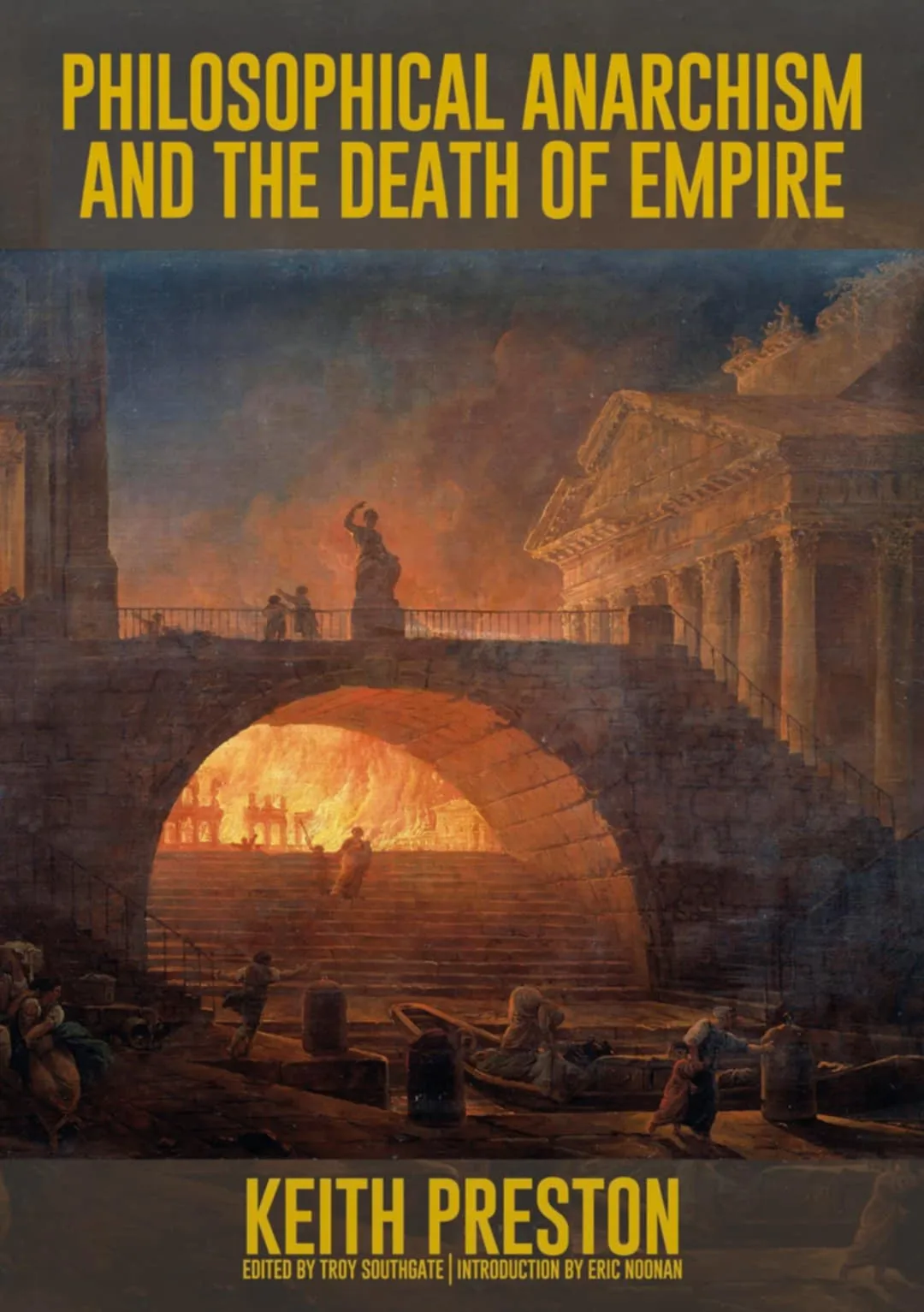
Keith Preston, Philosophical Anarchism and the Death of Empire, Black Front Press, 2025. Order from: blackfrontpress@yahoo.co.uk
To call Keith Preston’s Philosophical Anarchism and the Death of Empire a contribution to anarchist theory is accurate but insufficient. This is not another pamphlet of slogans or recycled condemnations of the state. It is something rarer: a serious attempt to unify divergent traditions—left and right, secular and religious, cosmopolitan and nationalist—under the shared conviction that the modern managerial state is both illegitimate and doomed.
Preston begins with what he calls the “philosophical anarchist” position: the rejection of the state not as a contingent evil, but as a permanent affront to voluntary association. “Philosophical anarchism,” he writes, “holds that the institution of the state is undesirable, unnecessary and should be eliminated in favor of voluntary association and cooperation among groups and individuals.” [p.35] There is no attempt to deny that people need structure or rules—only that those structures must arise from consent, not coercion. As he puts it later, “If anarchism is to be defined by the principle of voluntary association, then a system of radical individual autonomy is implied.” [p.36]
What makes Preston’s project unusual is that he does not try to smuggle in a single replacement ideology. His vision of anarchism is not a disguised version of socialism, libertarianism, or primitivism. It is a rejection of all attempts to impose a “uniform political system” on everyone alike. Instead, he insists that “individuals and groups [should be able] to form their own voluntary political systems organized according to their own needs.” [p.42]
That, he says, is the true meaning of decentralisation. Anarchism is not chaos. It is pluralism.
The Anti-Universalist Thread
Preston’s anarchism rests on a philosophical rejection of universalism, which he identifies as the central dogma of the modern Empire. That Empire, in his account, is not merely the United States or the European Union or the IMF. It is the synthesis of state and capital into a single, global “amalgam of Big Business and Big Government… consolidated on an international scale.” This system, he writes, “represents a centralization of wealth and power of so great a degree as to jeopardize the future of humanity.” [p.50]
It is here that his analysis becomes most relevant to present circumstances. Preston is not concerned with the Empire’s visible rulers—its ministers, its CEOs, its party functionaries—but with the system that makes their rule possible. He criticises not only its military interventions or economic frauds, but the moral structure that justifies them. “The sham of mass democracy,” he writes, “sets all sorts of varied sectional interests at the throats of one another… [so] they may be safely divided and conquered at the hands of rootless and predatory elites.” [p.44] In other words, opposition is permitted—so long as it is irrelevant.
To Preston, anarchism is the negation of this structure. It is not the imposition of a better system, but the refusal to play the Empire’s game. “As there is now really only one government,” he writes, “the system of international state capitalism… may well be the final stage in the historical evolution of the state.” [p.56] And so the only meaningful resistance is secession—not necessarily geographical or military, but cultural, psychological, and institutional.
A Pan-Anarchist Coalition?
Because the enemy is structural rather than ideological, Preston advocates for alliances across traditional lines. Here his writing becomes more difficult to summarise. Unlike many anarchists, he is not interested in purging the movement of undesirable allies. His anarchism is deliberately minimalist. What matters is the “common struggle against the New World Order global superstate and the regional/national elites who are its benefactors and beneficiaries.” [pp.102-3] Differences in economic theory, cultural preferences, or religious belief are, as he puts it, “peripheral issues.”
This leads him to some provocative conclusions. Preston does not shy away from defending the right of communities to govern themselves on whatever terms they choose—even if those terms would horrify mainstream liberals. He asks, pointedly: “Which is more authoritarian: a Nazi community on the top of a mountain whose members voluntarily choose their way of life or a massive, centralist, ‘democratic’ state that seeks to impose the narrow values of a self-serving elite on the whole of society?” [p.45] He does not endorse the former. But he does insist that voluntary evil is less dangerous than imposed good.
In his most expansive formulation, Preston imagines a world of radically autonomous communities: “There might well be communities of monarchists, fascists, communists, liberal capitalists, liberal multiculturalists, theocrats, black nationalists, white nationalists, ‘anarchists’ of every possible stripe, neo-Aztecs, UFO enthusiasts, or whatever.” [p.57] What matters is not agreement, but the refusal to coerce. Anarchism, he says, means “no hyphens.” It is not a programme. It is a boundary.
This vision will not appeal to everyone. But it is consistent—and it is deeply subversive of the present regime.
Tradition as a Source of Freedom
Though Preston’s arguments are framed in modern political terms, his roots are older. He draws freely on thinkers from across the spectrum: Bakunin, Rothbard, Russell, Stirner, and de Benoist. His footnotes range from medieval heresies to Confederate decentralists, from the Tao Te Ching to Nietzsche. But all serve the same thesis: that centralised power corrupts, and that the antidote is not reform but refusal.
Preston offers no nostalgia for the welfare state or the managerial class. His view of progressivism is cold and clear: “The global superstate represents the consolidation of conventional nation-states into an ever more powerful entity.” [p.56] And to fight it, one must first abandon the idea that any single tradition has all the answers. It is this spirit—not syncretism, but humility—that underpins his approach.
Where many conservatives see decentralisation as a retreat into tradition, Preston sees it as liberation from imposed moral consensus. Where progressives speak of diversity but enforce uniformity, Preston accepts real difference—even the kind that makes him uncomfortable. In this, he is more faithful to the principle of liberty than either camp.
Not Just Theory
Preston is not naive. He recognises that many self-proclaimed anarchists are caught in the orbit of the very Empire they claim to resist. He warns against “divisions [that] allow the opposition forces to be divided, conquered or coopted by the international ruling class.” And he devotes attention to strategy: from localist organising and dual power structures to media control and cultural insurgency. He understands that empires fall not only through collapse, but through being bypassed.
At times, his prose becomes almost prophetic. “The task of anarchists has become much more simplified,” he writes. “Globalism may well be the final stage in the historical evolution of the state.” [p.57] That phrase—“the final stage”—recalls the language of communists, but Preston’s tone is very different. There is no triumphant dialectic here. Only the warning of a man who sees what comes next, and urges us to prepare.
A Final Reflection
If Preston’s anarchism feels radical, it is because the times demand it. His book is not a theoretical exercise but a manual for post-liberal survival. He does not pretend that consensus is possible. He does not promise peace. What he offers instead is a path out of the managed order that now suffocates us—a path that begins with the refusal to be ruled.
In the end, his message is simple. “Anarchism allows for individuals and groups to form their own voluntary political systems organized according to their own needs.” [p.42] It is hard to think of a more dangerous sentence in the age of algorithmic governance and therapeutic surveillance. Or a more necessary one.
Those who still believe in the Empire will dismiss this book as fantasy. Those who understand what the Empire is will recognise it as prophecy.
Discover more from The Libertarian Alliance
Subscribe to get the latest posts sent to your email.
[…] 21 July, 2025 Sebastian Wang […]