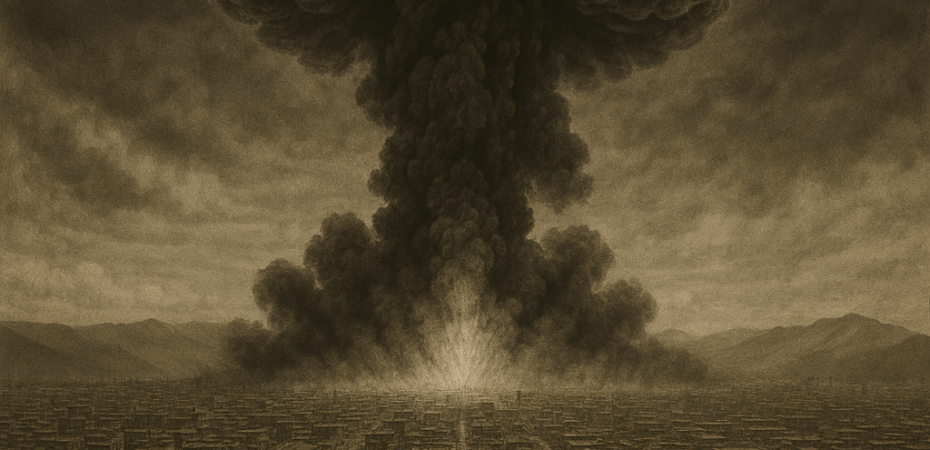
Today marks eighty years since the bomb fell on Hiroshima. At 8:15 AM on the 6th of August, 1945, a single American aircraft released a weapon of such destructive power that it vaporised human beings where they stood, etched their shadows into stone, and turned a city of 350,000 souls into a ruin of flame and ash. Three days later, Nagasaki suffered the same fate. By the end of that summer, over 200,000 Japanese civilians had died—many of them children, many more maimed or poisoned in ways that would claim their lives over the following decades.
I was brought up, as many people of Chinese heritage are, to distrust and resent the Japanese. I was told about the Rape of Nanjing, about the occupation of Hong Kong. The memory of brutality lives long in Chinese families. And yet, I write not to excuse the Japanese Empire, whose actions across Southeast Asia were themselves appalling. I write as a Catholic. And as a Catholic, I am obliged to speak the truth, not as it suits tribal memory, but as it is.
The truth is that the atomic bombings of Hiroshima and Nagasaki were atrocities. They were not strategic necessities. They were not morally defensible. They were crimes against God and against man.
Just War and Catholic Teaching
The Catholic tradition on war is rooted in the writings of St Augustine and developed further by St Thomas Aquinas, who identified three conditions for a war to be just: it must be waged by proper authority, for a just cause, and with right intention (Summa Theologiae II-II, q. 40, a.1). Yet beyond these conditions, Catholic theology imposes strict constraints on the conduct of war. One must discriminate between combatants and non-combatants, and one must use means proportionate to the ends pursued.
St Augustine warned that “the wise man wages just wars” only when compelled, not with joy or vengeance, and he reminded his readers that even just wars are a manifestation of the fallen condition of humanity (Contra Faustum, XXII.74). In the development of Catholic doctrine, Francisco de Vitoria in his Relectio de Indis (1539) stated unequivocally: “Innocents may not be directly killed, even as a means to an end.” And the Catechism of the Catholic Church today reaffirms this, stating: “One may never do evil so that good may result from it” (CCC 1789).
It follows, then, that any direct attack upon civilian populations is morally indefensible. What took place in Hiroshima and Nagasaki was not the accidental killing of civilians caught in the fog of battle. It was their deliberate incineration, planned and executed with full knowledge of the human toll.
Not Military Targets, but Cities
Hiroshima was not selected for its military value. It had a minor garrison, but its primary qualification was that it had been largely untouched by previous bombing. The same applied to Nagasaki. Both cities were chosen because they offered clean test environments to observe the effects of the atomic bomb. As General Leslie Groves, head of the Manhattan Project, later admitted, the goal was to ensure maximum psychological shock, not minimal military resistance (Rhodes, The Making of the Atomic Bomb, 1986).
The result was a horror beyond imagining. In Hiroshima, 80,000 people were killed instantly. Tens of thousands more died over the next year from burns, radiation sickness, and secondary infections. In Nagasaki, the death toll reached at least 70,000. And let us remember: these were not combatants. These were women buying fish, toddlers playing in alleyways, elderly men watering their gardens.
Even American planners knew the scale of the crime. The United States Strategic Bombing Survey concluded in 1946:
Based on a detailed investigation of all the facts, and supported by the testimony of the surviving Japanese leaders, it is the Survey’s opinion that… Japan would have surrendered even if the atomic bombs had not been dropped, even if Russia had not entered the war, and even if no invasion had been planned or contemplated. (USSBS, 1946, p. 26)
The Fiction of Necessity
The main justification offered—that the bombings prevented a land invasion and thereby saved lives—is a retrospective invention. Japan was seeking a way to surrender. Through diplomatic intermediaries in Sweden and the Vatican, Japanese officials made overtures as early as May 1945. The one condition they insisted upon was the preservation of the Emperor—a condition which the Americans eventually accepted after the bombings. The bomb, then, was not dropped to force surrender. It was dropped to demonstrate power.
President Truman’s own diary records his knowledge that the Japanese were approaching surrender. On 18 July 1945, after receiving a report of Japanese diplomatic communications, he wrote: “Stalin will be in the Jap war by Aug. 15. Fini Japs when that comes about. We will end the war a year sooner now, and think of the kids who won’t be killed.” (Truman Diary, July 18, 1945) Yet the bombs fell even earlier—on August 6 and August 9.
Even General Eisenhower, supreme commander of Allied forces in Europe, objected to the bombings. He later wrote:
Japan was already defeated and that dropping the bomb was completely unnecessary… I thought our country should avoid shocking world opinion by the use of a weapon whose employment was no longer mandatory. (Eisenhower, Mandate for Change, 1963, p. 312)
Nagasaki: The Second Sin
What happened at Nagasaki is even harder to explain. Why a second bomb, only three days later? Why target a city with a substantial Christian population? Why not give Japan time to assess the scale of the devastation at Hiroshima? The answer is chilling: the Americans did not want to appear indecisive. The plutonium bomb needed to be tested in live conditions. Nagasaki was destroyed as a demonstration.
The bomb exploded over the Urakami district, the heart of Japanese Catholicism. The cathedral, built by the descendants of Japan’s Kakure Kirishitan—”hidden Christians” who had survived centuries of persecution—was obliterated. Those who had gathered for morning Mass were vaporised. As Catholic historian Gary Bass wrote: “The destruction of Nagasaki Cathedral was not incidental. It was at the very centre of the blast.”
In a bitter irony, the Christian West obliterated one of the last surviving Christian centres in Japan. Not in the name of God, but in the name of power.
Mortal Sin and Moral Blindness
The bombings were mortal sins. This is not a rhetorical flourish. They meet every definition of intrinsic evil as laid out in Catholic moral theology: they were premeditated, indiscriminate, and targeted non-combatants. No appeal to consequences can excuse them.
As Pope St John Paul II said in Hiroshima in 1981:
To remember Hiroshima is to abhor nuclear war. To remember Hiroshima is to commit oneself to peace.
And the Second Vatican Council, in Gaudium et Spes, declared:
Any act of war aimed indiscriminately at the destruction of entire cities or vast areas with their inhabitants is a crime against God and man, which merits firm and unequivocal condemnation. (Gaudium et Spes, n. 80)
The Americans not only committed this crime. They celebrated it. Medals were struck. Cities rejoiced. Schoolchildren cheered. Eighty years later, many still do.
What the West Lost
The West likes to speak of moral authority. Of democracy. Of freedom. But in August 1945, it abandoned those claims. By reducing whole cities to radioactive rubble, the victors of World War II made clear that they were not bound by the restraints they demanded of others. As Augustine warned:
The earthly city will not cease to be a misery, or ever lack miseries. For as long as it loves its own strength more than justice, it will wage wars not for peace, but for domination. (City of God, XIX.12)
This is the truth that Hiroshima reveals. It is not the triumph of democracy. It is the revelation that the liberal order, when tested, was willing to kill on a scale unmatched in human history.
Forgiveness, but Not Amnesia
As a Catholic, I am bound to forgive. But forgiveness does not mean forgetting. It does not mean silence. It does not mean ignoring the facts, or sanctifying lies. The bombings of Hiroshima and Nagasaki were not unfortunate necessities. They were calculated massacres. The memory of those who died demands that we say so.
Today, we are told once again to prepare for war. Against Russia. Against China. Against Iran. And once again, we hear the language of necessity. The rhetoric of lesser evils. The logic of annihilation.
We must remember. And we must resist.
Bibliography
- Augustine, City of God, trans. Henry Bettenson. Penguin Classics, 2003.
- Augustine, Contra Faustum, Book XXII.
- Aquinas, Thomas. Summa Theologiae, II-II, q. 40.
- Catechism of the Catholic Church, 2nd ed. Libreria Editrice Vaticana, 1997.
- De Vitoria, Francisco. Relectio de Indis, 1539.
- Eisenhower, Dwight D. Mandate for Change: 1953–1956. Doubleday, 1963.
- Gaudium et Spes, Second Vatican Council, 1965.
- John Paul II, Address at Hiroshima Peace Memorial Park, February 25, 1981.
- Rhodes, Richard. The Making of the Atomic Bomb. Simon & Schuster, 1986.
- Truman, Harry S. Diary Entry, July 18, 1945. Harry S. Truman Presidential Library.
- United States Strategic Bombing Survey, 1946.

Discover more from The Libertarian Alliance
Subscribe to get the latest posts sent to your email.
The bombings of Hiroshima and Nagasaki are some of the worst war crimes in human history. One would think that after 80 years, we’d be looking back at them for what they are: a heinous case of mass murder for false utilitarian purposes.
Instead, the entirety of the population seems convinced that the bombs were necessary, or, in other words, that incinerating 140k civilians was a must to end a war that was already over. Far too many of the people who were killed were completely vanished from the world. Not only their bodies were turned to ash, but their homes completely erased alongside their belongings, their photos, their writings and everything else that spoke of their humanhood. The nuclear bombs weren’t just an act of indiscriminate murder; they were an act of complete erasure and dehumanization.
History does seem to be written by the victor, but that is not the problem; the problem is that the masses will believe the victor not for his reason or morality, but for his status.