Property and Freedom Society, Bodrum 2025
Alessandro Fusillo on “The Pirates of the Caribbean as Forebears
of the Libertarians and the American Revolution”
Reported by Sebastian Wang
Alessandro Fusillo, Italian lawyer and president of the Italian Libertarian Movement, opened his Bodrum lecture with a story from Augustine’s City of God. When Alexander the Great captured a pirate and demanded to know why he robbed the seas, the pirate replied: “Because I do it with a small ship, I am called a thief. Because you do it with a great fleet, you are called an emperor.” It is a story that has echoed through the centuries, a rebuke to the hypocrisy that condemns petty predation while exalting conquest on a larger scale.
From that starting point, Fusillo drew a line from the golden age of piracy in the seventeenth century to the American Revolution and beyond. The pirates, he argued, were not mere criminals. They were in some respects the first libertarians: men who built their own institutions, and declared war on all states as enemies of human liberty.
The seventeenth century is often described as the “golden age of piracy.” It was also the century in which the modern world was born. The Treaty of Westphalia (1648) ended the Thirty Years’ War and entrenched the state as the prime actor in international affairs. Europe had always known rulers and kingdoms, but Westphalia confirmed the idea of sovereignty in its modern sense: centralised authority, monopoly of force, and the capacity for total war.
The Thirty Years’ War itself was the first truly mass war in Europe, a conflict fought with conscripts and mercenaries on a scale not seen before, leaving parts of Germany depopulated. At the same time, the old patchwork of medieval liberties was crumbling. Local self-government, traditional rights to land, and the restraints on rulers were steadily swept aside in favour of centralisation.
England was no exception. Its revolution of the 1640s was the first of the four great revolutions that mark the modern world: English, American, French, and Russian. The English Revolution was a struggle for political and religious freedom. John Lilburne and the Levellers demanded rights that sound startlingly modern: freedom of speech, equality before the law, and accountable government. For a moment it seemed that these demands might reshape England. But by 1660 the revolution was crushed. The monarchy was restored, and with it the rise of a financial elite in London that would dominate politics thereafter.
The so-called Glorious Revolution of 1688 was not the triumph of liberty, as Whig historians like to say, but the consolidation of oligarchy. It gave England a central bank—the Bank of England—able to finance endless wars. Governments no longer needed to live within their means; they could borrow against the future, shackling the population with debt.
It also marked the beginning of enclosure on a vast scale. The commons, which for centuries had allowed villagers to graze animals, gather firewood, and support themselves outside the cash economy, were parcelled off by Acts of Parliament. Efficient agriculture was the excuse; the reality was expropriation. The dispossessed became a rural proletariat, driven into cities and factories, or pressed into the navy, or shipped as indentured labour to the colonies.
These were the sons of the men who had fought for liberty in the 1640s. When they crossed the Atlantic, they carried those ideas with them.
Conditions on naval ships and plantations were harsh. Sailors and indentured workers were kept obedient by force, often arbitrary and brutal. Yet the balance of power on ships was always unstable. A handful of officers commanded dozens or hundreds of men. Mutiny was a constant possibility, and when it occurred, the outcome was often piracy.
Between about 1650 and 1726, piracy flourished in the Caribbean and Atlantic. At times, Fusillo noted, pirates brought British trade almost to a standstill. The sight of the Jolly Roger was often enough to provoke mutiny among merchant crews. Sailors would depose their captains and join the pirates. Captains and officers were then tried by the pirates themselves. Those who had abused their men were hanged; those who had not were spared. Sailors who did not wish to join were usually released.
This picture differs from the official histories, which present pirates as indiscriminate butchers. Establishment writers relied heavily on court records and pamphlets produced by governments determined to terrify potential recruits. The reality, suggested by scattered evidence, was more complex. Pirates operated under their own codes, and those codes were often surprisingly libertarian.
Most pirate ships were governed by articles agreed upon by the crew. Captains were elected and could be deposed. Authority was limited. The quartermaster, a kind of tribune, represented the sailors and acted as a check on the captain’s power. Spoils were distributed according to agreed shares, with compensation for injury. Decisions of strategy were often taken collectively.
Some pirate bands even issued declarations of war against all the states of Europe, denouncing them as enemies of liberty. To modern ears this sounds theatrical, but it reveals a self-conscious ideology: a refusal to accept the legitimacy of kings and parliaments.
Pirates also displayed a rough sense of justice. They often targeted slave ships. Many crews were racially mixed, and freed slaves sometimes rose to positions of authority. It would be too much to say that piracy was an abolitionist movement, but the contrast with the official navies—which enforced slavery—was striking.
The British government responded with pardons for those who surrendered and with the gallows for those who did not. Pirates sometimes claimed they had been forced into the trade. Courts rarely believed them. Hundreds were hanged at Execution Dock in London and in colonial ports. By the 1730s, piracy as a serious threat had been crushed.
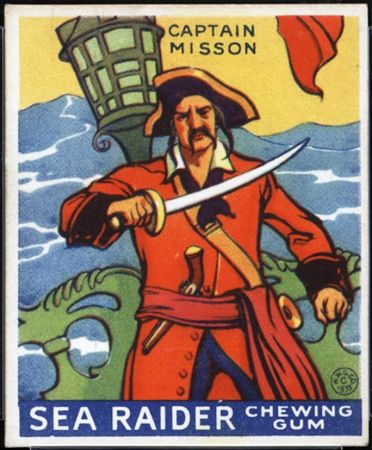
Yet the memory endured. Blackbeard, notorious for weaving slow-burning fuses into his beard to terrify enemies, became the archetype of pirate cruelty. But there were others, like the Frenchman Olivier Misson, whose story, preserved by Captain Charles Johnson (probably Daniel Defoe), presents a different image. Misson, once an aristocrat, rejected church and crown alike, hoisted a white flag as the emblem of liberty, and founded a community in Madagascar said to be governed by principles of equality and tolerance. Whether the details are embroidered or not, the story illustrates how piracy could be imagined as a radical alternative to state authority.
Fusillo ended by drawing the line forward. The men who turned pirate were often the descendants of those who had fought in England’s revolution. Their hostility to state power, their insistence on elected officers, their suspicion of arbitrary authority—all fed into the Atlantic world that eventually gave birth to the American Revolution.
By the eighteenth century, the English colonies in North America were filled with men whose fathers or grandfathers had known the loss of the commons, impressment into the navy, or transportation as indentured labour. They remembered the liberties their ancestors had fought for. When revolution came, it drew not only on Enlightenment philosophy but on a much older current of resistance to authority. The pirates of the Caribbean, for all their brutality, embodied something of that current.
It would be sentimental to pretend that pirates were saints. Many were violent, many killed without need, and few left anything lasting behind. Yet the caricature of the pirate as a mere criminal misses the point. They were products of an age when liberty was being extinguished by centralising states, debt-financed wars, and enclosure. On their ships and in their short-lived communities, they created alternative orders based on consent, election, and equality of shares.
Fusillo’s point was not that pirates were models to imitate. It was that they remind us of something vital: that the state is not the only source of law, and that resistance to empire can take forms dismissed as criminal by official histories. From Augustine’s pirate answering Alexander, to the American colonists defying George III, the line is clearer than we are encouraged to admit.
The pirates of the Caribbean were crushed, but their challenge to authority endures. In them we may see, if not libertarian perfection, at least the forebears of libertarian revolt.

Captain Misson, described by Johnson as founder of Libertalia – Wikipedia

Discover more from The Libertarian Alliance
Subscribe to get the latest posts sent to your email.
[…] 19 September, 2025 Sebastian Wang […]
Very appropriate for “Talk like a Pirate Day.”
[…] the Caribbean as Forebears of the Libertarians and of the American Revolution [Sebastian Wang, “Pirates, Liberty, and Revolution: Alessandro Fusillo in Bodrum,” Libertarian Alliance [UK] Blog (Sep. 19, […]
[…] Alessandro Fusillo: “The Pirates of the Caribbean as Forebears of the Libertarians and of the American Revolution” […]