Property and Freedom Society, Bodrum 2025
Sean Gabb on “Roman Slavery: A Very Peculiar Institution”
Reported by Sebastian Wang
It was an odd embarrassment to realise, as I reviewed my notes of the Property and Freedom Society in Bodrum, that I had neglected to report the first and in many ways most memorable lecture of the day. Dr Sean Gabb is my teacher of Greek and Latin, and has also become a guide to much beyond the languages. His lectures are never mere displays of erudition but arguments about how the past should be understood and what its lessons might be for the present. It was on his suggestion that I was invited to the PFS conference, and I confess I took the time off school with a vague sense that the main value would lie in the travel rather than in the ideas. In the event, I have found Turkey most appealing, and the quality of the discussions here has left me astonished. Yesterday I listened to Stefan Kinsella and Alessandro Fusillo and tried to do justice to what they said. That I overlooked Dr Gabb’s address at the start of the programme is something that needs correction, for it was in its own way the most uncomfortable and the most thought-provoking.
He began bluntly enough. For most who endured it, slavery in the Roman world was exactly as terrible as modern consensus has it. It is fashionable to suppose that older generations of historians minimised the sufferings of the slaves, and that our own age, in its righteous indignation, has finally seen clearly. The evidence is in fact as dark as one might imagine. The majority of Roman slaves worked in gangs on the latifundia or in the mines and quarries. Their lives were short. Most were dead before their thirties, simply worked to exhaustion and then replaced.
Household slavery could be no less appalling. He quoted Galen’s recollection that his father reproved friends who struck their slaves with their fists, not because striking them was wrong, but because a whip could achieve the same result without rupturing tendons in the heat of passion. He described the notorious Vedius Pollio, who kept in his villa a pond stocked with man-eating fish and was known to throw slaves into it for trifling offences. Augustus himself once had to intervene to prevent the execution of a boy who had broken a cup. Hostius Quadra, another figure mentioned, was remembered not for kindness but for perversions so obscene that even Augustus thought his eventual murder by his slaves not worth avenging. Seneca paints a grim picture of the slave markets, where women were stripped naked on the shore, their bodies handled like livestock before being sold to pimps. The remains of the Pompeian brothels confirm this degradation: airless cells with stone beds, dark and doorless, in which boys and girls were worked until they died.
Such stories can be multiplied endlessly. Abandoned slaves starved to death on the Tiber island until Claudius decreed that abandonment counted as manumission. Fugitive slaves, if caught, were branded, then fitted with iron collars engraved with their master’s names: “Hold me lest I flee, and return me to Viventius.” Gladiators, often trained slaves, were killed for sport, though some were too expensive to waste in every fight. Seneca records how one German fighter, given a moment’s privacy, jammed the sponge-stick of the latrine down his throat to choke himself rather than go out to the arena again. Against such conditions it is no surprise that there were revolts—Sicilian slaves under Eunus and Cleon in the second century BC, and of course Spartacus in 73 BC, who raised an army of ninety thousand and defeated four Roman armies before being crushed. Six thousand of his followers were crucified along the Appian Way, their bodies left to rot as a warning. Dr Gabb was in no doubt that for the mass of slaves life was miserable and often short.
Yet he argued that there was another side to the story, one that is usually neglected. This involved only a minority, perhaps a very small minority, but it complicates the picture. For the Romans, unusually among slave societies, freed their slaves in large numbers. Augustus had to legislate to limit testamentary manumissions to a hundred per household. The epigraphic evidence suggests that many household slaves, if they lived long enough, could expect eventual freedom. The reasons were not sentimental but practical. A man who owned hundreds of slaves could govern them by terror, but then he slept with a locked door and a sword beneath his pillow. Promise of manumission was a safer inducement to good behaviour. There were also economic reasons. Senators were legally and socially barred from direct commerce. They circumvented this by freeing capable slaves, setting them up in business as freedmen, and drawing on their profits.
This class of freedmen became indispensable to the imperial economy: managers, secretaries, financial procurators, even senior administrators. Narcissus, once a slave of Claudius, became his secretary of state. Felix, another freedman of Claudius, rose to be Procurator of Judaea and presided over the trial of St Paul.
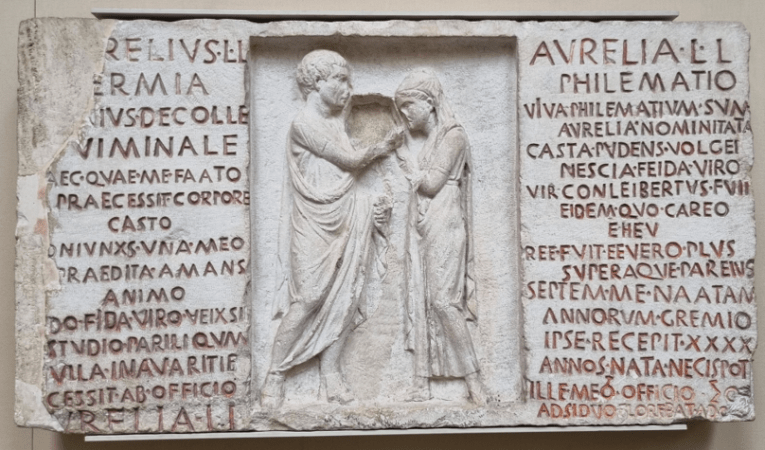
 Love also played its part. The gravestones in the British Museum tell their own story. Lucius Dasumius Callistus dedicated a relief to Dasumia Soteris, his freedwoman and wife, with whom he had lived for thirty-five years without complaint. The stone still bears his words of grief that she had died before him. Aurelius Hermia, a butcher of the Viminal Hill, commemorated his wife Aurelia Philematium, once a slave, describing her chastity, modesty, and fidelity. Lucius Antistius Sarculo, a priest of high birth, married Antistia Plutia, his freedwoman, and allowed their freedmen to dedicate their portraits in gratitude. These are not eccentric examples but common inscriptions. Marriages between masters and their freed slaves were routine enough to be mentioned casually. The epigraphic record suggests that such unions were woven into Roman social life.
A puzzle arises from this evidence. Many of the women freed and married were Greek. Their husbands were often Greek, and themselves former slaves. Yet in the first centuries of the Principate, Greece was at peace. Rome was no longer taking war captives there. Where, then, did these slaves come from?
The answer, Dr Gabb suggested, is that many were contractual slaves. Roman law allowed free persons to sell themselves into slavery. Ulpian noted: “A free person may choose servitude if he contracts for the price of his body.” Marcian wrote: “It is permitted by the law of nations for a free man to sell himself into slavery, since this is considered a contract freely made.” Cicero acknowledged that a man might prefer servitude to liberty with starvation.
The reasons were various. Ancient economies lacked credit markets. A poor man could not borrow for migration, education, or training. By selling himself he secured a lump sum and a master with an interest in his development. Some entered slavery as estate managers, actors’ stewards, or business agents—positions closed to the poor freeborn. The peculium, the allowance or savings slaves could sometimes accumulate, enabled many to buy their freedom later. Pliny observed: “I know many who, by selling themselves, became richer in slavery than they ever could in freedom.” For some, the slavery contract was a grim form of student loan or apprenticeship, a legal fiction to facilitate opportunity.
 From this emerged a further peculiarity. Before Caracalla’s decree of 212, Roman citizenship was restricted and highly prized. But a freed slave of a citizen became himself a citizen. Hence some provincials sold themselves into slavery only to be freed, thereby acquiring the coveted citizenship. Gaius explained the mancipatio, the formal sale by bronze and scales, as a mechanism applicable even to free men. Ulpian and Marcian treated the practice as dubious but real. By this fiction, Greeks, Syrians, and Egyptians could make themselves Romans. Keith Bradley and Peter Garnsey remark on the irony: by subjecting themselves to the legal fiction of slavery, provincials became citizens.
The case of Felix, already mentioned, may illustrate this. Once a slave of Claudius, he became Procurator of Judaea, married into the Herodian dynasty, and remained a figure of power. His brother Pallas was one of the most influential men in Rome. Their family retained prominence for generations. If Felix began as a contractual slave who rose by manumission, he was not unique. Such stories remind us that Roman slavery was not a closed caste system but a porous institution, cruel but sometimes capable of assimilation.
Dr Gabb insisted none of this should be read as an endorsement. Slavery, including contractual slavery, was degrading. It could be violent. For most it meant misery. But history is not served by one-sided judgments. To insist only on the horrors is to miss what was peculiar about Rome—that slavery could be a path to love, to wealth, even to citizenship. Some of his colleagues, he said, have admitted that once they thought about slavery they could no longer enjoy Virgil or admire Roman architecture. That, he argued, is a mistake. The truth is more varied, and it is stranger: Roman slavery was a horror, and yet a paradox, both a mechanism of oppression and a ladder of mobility. To confront that paradox is the only way to understand Rome as it was, rather than Rome as ideology wants it to be.

British Museum, 1867,0508.55. Inscribed stone funerary relief of Lucius Aurelius Hermia and his wife Aurelia Philematium, two freed slaves of Greek origin, portrayed as Roman citizens. Republican; c.80 BC. Sean Gabb photograph – plus the two others above
Discover more from The Libertarian Alliance
Subscribe to get the latest posts sent to your email.
Related posts:
 Stanislav Andreski’s Social Sciences as Sorcery: Enduring Errors and Academic Corruption – Thorsten Polleit, PFS Bodrum 2025
 David Dürr on Swiss Anarchism – Property and Freedom Society Bodrum 2025
 Stephan Kinsella on the Common Law: Lessons from Bodrum 2025
 Saifedean Ammous on Property Rights and the Palestinian–Israeli Conflict – PFS Bodrum 2025
 Pirates, Liberty, and Revolution: Alessandro Fusillo in Bodrum
 Guido Hülsmann on Universities and the State – PFS Bodrum 2025
 Jeff Deist on Post-Persuasion America – PFS Bodrum 2025
 Hans-Hermann Hoppe on Democratic Peace and Re-Education – PFS Bodrum 2025
 Tom DiLorenzo on “Virtuous” War Crimes – The American and Israeli Traditions (PFS Bodrum 2025)
Powered by YARPP.
[…] Gabb (England): Roman Law and Contractual Slavery [Sebastian Wang, “Roman Slavery: Horror and Paradox – Sean Gabb in Bodrum,” Libertarian Alliance [UK] Blog (Sep. 20, […]
[…] Sean Gabb: “Roman Law and Contractual Slavery” […]