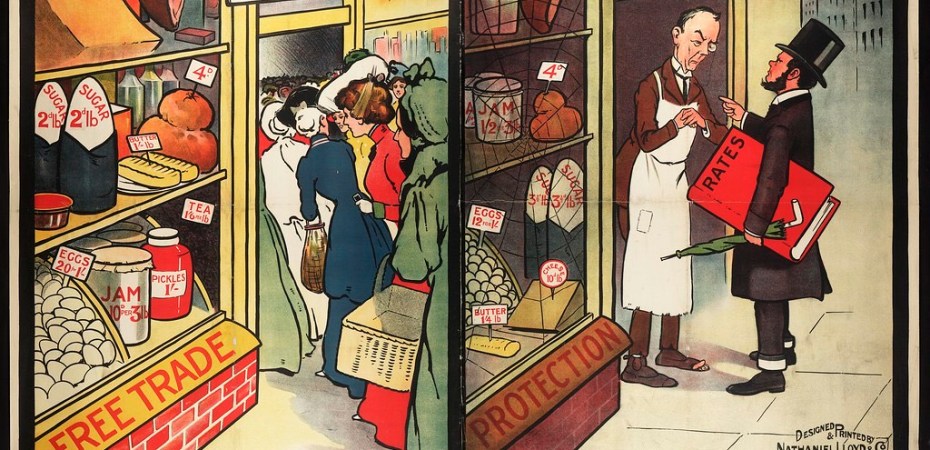
Bryan is right about one thing that most people miss. Economics proceeds by conditional logic. If p then q. If tariffs fall, prices fall. If prices fall, real incomes rise. Provided the premises match the world, the conclusion is not speculation. It is baked in. Where Bryan and I part company is at the next step. He treats the certainty of q as a warning to avoid p because the world is messy and ruled by interests. I treat the certainty of q as a reason to bank the gains of p while we clean up the mess domestically, where the mess is actually made.
Britain does not need tariffs to tame oligarchs, defend workers, or rebuild competence. It needs sober domestic reform: tax, planning, energy, finance. Keep trade open. Fix the rot at home. That is the least romantic programme on offer, and it is the only one that works.
Comparative advantage is not a mood. It is a constraint. Even when countries cheat, even when models omit grit, the general result of lower barriers is higher total output and faster diffusion of know-how. The dynamic gains matter most for a small, service-heavy, idea-rich country that imports almost everything physical it uses. This is Britain. Our prosperity depends on scale, variety, and competition that no internal market can supply.
I know the adjustment costs are real. A theorem does not move a redundant toolmaker into a lab. But the right conclusion is not to make imports dear for everyone. The right conclusion is to make adjustment cheap—by attacking the domestic obstacles that freeze people in place and keep investment away from the places that need it.
Tariffs are a tax on consumption. They fall hardest on the poor. They invite retaliation. They protect lobbies with better press offices than products. They congeal the economy around yesterday’s strengths. If our complaint is political capture, tariffs make that worse.
Bryan’s anger is aimed at the “monied interest.” Mine is aimed at the British state that built a playground for it. The broken incentives are ours:
- Planning that delays every productive project for years and inflates land values beyond reason.
- Energy policy that treats reliability as a vice and price as a sermon.
- A tax code that punishes payrolls and new capital while favouring financial churn.
- A finance regime that underprices property and overprices risk in the real economy, then pretends this is “prudence.”
None of this is fixed by raising a tariff. All of it is fixed by Parliament.
Replace business rates with a simple land value charge so upgrading a factory is not punished. Scrap employer National Insurance on the first slice of wages and make full expensing permanent. Fast-track energy projects that lower industrial power costs: nuclear, grid reinforcement, storage, and the boring engineering that turns plans into electricity. Set statutory time limits on planning decisions with appeal caps. Expand competition in banking and pensions so long-term domestic capital can flow to plants, not only to buy-backs and property. These are dull measures. They move mountains.
You can keep borders open and still reverse deindustrialisation if you attack these bottlenecks. If you leave the bottlenecks, you can raise every tariff in the book and still get stagnation. Most of the harm people blame on “free trade” is the price of British policy failure plus British snobbery toward making things.
Bryan worries about war, blockade, pandemics, and leverage by hostile powers. Good. So do I. The answer is resilience by design, not protection by reflex.
- Stockpile what can be stored: medical precursors, rare gases, critical spares.
- Contract for surge capacity at home and with allies, using standing purchase agreements and penalties for non-delivery.
- Target a short list of strategic capabilities for domestic support—ordnance, certain chemicals, secure compute. Tie any support to performance, not slogans.
- Harden infrastructure: ports, grids, data centres. This is defence policy, not tariff policy.
None of that requires a general tax on imports. It requires procurement that rewards uptime, regulation that values redundancy, and a Treasury that can recognise a balance sheet beyond a one-year horizon.
People do not move like fluid in a frictionless model. Towns decay when the skill ladder snaps and housing locks in failure. Keep trade open, and then make movement and upskilling possible:
- Build homes where the jobs are by sweeping away density bans and height fetishes that trap the young and price out families.
- Portable training accounts that follow the worker, topped up when a sector shrinks, spent only on accredited technical routes.
- Relocation support for workers who take a job two postcodes away from home, coupled with clawbacks if they game it.
- A simpler safety net that tapers cleanly with work, so taking a risk is not punished by a sudden loss of support.
If we want a proud, skilled working class again, give it a country that lets skills compound and a housing market that lets people chase opportunity. Tariffs do not build that. Permission and predictability do.
“But what about cheating?” Good question, and with two answers. First, most of what is called “cheating” is our decision to tolerate domestic self-harm: high energy, anti-building planning, and an education system hostile to applied excellence. Second, when there is cheating—forced labour, export bans, state subsidies that create real security risks—deal with it with narrow tools: targeted duties tied to evidence, import bans on goods made with coercion, rules of origin enforced with teeth, and alliance-based supply chains for a few sensitive inputs. Narrow beats blanket.
The test is simple. If the problem is moral or strategic, use a precise instrument. If the problem is that our firms face headwinds at home, remove the headwinds. Don’t raise prices for everyone and call it patriotism.
The Corn Laws did more than reward landowners. They taxed bread. Peel’s repeal shifted power, yes, but it also made food cheaper for the poor. The gain was not a trick. Later, the United States and Germany used tariffs to grow. They also used vast internal markets, abundant resources, political union, and brutal state action that would be neither available nor acceptable here. We are a medium-sized, import-dependent archipelago with world-class services, a deep research base, and a chronic habit of throttling both with our own rules. Copying nineteenth-century tariff books while keeping twenty-first-century planning and energy policy is not strategy. It is cosplay.
Bryan is right that rent-seekers capture policy. That is an argument for policies that are harder to capture and easier to police:
- Broad, neutral tax bases with low rates and very few carve-outs.
- Regulatory budgets that force departments to retire obsolete rules before adding new ones.
- Transparent procurement with open data on contract performance and lifetime costs.
- Lobbying disclosure with cooling-off periods that actually bite.
Every one of these tools works better in a free-trading system because protectionism multiplies points of capture. The more product lines you can wall off, the more rent windows you open. It is not an accident that the dirtiest politics clusters around the thickest tariff schedules.
We are very good at certain things: finance that prices risk when rules do not blunt it; legal and professional services that the world trusts; higher education and research—if it ever stops pretending that engineering is vulgar; creative industries; specialised manufacturing where design, standards, and integration matter more than commodity scale. None of this thrives behind a tariff wall. All of it thrives in a country that is cheap to build in, quick to permit, and affordable to live in.
Keep trade open and slash the domestic costs that now smother enterprise. That combination is how you raise real wages without inventing a new theology.
Here is a boring, brutal package that would raise British productivity and make free trade work for everyone rather than only for retail chains and funds:
- Replace business rates with a land value charge; abolish stamp duty on commercial property; make full expensing permanent across structures and equipment.
- Cut employer NICs on the first £20,000 of wages per worker; remove cliff edges in Universal Credit so extra hours always pay.
- Impose statutory shot-clocks on planning decisions; allow by-right building on brownfield; legal presumption for height in transport nodes.
- Publish a 15-year energy build plan with contracts that survive elections; bring industrial power prices down by treating firm supply as a national objective.
- Create portable, funded training accounts; tie corporate immigration sponsorship to genuine skill transfer rather than paper compliance.
- Identify five strategic capabilities for on-shore assurance and fund them with competitive contracts and exit tests. Not fifty. Five.
- Hard-ban procurement from firms using forced labour; enforce rules of origin; penalise evasion.
- Replace spaghetti subsidies with a single, simple R&D and capital credit; sunset it if TFP does not move.
None of this requires a general tariff. All of it constrains the “monied interest” far more than a performative border tax that they will evade and you will pay.
Power matters. Interests write rules. But policy is still a choice. We can choose to protect consumers and punish cronies by simplifying taxes and law, or we can choose to punish consumers and reward cronies by handing them a tariff lever. We can choose strategic resilience by building and stockpiling, or we can choose strategic theatre by posturing at the docks while the grid fails and the foundry sits in planning purgatory.
Free trade is not a love letter to oligarchs. It is a pressure system that punishes slackers and rewards excellence when the domestic rules let excellence breathe. Keep that pressure. Fix the rules. That is the grown-up route to a richer, stronger, more sovereign Britain.

Discover more from The Libertarian Alliance
Subscribe to get the latest posts sent to your email.
Related posts:


Powered by YARPP.