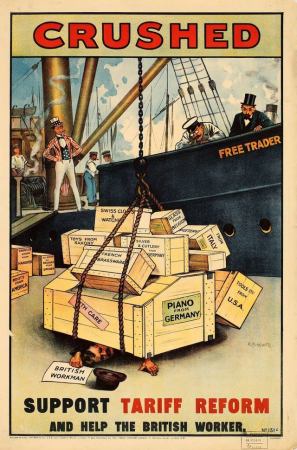
Economics is not a religion. It is a machine for drawing conclusions. You begin with a premise—call it p—and, by a chain of reasoning, you end with q. If the premise is sound and the steps don’t slip, then q follows with the same certainty as a properly proved theorem. If Britain removes tariffs under conditions C, then prices fall; if prices fall, then real incomes rise; if real incomes rise, then consumers enjoy a larger choice set. All of this is fine. It clarifies what happens if we do p. But the world is not a seminar. The world is a battlefield of power and second-best choices. States do not choose between p and not-p on a clean whiteboard. They often choose between two bad options, or they choose p, fully aware that q will follow, and then decide that q is a tolerable cost given the rest of the situation.
That is the frame missing from most discussions of free trade. The abstract case is unbeatable. Ricardo’s comparative advantage is the best thing any economist ever wrote who was not called von Mises. If England makes cloth more efficiently than wine, and Portugal makes wine more efficiently than cloth, both gain by specialising and trading. Restate it with cars and microchips, or legal services and semiconductors, and the logic still holds. The model is clean. The conclusions are certain. If p then q.
The trouble is not with the model. The trouble is with the world in which the model is applied. In the real world, premises come bundled with awkward facts—strategic rivalry, institutional decay, class interest, and technological dependency. We can know full well that q follows from p, and still say: we want p and will tolerate q because the alternative is worse. Policy is the selection of sub-optimal outcomes under constraint. Only an undergraduate imagines that a theorem abolishes trade-offs.
Let us grant the usual benefits of free trade. Lower prices. Greater variety. Specialisation and innovation. Pressure on domestic cartels. All true. But we should also grant the usual omissions. Average gains conceal distributional losses. Regions and classes are not algebra. The steelworks that closes in Sheffield does not teleport its workforce to a Korean shipyard with perfect retraining on the flight. Labour is not frictionless. Communities are not interchangeable. When the model says, “Resources will redeploy to higher-value uses,” it describes a long-run tendency, not a short-run certainty, and certainly not a humane transition plan. If the redeployment is blocked by planning law, tax disincentives, cartelised finance, broken education, and deliberate political sabotage, then the welfare losses are not a rounding error. They become the country.
This is where the nineteenth-century story matters. The Anti-Corn Law League did not crusade for free trade because it had read Ricardo with tears in its eyes. Manchester wanted cheaper bread to keep wages down. That is not a crime; it is an interest. Peel’s repeal of the Corn Laws delivered real consumer benefits and also a redistribution of power—away from land and towards money. Britain’s later glory was not costless, and it was not governed by pure theory. It was a political project in which economic arguments were the best available weapons.
Fast-forward half a century. Britain kept the free trade totem long after its rivals had protected their infant industries to adulthood. The United States, Germany, and Japan built depth behind tariff walls, then marched out to compete. We congratulated ourselves on “openness” even as the base of our prosperity was hollowed. Later still, the post-1970s settlement made a final choice: the City first; industry second, the slow suffocation of heavy manufacturing by planning, environmental vetoes, and a tax code designed by people who had never held a spanner. The result matched a trade model: we specialised in finance and business services; labour-intensive manufacture fled. The model predicted average gains. The street saw boarded-up high streets, broken skill paths, and a class taught to despise itself.
Does this refute free trade? No. It refutes the idiotic claim that a correct if p then q proposition determines policy for all time. If the choice is between marginally cheaper imports and strategic dependency on regimes that despise you, the decision is not technical. It is political. If the choice is between lower consumer prices today and the ability to arm, train, feed, and medicate your population in a crisis, you may reasonably choose to pay a premium for home capacity. You do not deny that q follows from p. You say that, given the rest of the world, q is acceptable, or not, relative to other qs.
This is heresy to the monied interest that governs Britain. They pretend to love free trade because it is the ideology most friendly to the movement of capital without responsibility, to open borders for goods, money, and—handiest of all—labour. A labour force made constantly replaceable is a labour force that cannot bargain. The old working class—rooted and skilled, and stubbornly proud—was a nuisance. The new service class—atomised and precarious—does not strike. It “re-skills” and writes LinkedIn updates.
In such an order, it is useful to reduce economics to moralising: “A tariff is a sin.” No. A tariff is a tool. Like a tax allowance or an infrastructure grant, it can be used badly or well. The serious question is not “Is it pure?” but “Does it serve a legitimate end at an acceptable cost?” If you need to rebuild a domestic industry that is strategically vital, a temporary tariff can be a shield while you fix the real bottlenecks: planning, energy, capital costs, skills. Comparative advantage is not a natural law. It is a function of institutions and technology, which governments can ruin and, sometimes, can improve.
I am not arguing for a siege economy. I am arguing for adult statecraft. Adult statecraft reads the model, notes that if p then q, and then asks three further questions:
- Are we sure our p is the same p assumed in the model, or have we imported hidden premises—distorted energy prices, manipulated currencies, slave labour, military subsidies to shipping lanes—that make “free trade” a misdescription?
- If q includes deindustrialisation, skills atrophy, and strategic dependence, is there a package of policies in which we keep most of the gains of p while fencing off the most dangerous parts of q?
- Who bears the cost during transition, and will we still have a country worth living in at the end?
You can answer those questions in different ways depending on circumstances. During a lull in great-power rivalry, with stable finance and cheap energy, you may choose p with few reservations and trust the model’s long-run clean-up. In a world of weaponised supply chains and political blackmail, you may choose a messier p, fully aware that q will raise prices, and decide that the insurance premium is worth paying. The sin is not to prefer one to the other. The sin is to pretend the choice does not exist.
Much of our current “free trade” is nothing of the sort. It is global mercantilism underwritten by American power and green-tinted bureaucracy. Call it what it is: a cartel of states and corporations designing rules that channel profit to those who already own the pipes. Within that system, exhortations to purity are stagecraft. The same ministers who denounce tariffs sign treaties that hand regulatory power to transnational committees. The same columnists who praise “openness” cheer for policies that lock out domestic entrants with compliance costs only multinationals can absorb. Free trade as a slogan is waved to keep the rest of us obedient while the real deals are done elsewhere.
What would an honest trade policy look like? It would begin by reinstating the real meaning of the economics. We keep the logic. We respect “if p then q.” We also say openly: we are not choosing in a vacuum. So:
- We reserve the right to use tariffs sometimes—not as alms for dying industries, but as temporary umbrellas while we repair the weather.
- We rip out the throttles on domestic investment: planning that takes years, energy policy that treats electrons as a moral contaminant, and capital rules that prefer buy-backs to foundries.
- We refuse treaties that outsource sovereignty to arbiters we do not elect.
- We align trade with border policy. If your trade model requires permanent labour inflows that collapse wages and cohesion, the model must be adjusted, not the nation.
None of this denies the theorem. It says that policy must weigh the costs and benefits of q against rival qs.
The free traders, in their purist mood, reply that any deviation invites “rent-seeking.” True. It does. But so does their preferred system. Ask yourself who captured the gains of the past half-century of liberalisation. Was it the towns that lost their mills, or the funds that arbitraged the closures? If your argument against any active choice is that it might be captured by interests, you have conceded the field to the interests already in charge. You have accepted a permanent veto on any attempt to tilt the playing field back towards production.
A final point on tone. It is not “protectionist” to insist that a country retain the capacity to feed itself, arm itself, and treat itself in a crisis. It is not “Luddite” to say that a nation of shopfronts and spreadsheets is not a serious nation. It is not “populist” to notice that when power leaves the factory floor and gathers in a handful of glass boxes in London, politics becomes pageantry. The people are permitted to vote. The decisions remain elsewhere.
So where does this leave the slogan “Free Trade Good, Tariffs Bad”? It leaves it in the classroom, where it belongs, next to “If p then q.” There is no contradiction in saying: we understand the model; we accept its conclusions; we also choose a policy mix that deviates from the frictionless optimum because we are not fools. We might prefer a slightly poorer country that can still deter an enemy and source insulin domestically over a slightly richer country that cannot. We might accept higher prices for steel to ensure we still have steelworkers. We might tolerate q because we want p, or we might reject p because the particular q on offer implies national impotence. This is not an attack on economics. It is economics used properly: as a guide to consequences, not a substitute for judgment.
I will end where I began. Economics provides conditional truths. If we do p, then q. It does not tell us which p to choose when the world is already on fire. That choice belongs to politics, which is to say to human beings with memories, loyalties, and obligations. The monied class hates this, because it admits that their favourite ideology is a tool, not a commandment. Good. Let them hate it. I would rather live in a country that produces things and men than one that outsources both and calls it efficiency.
Discover more from The Libertarian Alliance
Subscribe to get the latest posts sent to your email.
[…] Bryan is right about one thing that most people miss. Economics proceeds by conditional logic. If p then q. If tariffs fall, prices fall. If prices fall, real incomes rise. Provided the premises match the world, the conclusion is not speculation. It is baked in. Where Bryan and I part company is at the next step. He treats the certainty of q as a warning to avoid p because the world is messy and ruled by interests. I treat the certainty of q as a reason to bank the gains of p while we clean up the mess domestically, where the mess is actually made. […]
[…] his long response, Duncan Whitmore has paid me the compliment of taking my work seriously. I will return the favour. This response is friendly. Where he and I agree, I will say so. Where we […]
[…] The same author has recently published a further essay on this topic, which is reasoned a little better and may ameliorate some of my critique below. Nevertheless, as […]
[…] Bryan Mercadente Title: Free Trade and Protection: When “If p, then q” Meets Power URL: https://libertarianism.uk/2025/09/27/free-trade-and-protection-when-if-p-then-q-meets-power/ Summary: Mercadente expands his case by arguing that formal economic logic breaks down when […]