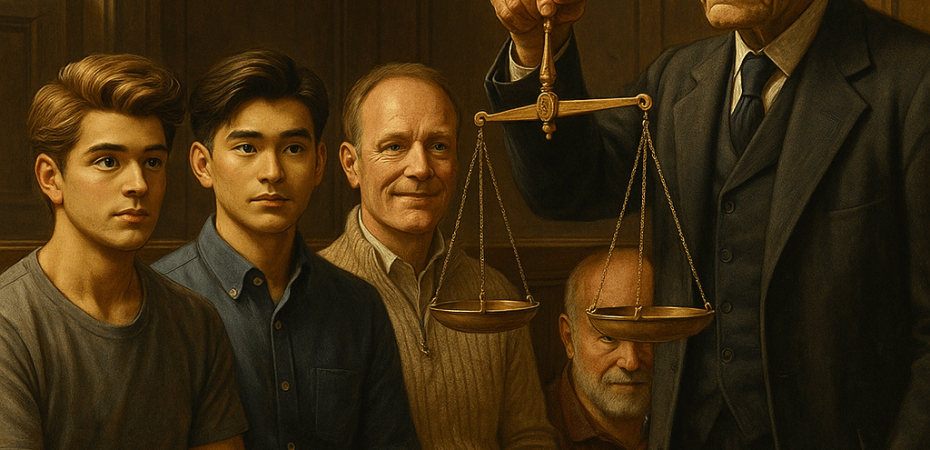
Mr Bickley has asked me to examine and comment on the genteel firestorm that began with a debate between Duncan Whitmore and Bryan Mercadente, but now involves Neil Lock, Sebastian Wang and Stephan Kinsella. “We normally criticise outsiders, Reggie,” he said yesterday over the telephone. “It shows reviving life in the Movement when we start on each other.”
I agree with him. However, I did not at first think it would take so long to go through all the points of the debate. In form, it is about supply-chains and whether “free trade” still deserves its old prestige. In substance, it is an argument about what libertarianism is: a doctrine of inviolable rights and voluntary exchange, or a strategic programme for recovering a freer civilisation under hostile conditions. Before starting work, I took a double dose of castor oil. It was only 40,000 words later, plus a most satisfying evacuation of my elderly bowels, that I was in a position to reach an informed judgment.
Because this is a long and involved debate, taking place over six months, here are summaries of the essays in chronological order:
- 6 May 2025
Author: Duncan Whitmore
Title: Tariffs, Trade and Trump – an Austro-Libertarian Response
URL: https://libertarianism.uk/2025/05/06/trump-tariffs-libertarian-viewpoint/
Summary: Whitmore rejects Trump-style tariffs by arguing that trade is an aggregate of individual voluntary exchanges and that tariffs are merely coercive domestic taxes masquerading as national self-defence.
- 16 May 2025
Author: Bryan Mercadente
Title: Free Trade and Protection: Why the Economic Case Doesn’t Matter
URL: https://libertarianism.uk/2025/05/16/free-trade-and-protection-why-the-economic-case-doesnt-matter/
Summary: Mercadente concedes the abstract economic case for free trade but argues that, under real political conditions, economic theory alone cannot determine policy aimed at national recovery.
- 27 September 2025
Author: Bryan Mercadente
Title: Free Trade and Protection: When “If p, then q” Meets Power
URL: https://libertarianism.uk/2025/09/27/free-trade-and-protection-when-if-p-then-q-meets-power/
Summary: Mercadente expands his case by arguing that formal economic logic breaks down when confronted with entrenched power structures, distorted institutions, and geopolitical vulnerability.
- 23 October 2025
Author: Duncan Whitmore
Title: Free Trade – Understanding the Economic Case
URL: https://libertarianism.uk/2025/10/23/free-trade-understanding-the-economic-case/
Summary: Whitmore restates the orthodox libertarian and Austrian economic defence of free trade, insisting that its failures are due to monetary and regulatory distortions rather than trade itself.
- 26 October 2025
Author: Bryan Mercadente
Title: Free Trade: Mercadente v Whitmore — A Friendly Exchange
URL: https://libertarianism.uk/2025/10/26/free-trade-mercadente-v-whitmore-a-friendly-exchange/
Summary: Mercadente acknowledges extensive agreement with Whitmore on theory and diagnosis but argues that selective protection may be required to rebuild a social base capable of sustaining liberty.
- 2 December 2025
Author: Duncan Whitmore
Title: “Contingent Libertarianism” Dissected – a Further Reply to Bryan Mercadente
URL: https://libertarianism.uk/2025/12/02/principled-contingent-libertarianism/
Summary: Whitmore formally distinguishes principled libertarianism from contingent variants, arguing that subordinating liberty to collective ends collapses into statism and emergency politics.
- 3 December 2025
Author: Bryan Mercadente
Title: Free Trade and the Foundations of Liberty: Another Response to Duncan Whitmore
URL: https://libertarianism.uk/2025/12/03/free-trade-and-the-foundations-of-liberty-another-response-to-duncan-whitmore/
Summary: Mercadente rejects natural rights metaphysics and argues that liberty must be politically constructed and defended through pragmatic sequencing in a world already structured by coercion.
- 5 December 2025
Author: Bryan Mercadente
Title: Natural Rights: Kinsella v Mercadente
URL: https://libertarianism.uk/2025/12/05/natural-rights-kinsella-v-mercadente/
Summary: Mercadente diverges from the trade debate to argue that rights are not grounded in human nature but are functional conventions emerging from social and political necessity.
- 6 December 2025
Author: Neil Lock
Title: An Examination in the Philosophy of Liberty
URL: https://libertarianism.uk/2025/12/06/an-examination-in-the-philosophy-of-liberty/
Summary: Lock intervenes by setting a structured philosophical “examination” designed to expose underlying assumptions about rights, authority, conscience, and the moral basis of liberty.
- 7 December 2025
Author: Sebastian Wang
Title: Sebastian Answers Headmaster Lock’s Examination in the Philosophy of Liberty
URL: https://libertarianism.uk/2025/12/07/sebastian-answers-headmaster-locks-examination-in-the-philosophy-of-liberty/
Summary: Wang answers from within the Catholic natural law tradition, grounding liberty in objective moral order, human dignity, and culturally mediated conscience.
- 7 December 2025
Author: Bryan Mercadente
Title: Bryan Answers Headmaster Lock’s Examination in the Philosophy of Liberty
URL: https://libertarianism.uk/2025/12/07/bryan-answers-headmaster-locks-examination-in-the-philosophy-of-liberty/
Summary: Mercadente responds as a philosophical nihilist, defining liberty, rights, and justice as pragmatic conventions designed to minimise conflict in an irreducibly coercive world.
- 8 December 2025
Author: Neil Lock
Title: Examination in the Philosophy of Liberty: The Headmaster’s Report
URL: https://libertarianism.uk/2025/12/08/examination-in-the-philosophy-of-liberty-the-headmasters-report/
Summary: Lock reflects on the submitted answers, noting the philosophical divergence between natural-law and conventionalist libertarianism while affirming the debate’s intellectual seriousness.
This being given, I will move to a more thematic summary, before passing to a detailed analysis. Before that, however, I will say that what I am writing is useful as a map, but is no substitute for the actual texts, for it is the actual texts are where the argumentative weight sits.
Duncan Whitmore begins the chain in May 2025 by rejecting the national-mysticism that treats trade as if it were conducted by “countries” rather than people. He insists that trade flows are the product of individual choices, aggregated into statistics that are then reified into talk of “trade deficits” and “trade wars”. His critique of Trump-era tariffs follows from that premise: tariffs are not taxes on foreigners, but taxes on one’s own citizens; they are coercive interference with voluntary exchange; they cannot be laundered into something libertarian by wrapping them in national rhetoric.
Bryan Mercadente replies (16 May) by conceding—explicitly and at length—that the abstract economic case for free trade is “unanswerable” and derived from comparative advantage, with familiar consequences for prices, innovation, monopoly-restraint, and the costliness of war. But his pivot is decisive: economic analysis clarifies options, it does not dictate policy; politics is not a classroom; and “free trade” in modern Britain is, in practice, a regime instrument serving a class structure, not a neutral application of Ricardo.
From there the debate matures. Whitmore later restates the orthodox economic case in October. Bryan responds with the “friendly exchange” (26 October) and then the more elaborate “last word” 3 December), where he makes the most distinctive claim in the entire sequence: tariffs are a deadweight cost, and they risk rent-seeking, but a narrow, timed, conditional use of protection can be a political and social scaffolding for any future liberalisation, because liberty requires a social base capable of understanding and defending it.
Finally, the argument erupts into first principles. Whitmore frames the dispute as “principled vs contingent libertarianism” (2 December). Neil Lock then sets his ten-question “examination” (6 December), explicitly to test the foundations of libertarian thought, not merely trade policy. Sebastian Wang answers from Catholic natural law, stressing an objective moral order prior to choice. Bryan answers as an anti-metaphysical conventionalist, insisting that rights only matter if they can be explained without “magic”. Lock marks the scripts with amused approval and notes, among other things, how different temperaments can inhabit the same broad “liberty” vocabulary.
These are the summaries. Let me now place each combatant within the libertarian tradition, and then assess the strengths and failure modes of each position.
Whitmore: rights-based, Austrian-flavoured, “border neutrality” libertarianism
1) Trade as individual action, not national ceremony
Whitmore’s opening move is textbook liberalism: the moral subject is the person, not the state. His insistence that “trade … consists of decisions made by individuals and firms according to their preferences” is not a minor semantic point. It is the hinge on which the entire moral argument turns. If trade is an individual act of exchange, then a tariff is an act of coercion imposed on individuals for reasons external to the exchange itself. It is therefore prima facie wrong under any libertarian ethic that treats property and consent seriously.
This framing is recognisably in the tradition of the classical liberals and the modern natural-rights libertarians: it treats cross-border exchange as morally equivalent to domestic exchange, with “international trade” becoming merely a by-product of political boundaries that happen to separate buyer and seller.
2) Tariffs as domestic taxes, and “trade deficits” as bad metaphysics
Whitmore also does something that Austrian economists often do well: he attacks the metaphors that mislead the public. The “trade deficit” is not a debt owed by one nation to another; it is the statistical net of many private exchanges. A “trade war” is not a war in any coherent sense, because voluntary exchange is mutual benefit; coercively “punishing” your trading partner punishes your own consumers and producers as well.
That is both good economics and good liberal political psychology: if you can strip away the collective hallucinations, you make space for a rights-based analysis.
3) His deeper commitment: principled libertarianism as deontological restraint
By December he makes the underlying doctrine explicit. The very title “Principled vs. Contingent Libertarianism” signals the moral architecture: libertarianism is a matter of rights that do not bend to collective ends, and policies that violate rights cannot be baptised by appealing to desirable outcomes.
This places Whitmore close to the Rothbardian and (in some respects) Nozickian wing of libertarian thought: self-ownership, property rights, and the non-aggression principle are not merely useful rules-of-thumb, but constraints that rule out entire classes of policy, including tariffs.
Even when Whitmore is not explicitly quoting that lineage, his way of talking—trade as individual action; tariffs as taxes on your own citizens; scepticism towards “national” explanations—fits the rights-first, coercion-suspicious tradition.
4) What is strong here
First, the moral clarity is real. If you believe that coercion is wrong unless narrowly justified (self-defence and restitution are the usual candidates), then tariffs are hard to defend without smuggling in collectivist premises.
Second, his insistence that we must not confuse “trade” with “globalisation” is important. He argues that globalisation is centrally about centralising power into supranational bureaucracies, not about ordinary people exchanging goods across borders. That distinction matters: it prevents libertarians from becoming fellow-travellers of protectionist statists merely because both dislike modern managerial empire.
5) Where Whitmore is vulnerable
He is vulnerable at precisely the point Bryan targets: sequencing and institutional reality.
Whitmore does acknowledge distortions: reserve currency effects, domestic regulation, and state-created cost structures that make production difficult. Yet his “principled” posture invites the reply that principles can become a form of political quietism: if every tool that could plausibly change the institutional environment is condemned as coercive, then the regime’s existing coercion becomes the only coercion available.
This is not a logical refutation, but it is a serious sociological objection: the rights-first libertarian must explain how a liberty movement operates under conditions where coercion is already pervasive, and where “leaving people alone” may simply mean leaving them under the rule of existing monopolies of force.
To be fair, Whitmore’s answer is the traditional one: do not add new coercion to old coercion; remove coercion where you can; do not compromise with “temporary” exceptions that become permanent. Bryan thinks this is not an answer but an evasion.
Mercadente: consequentialist libertarianism, with nationalist-social foundations
1) The deliberate concession: the economics is not the dispute
Bryan repeatedly concedes the internal validity of comparative advantage and the conventional efficiency case for free trade. That concession is not rhetorical politeness; it is structural. He is saying: “You are not wrong in theory; theory does not rule the world.”
This puts him in a recognisable strand of libertarian thinking: the consequentialist or “rule-utilitarian” tradition, where liberty is defended as the best system for prosperity, peace, and human flourishing, rather than as a set of inviolable moral axioms. You can see this in his language when he treats tariffs as an “insurance premium” and speaks of “option value” in preserving industrial capacity.
2) “Free trade” as class instrument, not neutral policy
In his May essay, Bryan argues that the loudest “free trade” advocates frequently do not care about liberty, and that “free trade” has historically served class projects, including the shifting of power towards the “monied interest”. He depicts deindustrialisation not as an unfortunate by-product of neutral market forces, but as a political project that destroys a class capable of resistance and replaces it with atomised service-sector dependency.
Whether one accepts every one of his historical flourishes is secondary. The libertarian significance is that Bryan treats political economy as a struggle over institutional power, not merely as a set of price signals. That outlook resembles a libertarianised version of elite theory and public choice: it is suspicious of how slogans are used by organised interests, and it does not assume that “the state” is a neutral referee.
3) Tariffs as “necessary violation” and the “social base” argument
By December Bryan’s central claim is explicit: the purpose of industrial protection is not to make Britain rich, but to recreate a skilled industrial working class that can form “a critical mass of opinion supportive of liberal ends”. He contrasts “applied rationalists” formed by skilled production with a service economy that, in his telling, breeds superstition and manipulability.
This is an unusual argument inside libertarianism, because it treats liberty as dependent on sociology and character formation, not merely on institutional design. In that sense it has affinities with:
- certain conservative-liberal arguments about civic virtue and the preconditions of freedom;
- Hayekian themes about evolved institutions and the limits of constructivist rationalism (though Hayek would not automatically endorse tariffs);
- the “paleolibertarian” habit of linking liberty to cultural inheritance, rather than to abstract individualism.
But Bryan goes further than those parallels, because he is willing to endorse a state intervention—tariffs—for the sake of producing the constituency that might later vote for rolling back the state. Whitmore reads that as morally incoherent and politically dangerous; Bryan reads Whitmore as politically naïve.
4) His anti-metaphysical turn: rights as conventions
The philosophical gulf opens fully in Bryan’s December answer to Lock. He insists that right and wrong are “human rules designed to keep conflict within bearable limits”, and that rights exist only where rules and enforcement mechanisms exist. In “Free Trade and the Foundations of Liberty,” he makes the same move in a more political register: coercion exists and is not going away; politics is the contest of coalitions and the shaping of coercion; libertarianism must therefore concern itself with how coercion is constrained and redirected, not merely with how it is condemned.
This places Bryan within a recognisable family of views often found at the edge of libertarian discourse: moral conventionalism, scepticism about natural rights, and a willingness to treat the state as an instrument that can, under constraints, be used to unwind older distortions. He is not alone in rejecting natural rights; some consequentialist libertarians do the same, defending liberty as a social technology rather than a moral revelation. Bryan’s distinctive feature is that he connects this to an explicitly national-reconstruction programme.
5) What is strong here
First, he takes political constraints seriously. His argument that reforms must be sequenced—clean up money and finance, reduce costs of building and energy, rebuild technical education, then consider narrow tariffs—is not a mere list; it is an attempt to avoid the standard failure, where partial liberalisation is blamed for harms caused by other distortions.
Secondly, he is honest about trade-offs: he repeatedly admits tariffs are taxes and that lobbies will form, and he treats this as a design problem (sunsets, performance conditions, tight scope) rather than denying it.
6) Where Bryan is vulnerable
He is vulnerable at the exact point Whitmore identifies: the emergency ratchet.
Once you allow coercive exceptions for resilience, option value, industrial ecology, social base, or national survival, you must explain why the governing class will not extend those exceptions indefinitely, or apply the same logic to censorship, surveillance, or any other “temporary” necessity. Whitmore fears that Bryan’s framework can justify almost anything in the hands of clever managers.
Bryan’s answer is institutional: make exceptions legible, narrow, timed, conditional, and subject to published metrics. The weakness is that this still assumes the existence, or the rapid creation, of institutions capable of enforcing the constraint. If you do not already have a state disciplined by law and culture, it is not obvious that you can “borrow” its coercive powers for a good cause without being swallowed.
There is a deeper vulnerability too: if rights are mere conventions backed by enforcement, then the moral basis for condemning the state’s coercion becomes thinner. Bryan can still condemn bad coercion as harmful or corrupt. He cannot condemn it as intrinsically illegitimate in the way a natural-rights libertarian can. That may be a feature (less metaphysical posturing), but it is also a cost (less moral constraint).
Lock’s “Examination”: a diagnostic of libertarian anthropology
Neil Lock’s intervention is clever because it shifts the debate from “what policy now?” to “what must be true for your policy to make sense?” He explicitly frames the exam as a way of probing “the foundations of libertarian thinking” that the trade dispute had uncovered.
Although he says marks reward argument quality rather than the chosen answer, the options are not neutral. For example, “rights are innate to anyone born of human stock” sits on the natural-rights side; “rights are granted by a political government” is there as a foil. The framing nudges the student towards a view where conscience, natural human nature, and pre-political rights do a great deal of work.
That places Lock broadly within the principled/natural-law or natural-rights strand of libertarian thought, even if he is genial about it. His report confirms that he is using the exercise to test assumptions, not merely to score points in the tariff quarrel.
Wang: Catholic natural law libertarianism, with cultural thickness
Sebastian Wang’s answer is an example of a tradition sometimes underplayed in modern libertarian circles: liberty grounded in natural law, understood not as individual whim but as objective moral order.
He begins by stating that “moral order precedes individual choice”, and that liberty rests on something “older and deeper than personal preference”. For Q1 he chooses an established religious or moral code and explicitly identifies Catholic natural law as his foundation.
This sits comfortably alongside certain Christian libertarian and classical-liberal lines: the belief that persons have dignity, that conscience is real but needs formation, and that political authority is limited and derivative. Wang’s position also has an affinity with subsidiarity: the idea that social order should be built from smaller, more local institutions, with the state restrained because it is morally dangerous.
Within libertarian taxonomy, Wang is therefore neither an oddity nor a mere “guest”. He represents a coherent family: libertarianism as a political conclusion drawn from moral anthropology, rather than a self-contained moral system.
Wang is also “culturally thicker” than Whitmore: he grants that culture binds a nation and that moral formation is not optional. This does not force him into Bryan’s tariff position, but it makes him more open to the idea that liberty has preconditions. He simply refuses to purchase those preconditions with coercive economic policy.
Putting the positions on the libertarian map
It may help to place the three main voices on two axes.
Axis A: moral foundations
- Natural rights / natural law: Lock’s exam options lean this way. Wang explicitly embraces it. Whitmore’s “principled libertarianism” is consistent with it, even where he frames arguments in economic language.
- Conventionalist / consequentialist: Bryan rejects rights as natural objects and treats them as enforced conventions.
Axis B: stance towards statecraft under non-ideal conditions
- Strict anti-intervention (even under distortion): Whitmore’s “principled” stance trends here, because he fears that exceptions become the machinery of permanent coercion.
- Strategic intervention to recover conditions for liberty: Bryan explicitly endorses timed, narrow exceptions tariffs as “tourniquets”, to use his metaphor, in a sequence designed to restore a liberal political economy.
Wang sits in an interesting middle: he is hard on moral foundations (objective order) but can be flexible about cultural preconditions, without endorsing coercive economic instruments.
The tariff dispute as a proxy for three older libertarian quarrels
This argument recapitulates, in modern British dress, at least three long-running disputes inside the liberty tradition.
1) Deontology versus consequentialism
Whitmore’s basic intuition is that coercion is wrong even when it is temptingly useful. Bryan’s is that coercion is endemic and must be domesticated, channelled, and constrained, because the alternative is not “no coercion” but “your enemies’ coercion”.
This is the familiar fault-line between rights-based libertarians and consequentialist libertarians. The former ask: “Is it just?” The latter ask: “Will it work, and what institutions can keep it from metastasising?”
Neither question is frivolous. A libertarianism that cannot say “no” becomes merely another managerial programme. A libertarianism that cannot explain how “no” is politically realised risks becoming a moral posture that leaves power untouched.
2) The nation: contract, culture, or organism?
Whitmore begins by rejecting the language that treats countries as economic actors; that implies a contractual individualism about political community. Bryan repeatedly insists that the nation is not merely a club of self-owners but a cultural entity with strategic vulnerabilities, and that sovereignty includes industrial and energy capacity. Lock’s exam explicitly separates “nation” from the administrative state and asks what binds a nation together—geography, race, culture, or political goals.
This is an old libertarian tension. Some libertarians want the nation to dissolve into individual contract. Others want the nation as a real moral community distinct from the state, capable of supporting liberty against empire. Bryan belongs to the latter camp; Whitmore leans towards the former; Wang affirms culture but grounds it in moral order rather than industrial policy.
3) Non-ideal theory: what to do when everything is already rigged
Both Whitmore and Bryan agree, in their different ways, that what is called “free trade” is entangled with fiat money, regulation, and political manipulation. Whitmore makes reserve-currency distortion central to the American case. Bryan makes class power and deliberate deindustrialisation central to the British case.
Their dispute is therefore not “free markets versus protectionism” in the usual factional sense. It is about whether a libertarian movement should treat the present as a distorted system to be dismantled by consistent principle, or as a distorted system requiring a staged counter-strategy that sometimes uses tools libertarians would dislike in a better world.
A fair assessment of the practical question: are “libertarian tariffs” coherent?
Bryan tries to make his case for tariffs coherent by surrounding them with constraints: narrow scope, explicit sunsets, performance conditions, and placement late in a reform sequence after monetary and regulatory clean-up. In effect, he proposes tariffs not as a national-development ideology, but as a limited patch for specific vulnerabilities, plus a social project to rebuild a competent working class able to resist managerial power.
Whitmore’s likely reply (and he makes the spirit of it plain in the “principled v contingent” framing) is that this is still coercion, still a violation of the rights of domestic consumers and firms, and still a generator of rent-seeking politics. Even if Bryan’s design is clever, it depends on the very political class whose incentives Bryan elsewhere describes as predatory.
A neutral judgement would be:
- Bryan has identified real problems that orthodox “free trade” rhetoric often ignores: strategic dependency, institutional decay, and the political consequences of deindustrialisation.
- Whitmore has identified a real mechanism by which “exceptions” become permanent, and by which “temporary coercion for the greater good” becomes the standard language of the modern state.
So the coherence of “libertarian tariffs” rests on a contingent empirical question: can you build (or already possess) institutions strong enough to prevent the tariff tool from being captured? Bryan’s programme is, in that sense, a bet on some capacity for institutional reform. Whitmore is refusing that bet on moral and prudential grounds.
The libertarian tradition, enriched rather than resolved
If one reads this as a quest for “who won”, one misses its value. The sequence demonstrates something healthy: libertarianism is not merely a set of slogans (“free markets”, “small state”), but a family of arguments about human nature, morality, institutional power, and the conditions under which liberty can be lived rather than merely praised.
Whitmore represents the libertarian insistence that coercion cannot be made virtuous by good intentions, and that trade is simply one facet of voluntary cooperation between persons. Bryan represents the libertarian suspicion that slogans are weaponised by ruling classes, and that liberty is a political achievement requiring a constituency, a culture, and a material base capable of sustaining it. Wang represents an older root: liberty as a political inference from objective moral order and human dignity, rather than as a metaphysical denial or a mere efficiency claim. Lock, by forcing the implicit assumptions into multiple-choice form, shows how quickly trade policy becomes anthropology.
If there is a sober conclusion to draw, it is this: libertarianism cannot live on economics alone, because economics does not tell you what you are allowed to do to people; and it cannot live on moral axioms alone, because axioms do not tell you how liberty survives contact with organised power. This debate is, at bottom, an argument about which inadequacy is more dangerous.

Discover more from The Libertarian Alliance
Subscribe to get the latest posts sent to your email.
Related posts:
 Free Trade: Mercadente v Whitmore — A Friendly Exchange
 Free Trade, Protection, and an Occupation Government: Whitmore v. Mercadente on the Foundations of Liberty
 Natural Rights: Kinsella v Mercadente
 Free Trade and the Foundations of Liberty: Another Response to Duncan Whitmore
 Bryan Answers Headmaster Lock’s Examination in the Philosophy of Liberty
 Sebastian Answers Headmaster Lock’s Examination in the Philosophy of Liberty
Powered by YARPP.
[…] 14 December, 2025 Reginald Godwyn […]