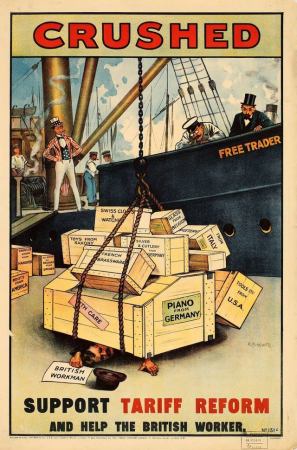
In his long response, Duncan Whitmore has paid me the compliment of taking my work seriously. I will return the favour. This response is friendly. Where he and I agree, I will say so. Where we part, I will try to show that our parting in policy terms derives from a disagreement over first principles, and that my own case from first principles is more solid than he seems to believe it. My hope is that we can both accept that we agree more than we disagree and that we should perhaps agree to disagree on the rest.
I will begin with our common ground, and there is more of this than casual readers might expect.
First, we agree about the abstract case for free trade. I do not deny this, and have said as much:
The abstract case is unbeatable. Ricardo’s comparative advantage is the best thing any economist ever wrote who was not called von Mises. If England makes cloth more efficiently than wine, and Portugal makes wine more efficiently than cloth, both gain by specialising and trading. Restate it with cars and microchips, or legal services and semiconductors, and the logic still holds. The model is clean. The conclusions are certain. If p then q.
Second, we agree that the phrase “free trade” is used to badge things that are not free by any honest standard. Duncan’s words are sharp and correct:
This legacy of dominance has morphed ‘free trade’ into a giant misnomer. International treaties and trading blocs that remove tariffs are routinely labelled ‘free trade’ on account of that narrow element of liberalisation. But they impose vast regimes of taxes, subsidies and regulations in their place. The outcome is not the elimination of trade restrictions, but their repackaging into more subtle and destructive forms under the cloak of freedom – all in a milieu of paper money which probably does more than anything else to foster the specific trade imbalances. The author is therefore right to recognise this kind of terminological inflation.
Quite. There is nothing “free” in a regime that couples the removal of border taxes with regulatory extraterritoriality, subsidy diplomacy, and credit money that rigs relative prices. I wrote the following to expose exactly that:
There is nothing ‘free’ about trade between a tightly regulated British firm and a Chinese sweatshop subsidised by state surveillance and artificially suppressed energy prices. There is nothing ‘efficient’ about importing fruit from Peru and electronics from Malaysia while leaving entire British towns to rot. There is nothing ‘natural’ about an economy whose entire structure is the outcome of political manipulation—of interest rates, of subsidies, of regulations, of foreign policy.
We give the same diagnosis.
Third, we agree that most “free marketeers” do themselves no favours when they wave the textbook about and ignore the order in which reforms must be done. Duncan is explicit:
It is… insufficient to resolve the current debate over tariffs and protectionism by regurgitating specific areas of textbook economics alone… the immiserating effects of artificially offshored production are real… a naked and unsystematic approach of deregulation doesn’t necessarily lead to greater liberty in the long run… banking regulations that temper the excesses of banks operating in a paper currency environment [exist]… If you remove the top layer of regulations without also removing the fundamental problem, then the old calamities return…
Once again, no quarrel. I have said that our elites deploy “free trade” as a stage prop for a wider system of management. The phrase covers a cartel. The cartel covers a class. That class uses the rhetoric of openness to harden its grip on a demoralised population.
Fourth, we may even agree on an awkward point that he throws at my feet. He writes that Britain is a services economy with high debt and yawning external deficits. He says time preference is high and savings low by definition. He concludes:
The entire endeavour therefore demands a sharp cut in present consumption to fund the reindustrialisation effort, the fruits of which will arrive only in the near future at best. This is a double blow to which no population has explicitly consented, and for which, culturally and psychologically, it is unprepared.
That is a difficulty that I need to consider. I cannot just say that we can lay on a tariff and wait for a steel industry to emerge spontaneously. We shall also need to rebalance saving and consumption in ways that are not immediately comfortable. That is a difficulty for any programme of conscious reindustrialisation. If I do not think it is a reason to do nothing, I still accept it as a difficulty.
Finally, we agree on method, at least in outline. He warns that one must not confuse the misuse of a principle with the principle itself. A corrupt ruling class can weaponise the idea of free trade. It does not follow that free trade is the problem.
So, if we agree so much, why write at all? The answer is because agreement on clean statements is not where policy lives. Choices are made in murky conditions where trade-offs bite. I will set out where we disagree and why, and then return to the practical consequences.
First, we disagree about the earlier history of this country under free trade. I said that Britain remained committed to free trade while rivals built power behind tariff walls. Duncan responds with a list of pertinent questions: did they grow because of protection or despite it? Did we stagnate because of free trade or because of other factors? Those are proper questions. I do not think we shall settle them to both our satisfactions here. The late-Victorian British slowdown is a thicket of causes — the beginnings of a managerial state, stupid trade unionists, corporate law, natural resource position, and more. My use of that period is not to “prove” the case for protection but to warn that a totem can become a blindfold. “We are free traders” hardened into ritual even as the structure of the world changed.
Second, and of much more importance, we disagree on what comes before policy: the frame of political judgement. Duncan is, I think, a principled libertarian. He does not lack national feeling, but seems to see a nation as a large club of self-owning individuals, all with rights that the state must not trench upon except to avert plain evil. I am a contingent libertarian. I take the nation to be a real thing, not only a sum of contracts. Individuals are parts of it, but not whole. My contingent libertarianism comes from the understanding that, if I want my nation to be rich and secure, individuals must be allowed certain rights to life, liberty and property, and that the state should abstain by default. It should normally interfere for the negative aim of protecting life and property. This being said, I do not rule out active state choice where national survival or resilience is at stake. Here, the difference between me and the less mystical big government advocates of the last century is that I do not believe the Italian fascists or the British socialists of the 1940s had a good understanding of economics or sociology. Otherwise, their premise was the same as mine – that government can be a force for positive good. That is a difference in first principles. We can explore it. We are unlikely to abolish it.
A third and unstated dispute is about comparative advantage itself. Duncan often writes as if advantage were exogenous: climate, resource endowments, pre-existing tastes, and given technology. I do not deny those as real causes. But advantage is frequently endogenous. It is a product of human choice, and even of political intervention. One of the reasons why the Scottish people were able to take a leading role in the first industrial revolution was that they already had an education system that encouraged scientific and technical progress. They also had moral prejudices and social institutions that encouraged the reproduction of the intelligent and ambitious. These were not natural advantages. They were products of human choice, and even of political interventions, that did not look useful until they became useful.
In the same way, a dense fabric of small tool-shops and foundries may look “inefficient” in a given decade and then be the ready seedbed for a new industry when technology jumps. It is a matter of institutions, norms, skill habits, capital deepening, and the compound effects of networks. If advantage can be built, it may sometimes be rational to protect fragility in order to preserve the human and institutional capital that makes the next advantage possible. A “thin” decision that treats an old electronics cluster as a relic can wipe out the craftsmen, testers, and line leaders whose presence would have made a later pivot into chip packaging or specialised modules cheap and fast. Protecting a sector for a time may look like sentiment. It may also be an investment in option value. It allows for time and continuity when a shock would erase the preconditions of future specialisation.
It is also an argument for national resilience. Other things being equal, a tariff is a deadweight cost. Yet “other things equal” cannot be conjured by decree in a geopolitical world. A state needs to insure against hostile leverage that does not show up in the short-run consumer surplus graph. A country that cannot make munitions is not sovereign. A country that cannot source basic medicines is brittle. If p removes a tariff and q lowers prices, good; but if the same p increases strategic dependency such that other agents can impose catastrophic costs in a crisis, the conditional result we care most about is not the local price vector but the loss of optionality. This is not a denial of the theory. It is ranking outcomes with a different weight.
Duncan is right to mock those who blame free trade for everything. I do not say this. He is also right that many of the harms are domestic: monetary distortion, legal privilege, welfare structures that trap people, and a planning system that smothers capital formation. I have already agreed with that, though take his point that I may have underweighted it in my first piece. He is right about these causes. Where he goes wrong is in his assumption that dealing with them is only a matter of putting the right arguments to find those will the political will to do the right thing. My fourth disagreement with Duncan is that he ignores the political economy of a de-skilled nation.
The real cause of where we stand is a circular loop set in motion when British industry was smashed in the 1980s. Once the mills and works closed, the old working class bled into two camps: low-status service skivvies and long-term dependants. These people still vote, and they are drenched in ruling class propaganda that they are scared to question, even when they retain the ability to see through it. Their votes legitimise a malign ruling class. They will not buy a “renewal through cuts in tax and regulation” message, because that sounds like more pain for people who already took the hit. They may, however, respond to a plain offer: vote for a programme that brings back paid, skilled work here and now. If accepted, that might break the loop. A country with a large productive base is more equal, not by redistribution alone, but because the wage structure is thicker from the middle up. You get ladders. You get status from mastery, not only credentials. You get unions that bargain for wages rather than campaign for speech codes. You get towns where identity is not curated by grant-funded NGOs. You get men with time and inclination to think for themselves. If we use reindustrialisation to rebuild a critical mass of workers who are neither terrified nor gullible, we may gain the electorate that can then hear a liberal case for a freed internal market. Liberty needs a social base that is secure, skilled, and proud; without that base, the abstract case will keep bouncing off a class trained to survive by obedience rather than by work.
I agree with Duncan that politicians who call for protection usually add interference rather than subtract it. He doubts that the people likely to impose tariffs will also remove the deeper distortions. That observation is true often enough to be useful. It is not an argument to barricade a necessary lever in advance. It is an argument to discipline its use. It is also a reason to rebuild the social base that punishes waste and rewards performance.
I am not a committed protectionist. But neither am I a committed free trader. I am a nationalist. I appreciate that protectionism as a core policy is a bad idea. It ignores time, capital, skills, and politics. It risks nation-wide taxation of consumption, retaliation, and a permanent lobby that lives by calling its friends “strategic.” I will not sign up to that. I will sign up to the narrow case: identify a handful of non-substitutable capabilities where failure implies humiliation or defeat; build the domestic capital stock that lets those capabilities scale in crisis; bind support to performance; publish sunsets and stick to them; clear the domestic impediments first. In every other domain, buy from the cheapest reliable world supplier and keep trade open. I am calling for an insurance policy you can price.
Here, in summary, is what I recommend:
- Clean up money and finance to favour patient capital over churn.
- Slash the cost of building and powering things.
- Streamline permissions and create fast tracks for strategic plant.
- Rebuild technical education and attach funding to outcomes.
- Use targeted procurement, stockpiles, and surge contracts for resilience.
- Then, where you still face a fatal import dependency in a tight, defined domain, use a modest, sunsetted tariff or fee to buy time.
Duncan will recognise much of this as his own programme with one extra lever made admissible. I expand the policy set; I do not invert the priorities. The more of these domestic reforms we achieve, the less any temporary shelter is needed. But I refuse to declare the lever illegitimate in principle. Some exposures are not one-product problems. Energy dependence, compute bottlenecks, and defence industrial capacity are system risks. You need assured domestic capacity, allied supply chains, and expensive redundancy. Some of that can be bought with procurement and contracts alone. Some may need price support against a tide you cannot turn quickly.
Here is another and longer summary, one that sets out what I think emerges from our exchange.
- We agree that “If p then q.” Free exchange across borders tends to lower prices, widen choice, and press incumbents to improve. Those pressures are real even when other forces muffle them.
- We agree that “free trade” has been used as a label to sanctify managed arrangements that have little to do with liberty. Duncan and I are agreed that libertarians should stop defending the label when the substance is cartel.
- We agree that many harms in Britain are domestic: monetary debasement, planning clog, energy policy that prices out industry, a tax code that favours churn. Fix those first.
- I insist that comparative advantage is often made, not given. That fact bears on sequencing and design. You sometimes preserve capacity now to build advantage later.
- I insist on narrow resilience. A small set of capabilities must be on-shored or assured with allied redundancy. Contracts and stockpiles do most of the work; temporary price cover may do the rest.
- I reject the idea that any use of a tariff is an outrage against economics. Tools are not sins. Their use can be wise or foolish. The test is narrowness, sunset, and the clearing of domestic blockages first.
- I further insist that the health of a liberal order depends on the social base that lives within it. If a modest tilt toward rebuilding productive depth helps to restore that base, it is a defensible choice even if it does not maximise a static efficiency measure in the short run.
If Duncan reads that list and says, “Then we are not so far apart,” I will count this essay a success. If he replies that any admissible tariff is a seed of capture, I will answer that capture is already everywhere and that the cure for capture is not to abolish every instrument, but to build institutions that punish cheats and reward builders.
We both want a richer, freer, saner Britain. We both know that economics gives us very strong “if p then q” maps. We both see that those maps are not the same thing as a journey. My case is not that we should burn the maps. It is that we should bring a compass, too, and keep an eye on the weather.

Discover more from The Libertarian Alliance
Subscribe to get the latest posts sent to your email.
[…] Recently, I posted a generally critical reply to an essay by Bryan Mercadente on the subject of free trade. He has been kind enough to acknowledge my comments and to offer a response. […]
[…] Bryan Mercadente Title: Free Trade: Mercadente v Whitmore — A Friendly Exchange URL: https://libertarianism.uk/2025/10/26/free-trade-mercadente-v-whitmore-a-friendly-exchange/ Summary: Mercadente acknowledges extensive agreement with Whitmore on theory and diagnosis but […]