Intellectual Property: Natural Right or State Privilege?
Sebastian Wang
Introduction: Reconsidering Property and Privilege
“Indeed it might be helpful to rethink the language used to describe IPRs and call them instead intellectual property privileges, which is what they are, and thus remove the possible confusion with human rights.” — Friends World Committee for Consultation
This remark, submitted by the Quaker United Nations Office in 2001 to the Commission on Human Rights, is more than semantic fastidiousness. It speaks to a foundational question in legal and political philosophy: What do we mean by property? The phrase intellectual property rights is so widely used that it has become, for many, an unquestioned legal category—something as natural as rights to land or a physical object. Yet a moment’s scrutiny reveals how loaded the term is.
The phrase suggests a parallel between tangible goods—my coat, my house, my car—and the intangible products of the mind: novels, inventions, musical compositions. But the analogy does not hold easily. Tangible goods are scarce and rivalrous. If I take your umbrella, you no longer have it. If I copy your poem, you still do. And so the very use of the word property already frames the debate in a certain direction, urging us to think of intangibles as if they were material, and therefore as if they merit the same institutional protection.
A more precise way to approach this debate is by distinguishing between two categories of entitlement:
- If an institution or right would exist in a stateless society where property rights are respected, it may be presumed legitimate as a natural right.
- If it would not exist without active state enforcement, it may still be useful—but the burden of justification lies on those who impose it.
This principle applies across the board. If courts and armed officers are needed to enforce a right that would not exist in a condition of liberty, then it is not natural but artificial. It must be justified on grounds of utility—and the benefit must outweigh the cost in liberty, privacy, and economic distortion. Intellectual property, in almost every case, fails the first test and sits uneasily under the second.
I. Natural Rights and the Myth of Mental Labour as Property
The strongest theoretical defence of intellectual property as a natural right stems from a Lockean framework—one in which all property rights derive from self-ownership. If I own my body, then I own my labour. If I mix my labour with unowned matter, I create property. So far, so familiar.
But what happens when the thing I mix my labour with is not a tangible good, but an idea? Ayn Rand extended the Lockean model precisely in this direction. “Patents and copyrights are the legal implementation of the base of all property rights: a man’s right to the product of his mind” (Rand 1967, 130). Rand considered the mind to be “man’s basic tool of survival” (Rand 1963, 96), and its fruits therefore worthy of the same recognition as the physical outputs of muscle or sweat.
Locke himself, of course, never wrote about intellectual property. His references were entirely to tangible resources: acorns gathered, land cultivated, deer hunted. But some scholars have taken his framework and pushed it into the realm of abstraction. If the key element of property is labour—and if intellectual products are the result of labour—why not grant them the same status?
Yet this extension depends on forgetting the second half of Locke’s argument. Property, for him, was not just about labour but about the removal of something from a common pool into a sphere of exclusive use. The idea of mixing labour with an object makes sense only where that object is scarce and rivalrous. But ideas are not like land. If one man sings a tune, and another man copies it, nothing has been taken. Scarcity is the heart of property; without it, the analogy collapses.
Furthermore, the Lockean proviso—that there must be “enough and as good” left for others—renders intellectual appropriation extremely dubious. If the first man to write a love poem can prevent others from using similar phrases or rhymes, the commons is enclosed before anyone else even arrives.
Gordon (1993) argues that the chain of title for intellectual property is cleaner than for tangible property: intellectual creations are recent, well-documented, and uncontested in authorship. But this is only true if we ignore the collaborative nature of knowledge. Every new idea depends on dozens of predecessors. If ownership were traced as rigorously in ideas as in land, most patents would collapse into competing claims.
The Roman jurist Gaius did categorise incorporeal things—such as debts, obligations, and legal claims—as property. English common law likewise recognised choses in action as a form of intangible right. But these legal categories were not derived from natural law. They were pragmatic devices to regulate commerce and ensure consistency. That they existed says nothing about whether they should exist in a free society. The point remains: intellectual products are not naturally exclusive. Only the State makes them so.
II. Utility and the Case for Incentive
Faced with the theoretical weaknesses of the natural rights case, defenders of intellectual property often pivot to a utilitarian justification. The core claim is simple: without legal protections, creative and inventive activity would decline. Since the benefits of intellectual products—literature, medicine, engineering—are great, the argument goes, we must offer temporary monopolies as incentives to encourage their creation.
This argument has intuitive appeal, especially in industries with high fixed costs and low marginal costs, such as pharmaceuticals or software. Who would invest millions in a cancer drug if rivals could immediately copy the formula? Who would write novels if publishers could undercut each other on price the moment the work appeared? The law, it is said, must create artificial scarcity to preserve the incentive structure.
This is the model embedded in the United States Constitution: “To promote the Progress of Science and useful Arts, by securing for limited Times to Authors and Inventors the exclusive Right to their respective Writings and Discoveries.” It is not a declaration of natural rights, but a policy measure—an incentive scheme.
Yet even on its own terms, the utilitarian argument is flawed. First, it assumes that absent state protection, creativity would wither. But much of human achievement occurred before modern copyright or patent law. Homer, Shakespeare, Galileo, and Mozart all produced enduring works under regimes that offered either no legal protection or only weak and uncertain privileges. Open competition did not destroy innovation—it spurred it.
Second, the incentive structure created by intellectual property is often perverse. As Rothbard notes, patent regimes tend to distort the direction of research: “The patent system then has the… effect of artificially stimulating research expenditures in the patentable areas, while artificially restricting research in the non-patentable areas” (Rothbard 2004, 658–59). Research into natural processes, for example, is discouraged because it does not yield proprietary technologies. Conversely, companies rush to patent trivial modifications of existing inventions to build legal arsenals against competitors.
Third, the costs of enforcing intellectual property regimes are considerable—and rarely discussed. The litigation burden on courts, the expense of compliance, the chilling effect on small businesses, and the deadweight losses from monopoly pricing all add up. Kinsella (2008) and others argue that the economic harm from intellectual property regimes often outweighs their benefits. If the goal is maximal welfare, the result is ambiguous at best.
And finally, the assumption that legal exclusivity is the only path to profit is false. Many creators thrive without copyright enforcement: open-source software developers, independent musicians, authors who publish into the public domain. Business models based on patronage, merchandise, performance, and reputation continue to flourish. The market finds ways to reward originality even when ideas flow freely.
III. Legal Constructions and Institutional Drift
While theoretical arguments are vital, much of the power of intellectual property comes from its codification into law. The United States Constitution, as we’ve seen, enshrines it as a tool to promote progress, not as a natural entitlement. Similarly, in the European context, Protocol 1 of the European Convention on Human Rights guarantees the peaceful enjoyment of possessions. Although the European Court has ruled that granted patents count as such possessions (ECHR 2010, 33), the protections extend only once the state has recognised a claim. They do not precede the law—they emerge from it.
In fact, the entire language of “rights” is a historical contrivance. As Machlup and Penrose observe in their history of 19th-century patent debates, “[T]hose who started to use the word property in connection with inventions had a very definite purpose in mind—they wanted to substitute a word with a respectable connotation, ‘property’, for a word that had an unpleasant ring, ‘privilege’” (Machlup and Penrose 1950, 2).
This strategic rebranding has been remarkably successful. Today, few question whether Disney should hold rights over a character designed 80 years ago. The idea that intellectual property expires—not because of any deep philosophical reason but because parliaments drew arbitrary lines—barely troubles legal consciences. Yet these lines change frequently. The duration of copyright in music in the United States went from 50 years to 75 years to 95 years within a few decades. It is the same in Britain and the European Union, except that the limit is 70 years. In each case, the expansion benefited those with the loudest lobbies, not the greatest merits.
Moreover, the scope of rights continues to grow. Patents were once restricted to physical devices. Today, they cover algorithms, genetic sequences, and even methods of doing business. Copyright once protected only fixed expressions; now, it covers preliminary sketches and derivative works. The legal apparatus expands ever outward, feeding a compliance industry and consolidating corporate power
IV. Abuse and the Erosion of Other Rights
Even if one concedes the possibility of a legitimate public interest in temporary monopolies, the real-world implementation of intellectual property often produces gross injustice. The enforcement of these claims frequently violates privacy, speech, and due process.
Anton Piller orders, for example, allow rights-holders to seize evidence from alleged infringers without prior warning. As Mackaay notes, such measures “intrude into people’s privacy in frightening ways,” and “invite aberration” (Mackaay 1990, 868–69). The use of spyware, bulk lawsuits against file-sharers, and cross-border domain seizures reinforce the point: the protection of one class of interest routinely overrides others.
Then there is the human cost. In the early 2000s, the Recording Industry Association of America (RIAA) filed over 30,000 lawsuits against individuals, many of them teenagers, for downloading music. The aim was not to recoup losses—most cases were settled for modest sums—but to intimidate the public. According to Kravets (2009), only one case reached full trial. It was lost.
Nor are abuses confined to the cultural sphere. In agriculture, seed patents have allowed corporations like Monsanto to sue farmers who replant patented seeds, even unintentionally. Vandana Shiva has linked these practices to debt and despair among Indian farmers, claiming over 270,000 suicides since the introduction of genetically modified crops. While this number is contested (Porterfield 2018), the underlying issue remains: IP enforcement often strikes those least able to defend themselves.
Conclusion: Privilege Demanding Justification
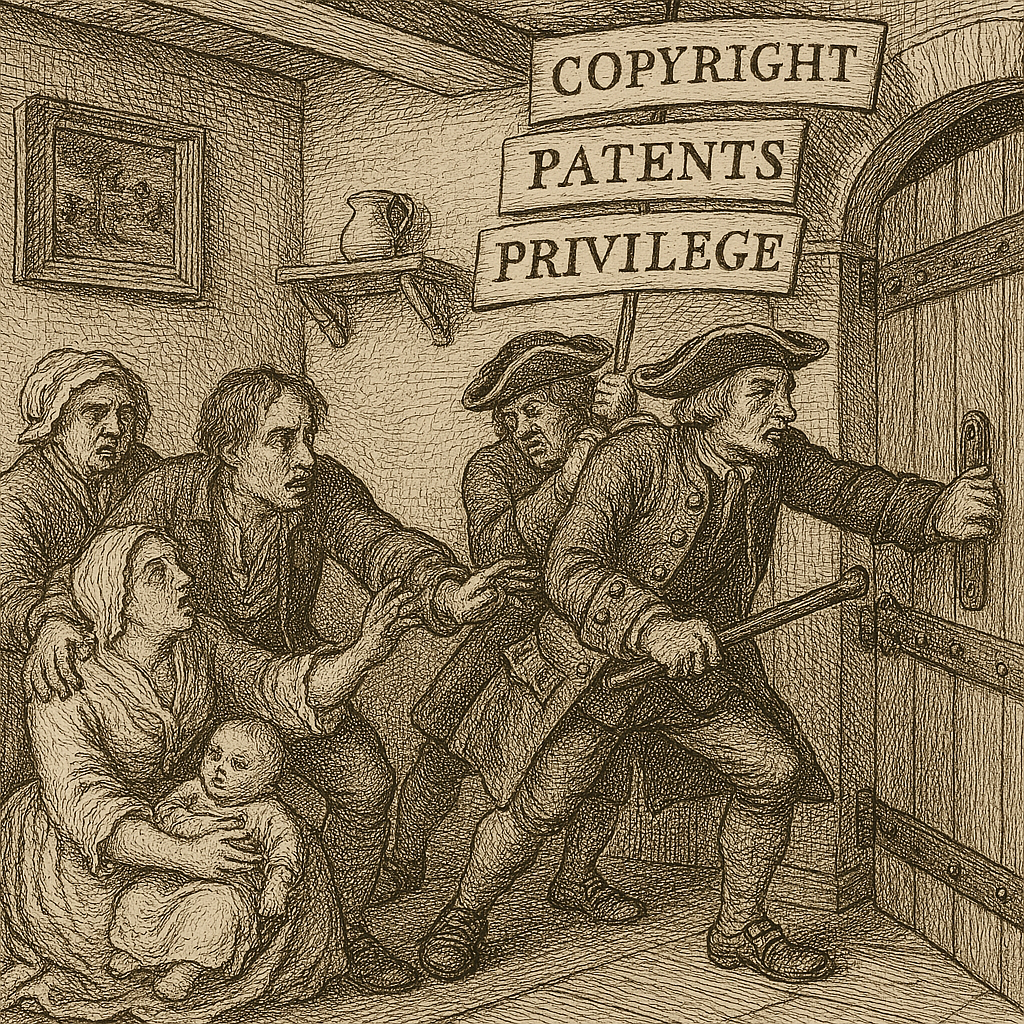
The moral clarity that surrounds tangible property does not extend to intellectual creations. These are not scarce by nature; they do not exclude others when used. Their protection relies not on spontaneous order but on state violence—courts, fines, confiscations, surveillance, imprisonment.
There may be reasons to grant such privileges. But the burden of proof lies on those who demand them. As the British Government’s Commission on Intellectual Property Rights concluded:
“[W]e prefer to regard IPRs as instruments of public policy which confer economic privileges on individuals solely for the purpose of contributing to the greater public good” (CIPR 2002, 6).
To accept this framing is not to abolish IP altogether, but to reframe it as a contingent arrangement—one subject to scrutiny, limitation, and reform. That is the beginning of intellectual honesty in this debate.
Bibliography
- Confino, Jo. “Vandana Shiva: Corporate Monopoly of Seeds Must End.” The Guardian, October 8, 2012.
- Croskery, Peter. “Institutional Utilitarianism and Intellectual Property.” Chicago-Kent Law Review 68, no. 2 (1993): 631–697.
- Drahos, Peter, and T. D. Campbell. A Philosophy of Intellectual Property. London: Routledge, 1996.
- European Court of Human Rights. European Convention on Human Rights. Strasbourg: Council of Europe, 2010.
- Fisher, William. “Theories of Intellectual Property.” In New Essays in the Legal and Political Theory of Property, edited by Stephen R. Munzer, 168–200. Cambridge: Cambridge University Press, 2001.
- Gordon, Wendy J. “A Property Right in Self-Expression: Equality and Individualism in the Natural Law of Intellectual Property.” Yale Law Journal 102 (1993): 1533–1609.
- Hegel, Georg Wilhelm Friedrich. Elements of the Philosophy of Right (1821). Translated by H. B. Nisbet. Cambridge: Cambridge University Press, 1991.
- Hughes, Justin. “The Philosophy of Intellectual Property.” The Georgetown Law Journal 77, no. 2 (1988): 287–366.
- Kinsella, Stephan N. Against Intellectual Property. Auburn, AL: Ludwig von Mises Institute, 2008.
- Kravets, David. “File Sharing Lawsuits at a Crossroads, after 5 Years of RIAA Litigation.” Wired, April 8, 2009.
- Landes, William M., and Richard A. Posner. “An Economic Analysis of Copyright Law.” Journal of Legal Studies 18 (1989): 325–363.
- Locke, John. Second Treatise of Civil Government. 1690. Many editions.
- Machlup, Fritz, and Edith Penrose. “The Patent Controversy of the Nineteenth Century.” Journal of Economic History 10 (1950): 1–29.
- Mackaay, Ejan. “Economic Incentives in Markets for Information and Innovation.” Harvard Journal of Law and Public Policy 13 (1990): 867–909.
- Mack, Eric. “Self-Ownership and the Right of Property.” The Monist 73, no. 4 (1990): 519–543.
- Mansell, Robin, and W. Edward Steinmueller. “Copyright Infringement Online: The Case of the Digital Economy Act Judicial Review in the United Kingdom.” LSE Research Online, 2011.
- Masnick, Mike. “Copyright Extension: A Way to Protect Hollywood from Having to Compete with the Past.” Techdirt, June 6, 2012.
- Moore, Adam D. “A Lockean Theory of Intellectual Property Revisited.” San Diego Law Review 50 (2012): 1–32.
- Palmer, Tom G. “Intellectual Property: A Non-Posnerian Law and Economics Approach.” Hamline Law Review 12 (1989): 261–304.
- Palmer, Tom G. “Are Patents and Copyrights Morally Justified? The Philosophy of Property-Rights and Ideal Objects.” Harvard Journal of Law and Public Policy 13, no. 3 (1990): 817–865.
- Porterfield, Amy. “Are Seed Patent Protections Abused by Monsanto and Other Agro-Corporations?” Genetic Literacy Project, January 5, 2018.
- Rand, Ayn. For the New Intellectual: The Philosophy of Ayn Rand. New York: Signet, 1963.
- ———. Capitalism: The Unknown Ideal. New York: Signet, 1967.
- Rothbard, Murray N. Man, Economy, and State: A Treatise on Economic Principles. Auburn, AL: Ludwig von Mises Institute, 2004.
- Schroeder, Jeanne L. “Unnatural Rights: Hegel and Intellectual Property.” Cardozo Legal Studies Research Paper No. 80, 2004.
- Shapiro, Daniel, et al. “The Invention of Compact Discs.” Faculty Project, Dartmouth College, 2012. [Accessed April 22, 2019].
- United States. Constitution of the United States. 1788.
- Commission on Human Rights. Economic, Social and Cultural Rights: Intellectual Property Rights and Human Rights (E/CN.4/Sub.2/2001/12/Add.1). New York: United Nations Economic and Social Council, 2001.
- Commission on Intellectual Property Rights. Integrating Intellectual Property and Development Policy. London: Department for International Development, 2002.
Discover more from The Libertarian Alliance
Subscribe to get the latest posts sent to your email.
Related posts:

Powered by YARPP.
[…] Wang, “Intellectual Property: Natural Right or State Privilege?“, Libertarian Alliance (UK) (27 October, […]
The graphical illustration of your work looks very impressive. You might also want to take a look at the paper:
Pearce, J. M. (2025). Quantifying the Human Mortality Costs of Patent-based Intellectual Property: How Many Premature Deaths are due to Patents?. Health Care Analysis, 1-12.