
Adolf Hausrath, Antinous: Historischer Roman aus der römischen Kaiserzeit. Leipzig: Breitkopf und Härtel, 1884.
Let’s begin with the facts. Antinous was born in Bithynia around AD 111. He met the emperor Hadrian—then in his late 40s, when the boy may have been twelve—in Claudiopolis in about 123. They became lovers. The boy, obviously beautiful and poised and probably intelligent, travelled with Hadrian for nearly a decade, accompanying him across the empire on administrative and ceremonial duties. In October 130, during a voyage up the Nile, Antinous died—he drowned. Whether he slipped, jumped, or was sacrificed in some obscure mystery rite is still debated. What is not debated is what followed. Hadrian was distraught. He declared the boy a god. He founded a city in his name. Statues were erected across the empire. Coins were struck. A cult was born and lasted centuries.
This is history. This is real. If you want it told straight, with proper attention to the evidence and no coy evasions, there’s a book by Sean Gabb called The Cult of Antinous. I will say this is a thrilling read—then again, Dr Gabb a classicist by training and my own Greek teacher by accident—and it gives you the facts without moral fog or modern posing. It doesn’t sanctify or condemn. It just walks you through what happened and why it mattered.
What it doesn’t do—mercifully—is try to retell the story in novel form. I picked up a copy of Adolf Hausrath’s Antinous for 30p in a charity shop. It was printed in Gothic script, and I bought it to see whether I could read the whole thing without hallucinating blackletter serifs in my sleep. I could. What I couldn’t do was find any justification for this novel’s continued existence, let alone its author’s reputation as a writer of historical fiction.
Hausrath was a Protestant theologian, the kind of man whose idea of narrative rhythm was probably learned from the Book of Numbers. He was a professor of ecclesiastical history and a sometime biographer of German worthies. That alone should have been enough to keep him away from historical fiction, and certainly from the ancient world, where people had inconvenient habits like dying in orgiastic cult rituals and loving beautiful boys with more than just their minds.
The premise of Antinous is obvious. What if we took one of the most openly erotic relationships of the Roman imperial period and scrubbed it clean with holy water? What if we filtered Hadrian’s documented grief, Antinous’s cult, and the explosion of statuary through the sensibility of a man who thought Goethe was a bit racy?
The result is a novel so timid, so starched, so spiritually strangled that you almost have to admire its commitment to dishonesty.
Here’s a representative passage—translated, though the original is even worse:
Antinous was to Hadrian as a morning glow breaking through the mist—a gentle radiance played about his face, which, youthful though it was, bore the solemn depth of a temple’s silence. It was as if the gods had shaped him, not for life, but for death, for sacrifice, for immortality.
In German:
Wie ein Morgenglanz, der durch den Nebel bricht, so war der Anblick Antinous’ für den Kaiser. Ein weicher Glanz umspielte sein Gesicht… Es war, als ob die Götter selbst diesen Knaben geformt hätten, nicht für das Leben, sondern für den Tod, für das Opfer, für die Unsterblichkeit.
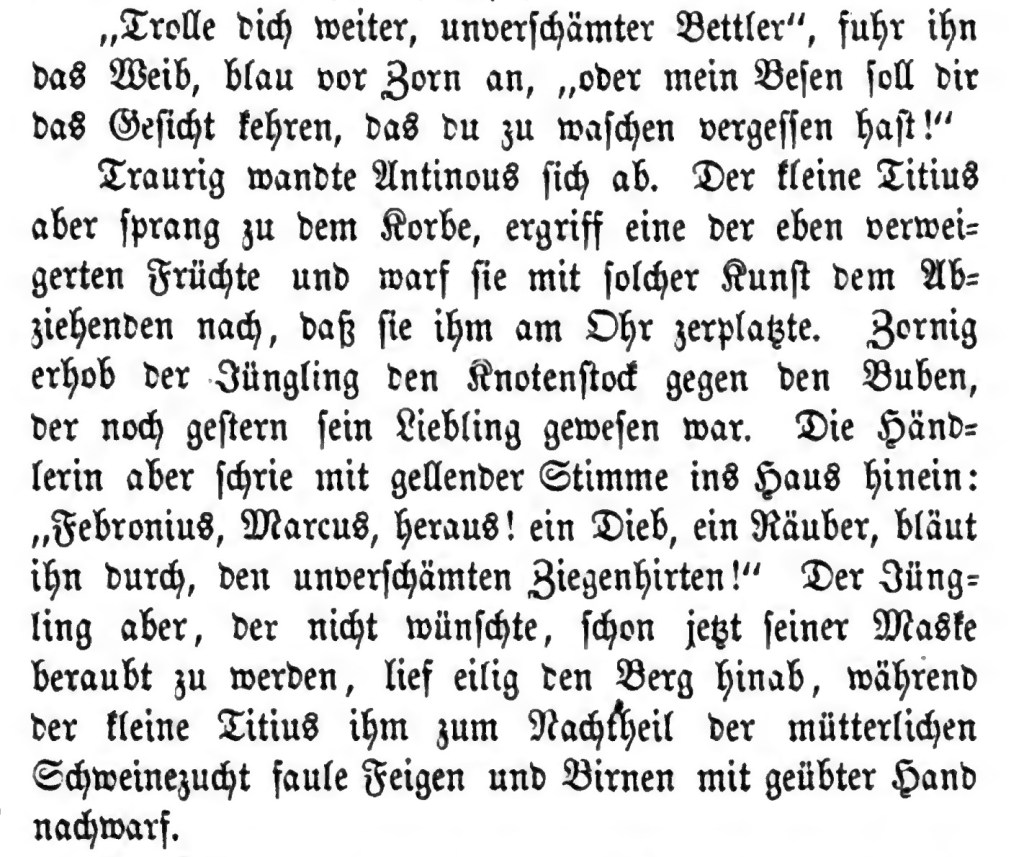
I include the German because I want to be fair. But it really doesn’t help. This is not characterisation. It is vaporous flattery from a man who cannot bear the idea that ancient people had bodies. The whole novel is like this: dense with adjectives, faint with awe, padded with theological hemming and hawing. It reads like it was dictated by a Unitarian archangel to someone who’d never seen a naked statue without looking away.
There’s no sex. There’s barely any touch. There is certainly no desire. Antinous is not so much a character as a soft-edged glow with hair. His death, when it comes, is a polite glide into the Nile, described with the passion of a death notice in a church newsletter:
Er ging in das Wasser, wie ein Priester, der sich seinem Gott opfert, in stummer Ergebung, mit dem Frieden des Erwählten auf dem Antlitz.
This is the literary equivalent of drawing a sheet over a crime scene and calling it poetry.
The issue isn’t that Hausrath avoids being crude. The issue is that he avoids being honest. His Antinous isn’t innocent—he’s erased. His Hadrian isn’t grieving a lover—he’s mourning a concept. This is not fiction. It’s casuistry in costume. If Hausrath had written a novel about the crucifixion, he’d have described the nails as “symbols of celestial union” and the blood as “a mist of spiritual regret.”
Meanwhile, the actual historical material is gripping. Statues of Antinous project strength, sexuality, and cultic charisma. His hair is coiffed with obsessive detail. His gaze is serene, his body strong, his posture imperial. As Gabb puts it:
You don’t imitate that hair by running about on a windy day. To those willing to look, it projects power and unlimited wealth.
Hausrath doesn’t look. He flinches. He cuts away everything that makes the subject interesting—youth, power, love, politics, pain—and replaces it with cotton wool. It is the literary equivalent of taking every statue of Antinous in the Louvre, chiselling off the genitals, and telling visitors the result is “elevating.”
What’s really grotesque is that Hausrath seems to think this is morally superior. That by denying what was physical, he’s dignifying what was divine. But the result is not transcendence. It’s amnesia. It’s the lie that affection without desire is more noble, that grief without flesh is more pure. It’s the lie, in other words, that only spiritual love counts.
I’ll say it again for the slow learners: sex happens. It happened in antiquity in ways we find difficult. It happened between Hadrian and Antinous. The sources say so. The statues scream it. And when joined with affection, it is not lesser. It is not shameful. It is human. What Hausrath gives us is not purity but cowardice. He didn’t want to deal with the reality of pagan love, so he invented a Protestant fantasy.
And no, writing in Gothic script doesn’t make it art.
So read Gabb, not because he’s a genius—though he probably is once you overlook his eccentricities—but because he tells the truth. He doesn’t exalt Hadrian. He doesn’t fetishise Antinous. He doesn’t turn history into a scented candle. He gives you what happened and invites you to draw your own conclusions. That’s more than Hausrath ever managed.
Antinous drowned once. Hausrath drowns him again—in adjectives, in abstractions, and in fear.

Discover more from The Libertarian Alliance
Subscribe to get the latest posts sent to your email.
Humblebragging about being able to read German in gothic lettering. Try Sütterlin if you want a challenge.