by Juan I. Núñez
Introduction
Intellectual property (IP) law is a near-universal feature of the modern world. Through international bodies like the World Intellectual Property Organization (WIPO) and treaties such as the Paris Convention, a global enforcement regime has steadily been constructed since the late 19th century up until today. Such is the perceived importance and reach of IP that even nations nominally opposed to private property, like the former Soviet Union, have historically ratified and participated in this system, serving as a testament to IP’s uniquely resilient status.[1]
Few concepts in the modern world are as overlooked, and as unquestioned, as intellectual property. It has become a sacred cow, protected by the cultural assumption that owning an idea is ethically indistinguishable from owning a house. And while the origins of this belief are complex, its hold on the public imagination is undeniable. It is not merely a law, but an intuition, deeply ingrained by the sheer inertia of its existence.
Arguments for intellectual property typically spring from three philosophical wells. First are the utilitarians, who argue that IP is a necessary legal construct to incentivize innovation and the creation of art. Second is the Hegelian defense, which justifies IP through the metaphysical claim that a creator’s will is objectively embodied in their ideas—IP as a moral necessity. Finally, and most central to our discussion, is the Lockean or natural rights tradition, which contends that creators have a just property right in their work as an extension of their person.
Of these three, the Hegelian argument is largely confined to the mists of academic philosophy and can only exist in abstraction, while the utilitarian case, for all its popularity, has been empirically refuted time and again. [2][3] It is the Lockean appeal to natural rights—the chosen weapon of thinkers from Ayn Rand to many classic liberals—that presents the true ethical challenge. This is the argument that must be met on its own terms. This essay, therefore, will set aside the question of whether IP’s outcomes are desirable and ask a more fundamental question: is the law itself just?
The Foundation of Property
To understand intellectual property, we must first understand property itself. The entire concept of property rights arises as a solution to one inescapable problem: interpersonal conflict over scarce resources. The physical world is defined by scarcity; tangible goods are rivalrous. Because two people cannot use the same resource for conflicting purposes at the same time, a system of rules is necessary to permit a peaceful, cooperative social order. Property rights are those rules. They are not a descriptive economic phenomenon like possession, but a juristic concept: the assignment of exclusive ownership to prevent conflict before it begins.
Consider a bicycle, a slice of pizza, or a kitchen knife. These goods are not just scarce; they are rivalrous. Because of their physical nature, their use by one person precludes their simultaneous use by another. Two people cannot ride the same bicycle to different destinations at the same time, nor can two people use the same knife to cut different things simultaneously, nor consume the same slice of pizza. This rivalry over use creates the potential for violent conflict. The central problem of social order, then, becomes how to secure peaceful possession of these goods. Property rights are the answer. They are the normative rules that provide security for one’s rightful possession.
This potential for conflict demands a just rule of first appropriation. The homesteading principle provides that rule: ownership is justly acquired by the first person to establish a clear, objective link to a previously unowned resource, whether through transformation, embordering, or first occupation. Through this act, the resource becomes an extension of the homesteader’s person, which is why we call the right one has in the resource a “property right.” This method alone provides a peaceful and objective basis for assigning ownership, as any other rule—such as allocating resources by verbal decree or brute force—is necessarily arbitrary and conflict-driven, leading to the chaos of the tragedy of the commons.
The result is a clear and objective claim. A homesteader who first cultivates a parcel of unowned land establishes a unique, publicly visible link to that resource. This link is the basis of his property title. From this point forward, ownership of that resource is determined by a clear set of rules: the title belongs to the original homesteader, to anyone he has voluntarily transferred it to via contract, or to a victim to whom it is owed as rectification for a tort. The boundary is clear, the title is just, and the potential for conflict over that physical resource is resolved. The crucial question, then, is what happens when we attempt to apply this logic to the non-physical realm?
The Nature of Ideas
Unlike rivalrous physical goods, ideas are, by their very nature, non-rivalrous. Praxeologically, every action requires two distinct components: the rivalrous physical means we employ (our bodies, tools, land), and the non-rivalrous knowledge that guides our action. Property rights exist to prevent conflict over the scarce means, but such conflict is impossible over the knowledge itself, as any number of actors can be guided by the same information at once. I can sing “Let It Be” without preventing you from doing so; you can copy the patented method of swinging sideways on a swing, [4] and my ability to do likewise remains completely unaffected.
It is therefore not only unjust but impossible to own an idea in the same way one owns a phone. All legitimate property rights assign an owner to a specific scarce resource. But since ideas are non-scarce knowledge, an “IP right” does not, and cannot, assign ownership to the idea itself. Instead, it functions as a negative servitude: a claim that grants the IP holder partial control over the scarce resources already owned by everyone else. My copyright in a song is not a right in the song; it is a claim of a right to control your vocal cords and your property, preventing you from using them to reproduce the song. It is a direct violation of the homesteading principle, illegitimately reassigning ownership of justly acquired property.
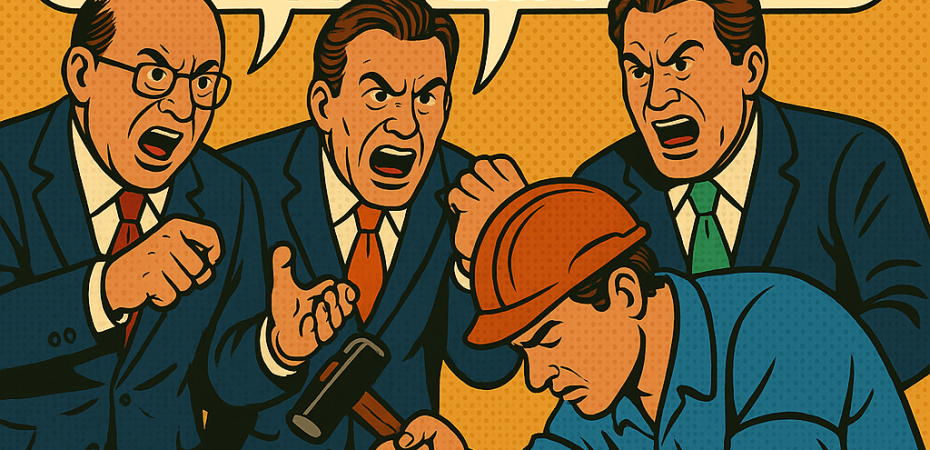
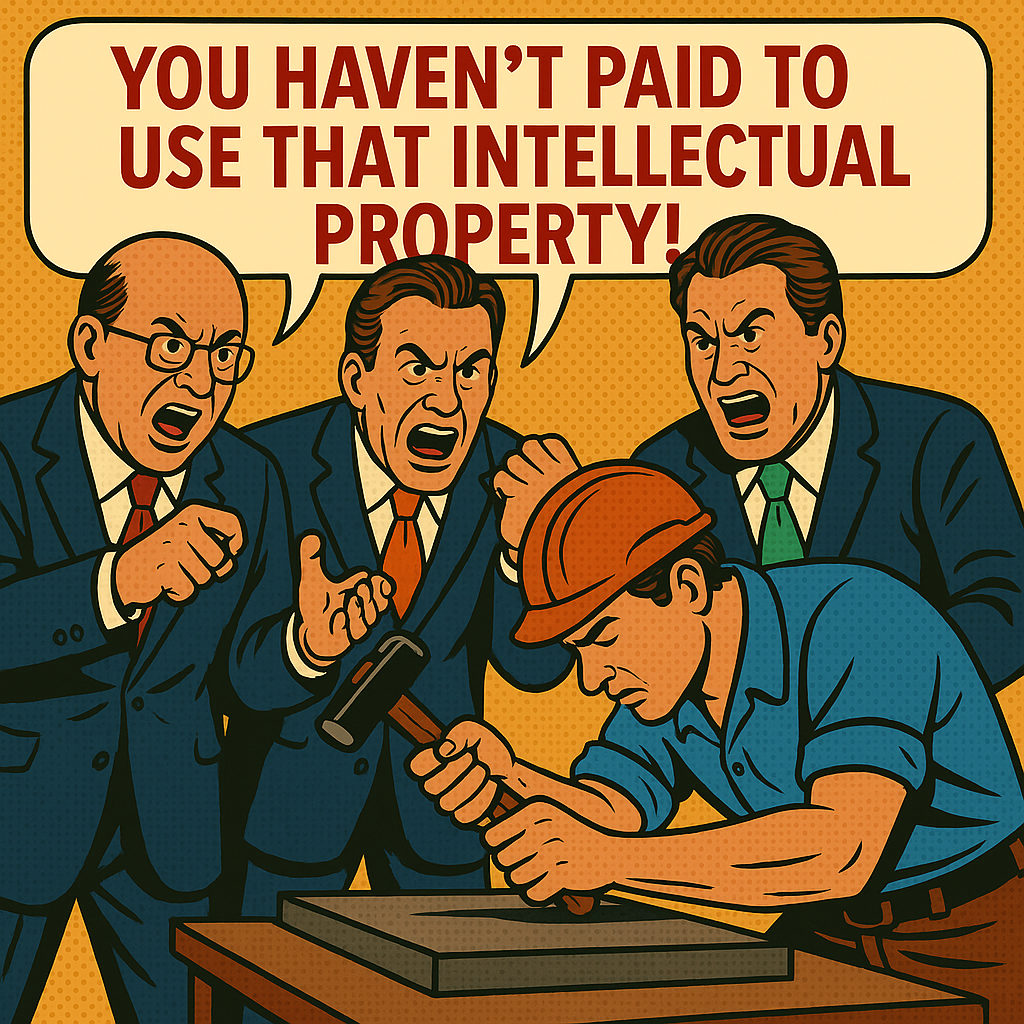
We are thus forced to a damning conclusion. The enforcement of intellectual property rights is not the protection of property, but the mass censorship of speech and peaceful action through the threat of violent aggression. It is a system that fabricates scarcity where none exists, erecting a fence of coercion around the infinite commons of human knowledge. It is, particularly in the case of patents and copyright, a nonsensical negative servitude.
Simply put: intellectual property is censorship. And it is aggression.
What Intellectual Property Claims to Be
The ethical case for IP rests on a series of appealing but philosophically empty claims. We are told that creators have a right to the “fruits of their labor”—a meaningless metaphor—and a right to “their own creations.” But this confuses the creation of wealth with the origin of property. Creation does not magically generate a property right; it is merely the act of transforming property that one already owns. This appeal to “natural rights” is therefore deceptive from the start, and as we shall see, the unprincipled reality of IP law—with its arbitrary limits, its internal contradictions, and its reliance on State power—only confirms its corrupt and inconsistent foundation.
The term “intellectual property” is itself a misleading catch-all, bundling together several legally distinct forms of State-granted monopoly. The most significant are patents, which grant temporary control over inventions, and copyright, which does the same for creative expressions like literature, art or music. Next are trademarks, which protect brand identifiers and are supposedly aimed at preventing consumer fraud rather than rewarding creation, and even defamation laws, which effectively create a property right in one’s personal reputation. Finally, and most revealingly, are trade secrets, which protect confidential business information not through a State monopoly, but through private contracts and non-disclosure agreements. The very definitions already hint at the incoherence: a jumble of arbitrary monopoly grants sitting awkwardly alongside a legitimate system of private contract.
This incoherence is laid bare by their arbitrary and wildly inconsistent term limits. A patent lasts for almost twenty years; a copyright can extend for the author’s lifetime plus seventy. A trademark, if used continuously, can be perpetual. And a trade secret? Its duration is not decreed by the State at all. It lasts only as long as the owner can successfully keep it a secret. This is not the uniformity of a principled legal doctrine; it is the chaotic patchwork of very obvious political compromise.
Beyond the arbitrary term limits, the supposed “property” right is further eroded by an array of legal carve-outs. Copyright is riddled with vague “fair use” exceptions, allowing the use of a work for purposes like citation or parody. Patents are subject to “compulsory licensing,” a legal mechanism through which the State can force an inventor to license his creation to a third party against his will. From its creation to its enforcement, IP behaves less like a real property right and more like a temporary, State-managed privilege riddled with loopholes inherent to its arbitrariness.
The intended effect of this entire apparatus is beyond evident. The purpose of intellectual property is to grant a legal monopoly. It empowers the holders of State-granted IP rights to prevent competitors from using a particular pattern of information, whether to publish a book or to build a better machine. It is, therefore, an inherently anti-market institution, a deliberate restraint on trade designed to limit competition, stifle follow-on innovation, and restrict consumer choice, all for the primary benefit of politically-connected corporations and rent-seekers.
Intellectual Property as a Principle
Our tunnel boring machine now arrives at the supposed ethical bedrock of IP: the natural rights claim that “you own what you create.” Yet this principle, upon inspection, is so brittle that even its most ardent champions are forced to abandon it. Consider Ayn Rand, arguably the fiercest mainstream modern defender of creation as a source of property. Even she could not follow the principle to its logical conclusion, recognizing that perpetual IP would be a monstrous “cumulative lien on the production of unborn generations.”[5] She was thus forced to concede that this “right” must have an arbitrary time limit. Here, at the very foundation of the argument, the principle collapses into consequentialist compromise.
Unsurprisingly, this retreat from principle is not unique to Rand. Nearly all IP advocates implicitly concede that their “property right” cannot be unlimited in term or scope. Many accept the necessity of “fair use” for copyrights and compulsory licensing for patents in emergencies. The reason for this inconsistency is simple: they recognize, consciously or not, that a truly absolute and perpetual IP right would lead to the extinction of the human race. As Stephan Kinsella—IP Man—explains:
“[B]y extending the term of patents and copyrights to infinity, subsequent generations would be choked by ever-growing restraints on their own use of property. No one would be able to manufacture—or even use—a light bulb without getting permission from Edison’s heirs. No one would even be able to build a house without getting permission from the heirs of the first proto-human who left the caves and built a hut. No one could use a variety of life-saving techniques, chemicals, or treatments without obtaining permission of various lucky, rich descendants. No one would be able to boil water to purify it, or use pickling to preserve foods, unless he is granted license by the originators (or their distant heirs) of such techniques.”[6]
This katabasis from principle raises a series of questions that leave the pro-IP argument on the slab of an ideological morgue. Are these exceptions consistent with the concept of property as a natural right? Is there any objective basis for deciding that a patent term should be twenty years, but not fifty, or five hundred? Is there a non-arbitrary way to define the precise contours of “fair use”? Can anyone draw a clear, principled line between a patentable “invention” and an unpatentable “abstract idea”?
The answer to all of these questions is, of course, no. There are no objective principles guiding the terms and exceptions to intellectual property. Any proposed rule is immediately exposed as arbitrary. For instance, if a copyright term ends at the creator’s death, it undermines the principle of heritability essential to real property. The line between “fair use” and infringement, or between a new design and a trademark violation, is never fixed; it is a perpetually shifting judgment call left to the subjective whims of lawyers, judges, and legislators. This is not the rule of law; it is the rule of men. How ironic, then, that the most steadfast champions of an “objective” legal system can offer nothing but arbitrary solutions to their own IP problem, which is claimed to be born from that same objectivity.
Real property rights, if they are to mean anything, must be inviolate. Imagine claiming absolute ownership of your house, only to be told, “Not so fast—I can enter your kitchen for fifteen minutes, provided it’s for the purposes of parody or education.” Such a system would rightly be seen as a mockery, exposing “ownership” as a mere State-granted privilege, riddled with arbitrary exceptions, not a true right rooted in any deontological principle.
This is because the property title in my house is established by a clear, unbroken chain of just acquisition, tracing back to its original homesteader. My ownership is not contingent on the whims of legislators, the needs of a sovereign, or the desires of my neighbor. It does not expire after seventy years, nor does it yield to claims of “fair use.” It is a right in a specific, rivalrous resource with objective physical boundaries, evidenced by a clear title. Its validity is not subject to a shifting thicket of subjective interpretations based on appeals to a “greater good.”
How, then, can IP advocates claim their “right” is natural, yet require a slate of arbitrary exceptions to function? A genuine property right is defined by its consistent principles of exclusivity and perpetuity. To defend a system riddled with haphazard exceptions like “fair use” and temporary terms is to abandon principle altogether. One is then forced to a single, inescapable conclusion: intellectual property, as it exists, is not a natural right, but an artificial, positivist concoction of the State.
The Principled (and Monstrous) Case for Intellectual Property
Having established that the mainstream case for IP is an unprincipled mess of political compromise, we must now confront its only truly consistent adherents. There exists a fringe group that takes the premise of “creationism”—the idea that creation is a source of property rights—to its most radical, logical conclusion. Their patron saint is the late Andrew Joseph Galambos, and his philosophy is a perfect showcase of the monstrous reality that results when false principle is followed with perfect consistency.
Galambos constructed a bizarre, inverted hierarchy of property. At the foundation lay “primordial property”—an individual’s life. But in a radical departure from the Lockean tradition, he elevated “primary property”—a person’s thoughts and ideas—to the highest rank. Consequently, all rivalrous, tangible goods—what we would normally consider real property—were demoted to “secondary property,” treated as mere derivatives of the mind’s primary creations. The implication of this reordering is stark: the right to control a pattern of information becomes more fundamental than the right to control the physical world.
Following his own premises with axiomatic consistency, Galambos argued that these “primary” rights to ideas must be perpetual and uncompromising, taking precedence over mere “secondary” rights in tangible goods. He drew no arbitrary lines. If all creations of the mind are property, then not only inventions and books, but all original words, names, and even physical gestures could be homesteaded and owned forever, passed from heir to heir, ad infinitum. Any subsequent utterance or performance by another would thus constitute “theft,” requiring the full coercive power of the State for enforcement.
To his credit—and unlike Rand—Galambos attempted to live by this bizarre code of his own making. He reportedly required his students to pay royalties and give credit to him on the knowledge gained in his courses by making them sign a “proprietary notice” prior to his lectures. He himself would deposit a nickel into a fund box each time he uttered the word “liberty,” as payment to the heirs of Thomas Paine, whom he deemed its rightful originator. In the ultimate act of principled absurdity, he even changed his own legal name to avoid infringing on the supposed intellectual property his father held in it.
As preposterous as his conclusions were, Galambos’s position stands as the only intellectually honest defense of IP as a natural right. He was no hypocrite. He took the creationist premise to its logical end and, in doing so, revealed the egregious crux of the idea itself: a system that requires the violent suppression of peaceful action. His framework, in its very consistency, declares war on the Non-Aggression Principle by asserting a right to control how others use their own bodies to speak a word or make a gesture. Hence, even the concept of the NAP could itself be privatized and its utterance forbidden. The result is not an extension of property rights, but their complete inversion—the collapse of social order into the absurdity of universal trespass.
The Ethical Contradictions of Intellectual Property
The ship of this essay now touches land on the inescapable conflict. For any libertarian who holds to the primacy of natural rights, the Non-Aggression Principle is the ethical cornerstone: no one may legitimately initiate force against the person or physical property of another. Yet intellectual property, by its very nature, can only be enforced through the initiation of force against those engaged in peaceful, non-aggressive actions. It is therefore fundamentally at odds with the NAP, the entire deontological tradition of libertarianism, and ironically, with the core tenets of Objectivism itself.
To “own” an idea is to claim a right to have the State initiate aggression on your behalf. It means empowering armed agents to aggress against peaceful individuals for the crime of using their own property in a prohibited way. This is the cornerstone of the conflict: the enforcement of intellectual “property” requires the violation of actual, physical property rights. A right that protects a non-scarce pattern by violating rights in scarce resources is a logical contradiction. The two can never be reconciled.
Follow this logic to its conclusion. If I use my own ink to write a copyrighted poem on my own paper, the poet instantly acquires a partial right of control over my property, vetoing how I may use the very ink I arranged. If I install a pirated piece of software, the corporation that wrote the code instantly asserts partial ownership over my computer. The very notion that some far-off stranger can, by virtue of having first arranged a pattern of ink or bits in a particular way, dictate how I may configure the ink on my paper or the electrons in my own machine is a grotesque and tyrannical absurdity.
Inevitably, this rationale extends beyond tangible property to the violation of one’s own body. Copyright law grants the right to control “public performance.” Therefore, singing a song in public, or even reading a poem aloud, can be deemed a rights violation.[7] One could even be sued for performing a drum fill that too closely resembles a specific recording.[8] You are forbidden from tattooing a copyrighted image onto your own skin if it is ever displayed “commercially”—a term so vague it could apply to a tipped street performer. The conclusion is as inescapable as it is inhumane: if another person can dictate how you may use or profit from your own body, based on a pattern of ink in your skin, then they are asserting a partial ownership over you.
Thus, intellectual property grants creators a positive right to censor, empowering them to control how you may use your own vocal cords to produce sounds, how you may move your own limbs to create a dance, or how you may use your own instruments to play a melody. When another person can legally dictate the use of your body, you effectively lose your exclusive self-ownership. And in the purely consistent Galambosian world, this violation pierces the final sanctuary of the self, extending to the mind itself, where the mere act of thinking a “prohibited” thought would become the ultimate crime; “Thoughtcrime, they called it.”
Nolens volens, the conclusion is forced upon us: intellectual property is a direct assault on the principle of self-ownership. One cannot rationally uphold the right of an individual to control his own body while simultaneously granting another the right to veto that control. The two positions are, and must be, irreconcilable.
The Argumentation Ethics of Intellectual Property
The final case against intellectual property is, peradventure, the most fundamental, for it reveals an inescapable performative contradiction. To make this case, we turn to Hans-Hermann Hoppe’s Argumentation Ethics. Hoppe’s insight is that argumentation itself, as a peaceful and voluntary activity, necessarily presupposes certain norms. To engage in a debate is to implicitly accept the self-ownership of all participants and their property rights over the scarce resources required for that debate. To argue in favor of aggression is therefore a paradox: one is using the peaceful framework of argumentation to advocate for a state of affairs that would make argumentation impossible.
I contend, however, that Hoppe’s framework has further, implicit presupposition. Argumentation does not only presuppose the ownership of scarce, physical bodies. It also presupposes a free and unrestricted commons in the non-scarce realm of ideas. For any debate to occur, participants must be free to speak, to listen, and to think—to employ and reference a shared universe of language, concepts, and information. One must be able to form and utter a sentence, cite a prior text, hum a melody, draw a specific arrangement of shapes, or perform a gesture without first seeking permission from the supposed “owner” of those patterns.
As we have very clearly established, property rights are a normative solution to conflict over rivalrous resources. But ideas are not rivalrous. Ergo, to “exclude” others from an idea requires not the defense of a scarce resource, but the initiation of aggression against another’s control of his own body and property—his mouth, his printing press, his computer. Intellectual property, therefore, can by no metric be considered an extension of self-ownership, but a direct violation of it.
If intellectual property rights are to be considered valid—especially in their only consistent, Galambosian form—then reasoned argumentation itself becomes impossible. Any participant in a debate could, at any moment, be silenced. One could be forbidden from citing a crucial text, uttering a proprietary name, or even employing a patented turn of phrase. Discourse would collapse under a hail of infringement claims. Here, the performative contradiction is laid bare: to argue for intellectual property is to presuppose and utilize the very intellectual commons that the principle of IP, if taken seriously, would destroy.
The immediate objection from Randians, of course, will be: “But I am not Galambos!” This is an evasion, not a refutation. As we have seen, the Galambosian position is the only one that treats IP as a true, principled property right. To reject his conclusions is to implicitly admit that IP cannot survive without arbitrary, unprincipled exceptions—that it cannot function as real property at all. It is an attempt to have it both ways, and it is no different than a man claiming, “I am not a murderer, I only enjoy committing non-lethal harm!” The partial violation still concedes the legitimacy of the act itself.
Even this “moderate” stance on IP, then, remains a profound betrayal of libertarian principle. It is no different than declaring, “I support property rights, except when I want the State to nullify and violate them for my benefit.” To argue for any IP law is to argue for the State to initiate aggression against peaceful actors. It is to endorse the theft of taxation required to fund the coercive apparatus of clerks, courts and armed enforcers that makes the system possible. And so, the final truth is revealed: to argue for intellectual property is, necessarily, to argue for the State itself. The argument for IP as a part of liberty is hence an argument begotten of contradiction.
Conclusion
From these formulations, I hereby conclude that the ethical case for intellectual property is incoherent. As we have established, the vast majority of its own advocates treat it not as an inviolate right, but as a temporary privilege, abandoning any claim to a consistent, objective principle.
Furthermore, we have seen that its only consistent form—Galambos’s stance—requires aggression against peaceful individuals for the “crime” of using their own bodies and property. Intellectual property is therefore fundamentally incompatible with the Non-Aggression Principle, and with the universal, a priori, apodictic truth of self-ownership from which the NAP is derived.
And finally, we have seen that to argue for intellectual property is to commit a performative contradiction: one must presuppose and utilize the intellectual commons of peaceful discourse in order to advocate for its abolition through aggression.
[1] Wikipedia contributors. (2025, June 11). List of parties to international patent treaties. Wikipedia. https://en.wikipedia.org/wiki/List_of_parties_to_international_patent_treaties
[2] Kinsella, N. S. (2025, April 3). The overwhelming empirical case against patent and copyright. C4SIF.org. Retrieved October 10, 2025, from https://c4sif.org/2012/10/the-overwhelming-empirical-case-against-patent-and-copyright/
[3] @witheredsummer. (2025, September 4). Ideas are free: a case against intellectual property. Center for the Study of Innovative Freedom. Retrieved September 12, 2025, from https://c4sif.org/2025/09/ideas-are-free-a-case-against-intellectual-property-witheredsummer/
[4] Olson, S. (2002). Method of swinging on a swing (U.S. Patent No. 6,368,227). U.S. Patent and Trademark Office. https://patents.google.com/patent/US6368227B1/en
[5] Rand, A. (1966). Patents and Copyrights. In Capitalism: The Unknown Ideal. p. 130. New American Library. http://www.edarcipelago.com/classici/ayn%20rand/capitalism-the_unknown_ideal_-_ayn_rand.pdf
[6] Kinsella, N. S. (2001). Against intellectual property. Journal of Libertarian Studies, 15(2), 1–53. pp. 18-19. https://cdn.mises.org/15_2_1.pdf
[7] While rarely prosecuted against individuals, singing copyrighted music in a public space is technically a copyright infringement in many jurisdictions, including the United States. This is why private venues must pay licensing fees to Performing Rights Organizations (PROs) to allow for the “legal” performance of cover songs.
[8] This refers to infringement not of the song’s composition, but of the separate “phonographic” copyright in a specific sound recording. The unique “artistic expression” of a performance is also protected. Thus, perfectly replicating an improvised guitar solo or a unique drum fill from a famous recording could, in theory, constitute a separate infringement. For instance, one could not legally replicate the iconic guitar licks or the specific microphone feedback from Bob Marley’s famous 1975 live version of “No Woman, No Cry,” as those elements are part of that specific, copyrighted recording.
Discover more from The Libertarian Alliance
Subscribe to get the latest posts sent to your email.
Related posts:
 The Monopoly of Ideas: Against Intellectual Property
 Intellectual Property: Natural Right or State Privilege?
Powered by YARPP.
[…] I. Núñez, “Counterfeit Property: The Ethics and Contradictions of Intellectual Property,” Libertarian Alliance (UK) (29 October, […]