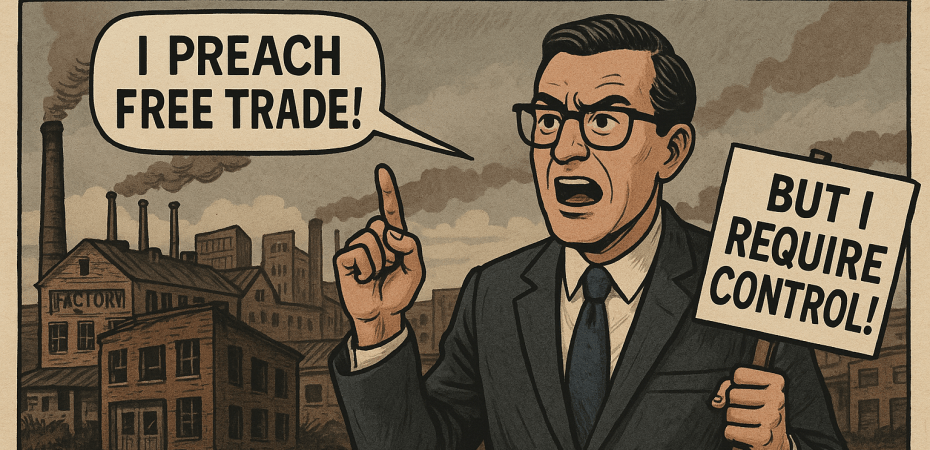
This afternoon, I began writing what follows as a response to Duncan Whitmore’s Tariffs, Trade and Trump – an Austro-Libertarian Response. However, another target soon emerged that was much more inspiring. I hope Mr Whitmore will not take anything unkind I may have written as directed against him, because he soon stopped being the person I had in mind. I will explain.
My A-Level Economics course has collapsed. The teacher is off on long-term sick leave, and his place has been taken by a shifting cast of supply teachers, most of whom might as well have been pulled from a bus queue. None can teach the subject in any consistent way, and none seems particularly interested in doing so. It doesn’t matter. I’ve read the textbook. I’ve read everything else worth reading. When it comes to sitting the exam, I will draw on my own notes and on Dr Gabb, whose talents are not confined to Greek and Latin.
The reason I mention this is because one of these supply teachers—an uninspiring man with a beard and jacket, and the sort of dandruff that suggests a longstanding war with personal hygiene—decided to burn off eighty minutes of my life this morning with a sneering diatribe against Trump’s trade policies. His argument, if one can call it that, was that any politician who refuses to embrace the impersonal wisdom of market forces is a moron. Apparently, tariffs are barbaric, and those who favour them are a danger to the well-being of the nation.
When he asked in the usual formulaic way for any questions, I put up my hand. I summarised his claim, then asked whether he’d apply the same logic to minimum wage or anti-discrimination laws. These too reject market outcomes. Watching him try to draw distinctions that didn’t exist was the only enjoyable part of the lesson. If I’d cared enough, I might have pressed him to admit what any honest economist knows: economic analysis is a tool. It clarifies choices. It doesn’t dictate them. A rational leader considers more than abstract theory.
Let me begin, then, by admitting the obvious. The abstract case for free trade is unanswerable. It rests on the principle of comparative advantage, first articulated by Ricardo. If Portugal can produce wine more efficiently than England, and England can produce cloth more efficiently than Portugal, then each should specialise and trade. The result will be greater total output and, by implication, higher average living standards.
From this we derive a cascade of benefits. Free trade lowers prices. It creates incentives for specialisation and innovation. It discourages domestic monopolies and restrains rent-seeking. If pursued consistently, it also makes war more disruptive, by intertwining the economies of states that might otherwise be enemies. These are all real advantages. But they are no more decisive in practice than the theoretical case for abolishing income tax and closing down the central banks. The world is not arranged according to economic logic. Nor is policy.
Those who shout loudest for free trade are rarely those who care most about freedom. Most have no time at all for a minimal state, or for personal autonomy. They deploy economic logic not as an end, but as a means. Their goal is not prosperity. It is control. This becomes obvious if you consider where the idea of free trade came from, and what purposes it has served.
Take the nineteenth century, when free trade became the central dogma of British policy. Ricardo’s theory was not simply a feat of clever economic analysis. It was also a weapon. His theory of rent—alongside his theory of comparative costs—was directed at the landed interest. At the end of the Napoleonic Wars, agricultural prices soared. Britain faced what was called “agricultural distress.” But this had nothing to do with the Corn Laws. The real cause was the eruption of Mount Tambora in 1815. This was the most powerful volcanic eruption in recorded history, and it disrupted global weather patterns for years. Harvests failed. Prices quadrupled. There was nothing to import. Or rather, there was nothing to import cheaply. Lowering tariffs would have done as much good against the supply shock as showering the population with fresh banknotes from a hot air balloon.
But this didn’t matter to those who had other ends in view. The free trade campaigners, culminating in the Anti-Corn Law League, backed by the factory owners of Manchester and Birmingham, used the food shortages as a pretext. What they wanted was cheaper bread, not to feed the poor, but to cotain wage costs. Hungry workers were demanding higher pay. Well-fed workers would be more docile. The repeal of the Corn Laws in 1846, then, was not an act of kindness. It was a calculated betrayal. Peel’s embrace of free trade was less about principle than about serving the interests of a new class of capitalists—those who had money but not land. It was the start of a long process whereby political power was transferred from the aristocracy to the monied interest.
This is not to say that free trade brought no benefits. It did. But its benefits were uneven, and its advocates were rarely disinterested. By the late nineteenth century, Britain remained formally committed to free trade, even as its rivals—America, Germany, and Japan—built their industrial power behind high tariffs and state-directed investment. These countries grew. Britain stagnated in relative terms. Still, the rhetoric of free trade persisted. It was a totem. A myth. It served to legitimate a political order in which financial capital, centred in the City of London, reigned supreme.
The pattern repeated itself in the twentieth century. By now, the idea of free trade had become less a policy than a symbol. It was no longer linked to any broader belief in limited government. Rather, it became a useful exception in a system otherwise built on high taxes and social engineering.
The key to understanding this is the nature of the modern ruling class. In the early nineteenth century, the rich were landowners. They had an interest in the long-term viability of the country. Their wealth was tied to the soil. Later, industrialists joined them. They too had fixed capital. They built things. They employed people. They lived in the same communities as their workers.
But from the twentieth century at the latest, a different class began to dominate: the monied interest. These were not builders. They were not manufacturers. They were speculators. Their wealth came from manipulating money, not creating value. They were rootless by design. For them, England was a trading platform, not a home.
The interests of this class are straightforward. They want open borders—not just for goods, but for capital and labour. They want low taxes on financial transactions and high taxes on productive enterprise. They want weak nation states and strong global institutions. Most of all, they want a population that is too fragmented and too insecure to be capable of resistance. The destruction of the industrial working class since the 1970s was no accident. It was policy.
The story of Britain’s deindustrialisation is not one of passive decline. It is a story of deliberate destruction. From the late 1970s, successive governments—Labour and Conservative alike—chose to prioritise financial services over manufacturing. They slashed tariffs. They tightened monetary policy. They allowed the pound to rise against the dollar and the Deutschmark, rendering British exports uncompetitive. They strangled heavy industry with health and safety regulations, environmental directives, and capital taxes that sent investment abroad.
This wasn’t an accident. It wasn’t even stupidity. It was malice. The traditional working class, with its unions and its solidarity and its obstinate pride, had become a nuisance. It could strike. It could organise. It could vote. It remembered, dimly, a time when it mattered. That had to end. And so it did.
The resulting pattern was textbook Heckscher-Ohlin. Capital-rich Britain shifted towards capital-intensive services. Labour-intensive industries fled to China and Bangladesh. The economy “specialised”—just as the models predicted. But the models left something out: people are not factors of production. They are not infinitely mobile. When steelworks close in Sheffield, the unemployed do not migrate to Shanghai. They sign on. They drink. They decay. Their communities rot around them.
And then come the economists, blinking behind their glasses, to explain that average GDP per capita has gone up, so what’s the problem? The problem is that averages conceal. In the past forty years, we have built an economy where one part of London earns like Manhattan, and much of the North lives like post-Soviet Moldova. The wealth exists, but it is walled behind postcodes and connections. Those who lost their jobs in the 1980s were told to retrain. Retrain as what? There are only so many roles in marketing. The man who built turbines is not going to “upskill” into strategic PR consultancy. He is going to become obsolete—and then be blamed for it.
This is where the free trade debate collapses. The abstract logic is sound. But the social cost is dumped on those with the least power to avoid it. Under normal conditions, market shifts cause disruption. But the market also supplies compensations—new industries, rising wages, geographic mobility. In a healthy nation, people move from farm to factory, from factory to factory, from factory to office, and everyone rises together.
That is not what has happened. What we have is global specialisation without national cohesion. Britain has moved from industrial autonomy to total dependence. We import our energy, our steel, our fertiliser, our microchips, our pharmaceuticals, even our weapons. The assumption is that the world will always provide. But what if it doesn’t? What if the sea lanes close? What if the suppliers stop supplying? What if China decides it no longer wants to sell us cheap electronics in exchange for digitally-printed IOUs?
The reality is that Britain today could not fight a serious war, or survive a major supply shock. Our self-sufficiency is a joke. And this is not the result of natural market forces. It is the outcome of policies chosen by men who do not believe Britain needs to exist.
This brings me to the real point. The free trade consensus, as enforced since the 1970s, is not a product of classical liberalism. It is not even about economics. It is about class. A class that owns without building. That speculates without risk. That hides behind shell companies and jargon. A class with no stake in the nation, and no interest in those who live in it.
For this class, globalisation is not a cost. It is a strategy. It breaks up national identity. It turns workers into renters. It reduces resistance. It replaces inherited communities with transient labour. It makes everyone interchangeable, and therefore disposable. The “openness” it demands is not a condition of prosperity—it is the condition of their power.
This is why the same people who demand free trade also demand mass immigration and media censorship. They are building a regime, not an economy. And their ideal subject is a deracinated, over-medicated serf who believes that trade, like morality, is something imposed from above by experts.
To illustrate this, let us go briefly back to Robert Peel. His repeal of the Corn Laws was hailed as a victory for logic over prejudice. In truth, it was the first step in a long betrayal. Peel was the prototype for the modern Tory: say whatever it takes to get elected, then do whatever the bankers ask. He gave us limited liability, creating the modern corporation as a mask for irresponsibility. He gave us a banking system rigged in favour of the City. And he gave us unilateral free trade, not because it made Britain stronger, but because it made his friends richer.
Two hundred years later, we are left with a hollowed-out country: a handful of prestige firms floating above a sea of zero-hours contracts and urban blight. In theory, we are still rich. In practice, we are anaemic. And all the while, the advocates of this order continue to quote Adam Smith:
Were all nations to follow the liberal system of free exportation and free importation, the different states into which a great continent was divided would so far resemble the different provinces of a great empire. (Wealth of Nations, Book IV, Chapter 3, Part II:)
This is often cited as a defence of globalisation. It should instead be a warning. Smith was describing a hypothetical—a system of mutual trust and open exchange. What we have is no such thing. The modern world is not a great empire. It is a set of hostile camps, ruled by oligarchies, and manipulated through proxies. Trade in this world does not bind. It enslaves. It turns nations into dependencies. It hands power to those who can move their capital at will and strips it from those who cannot.
This is the context in which “free trade” must be judged. Not as an abstract doctrine, but as a political instrument. And the reality is this: in the hands of our current elites, free trade is not freedom. It is a mask for domination.
When he was younger, Dr Gabb used to wonder why so many politicians seemed so desperately attached to the idea of globalisation. Surely they could see what it was doing. The hollowing out of towns, the disappearance of skilled jobs, the replacement of pride in work with service-sector compliance. But I understand, and so now does he. They saw it all perfectly well. They simply didn’t care. Or worse—they liked it. Because globalisation wasn’t a side effect. It was the point.
Free trade, as interpreted since about 1975, is not a system of voluntary exchange. It is an ideological weapon. It is used to justify the demolition of national economies, the devaluation of citizenship, and the entrenchment of a new ruling class with no homeland, no loyalty, and no sense of obligation. The same class that tells us open borders are economically necessary also tells us that national identity is a moral disease. The same class that defends “comparative advantage” also defends the idea that your nation’s traditions, industries, and cohesion must all be sacrificed on the altar of efficiency.
The result is a society that resembles a logistics hub with delusions of grandeur. Goods flow in. Debt flows out. Culture becomes entertainment, and entertainment becomes therapy. The population is drugged, tracked, entertained, and pacified. And all of this is framed as “progress.” What we’ve really done is turn entire cities into holding pens for surplus labour.
This isn’t capitalism. It’s not even mercantilism. It’s managerial cannibalism. It consumes the social capital built by previous generations and vomits it back as statistics about GDP growth and “consumer choice.” We are told this is liberty. It is not. Liberty presupposes self-government. Self-government presupposes self-sufficiency. And self-sufficiency requires production.
A nation that cannot make its own weapons cannot defend itself. A nation that cannot feed itself cannot survive a blockade. A nation that cannot produce its own medicine, its own steel, its own energy, cannot endure a crisis. And yet, here we are: a country that imports its tanks, its turbines, its semiconductors—and increasingly, its food. We’re not a sovereign state. We’re a tenant.
The usual reply to this is that markets will always provide. Maybe they will. Maybe they won’t. But sovereignty is not about convenience. It is about capacity. You don’t insure your house because you think it will burn down. You do it because you can’t afford to be wrong. And yet we are told that any attempt to rebuild domestic industry is a dangerous form of protectionism. As if sovereignty were somehow incompatible with prosperity.
This is absurd. No sane person wants tariffs for the sake of tariffs. No one is arguing for a siege economy or a return to the 1950s. But what we have now is worse than protectionism. It is dereliction. It is the abandonment of the most basic responsibilities of statecraft. And all of it is done in the name of a “free market” that doesn’t exist. The free market, as usually advertised, is a lie. There is nothing “free” about trade between a tightly regulated British firm and a Chinese sweatshop subsidised by state surveillance and artificially suppressed energy prices. There is nothing “efficient” about importing fruit from Peru and electronics from Malaysia while leaving entire British towns to rot. There is nothing “natural” about an economy whose entire structure is the outcome of political manipulation—of interest rates, of subsidies, of regulations, of foreign policy.
As Dr Gabb rightly observes, most of what we call “free trade” is simply global mercantilism propped up by American military power. Shipping lanes don’t guard themselves. Petrochemical extraction doesn’t happen spontaneously. Global trade is sustained by a network of political interventions—many of them violent. Without those interventions, the price of globalised supply chains would be far higher, and their supposed “efficiency” would collapse.
If we accept that, then the moral high ground claimed by free traders disappears. What we are left with is a choice: do we continue serving the interests of a rootless class of financial extractors, or do we begin rebuilding the productive capacity of the nation?
This doesn’t mean we need a planned economy. But it does mean we need a real one. And a real economy is one in which people make things, sell things, and keep enough of what they earn to raise a family and pay for a future. We do not have that now. What we have is a parasitic simulation—an economy of compliance and consumption, run by cowards and crooks.
To rebuild, we need to begin with industry. That means stripping out the barriers to domestic investment: the environmental vetoes, the planning controls, the corporate welfare schemes that reward bloat and punish productivity. We need to abolish half the bureaucracies that exist only to make entrepreneurship impossible. Where private capital is willing to act, government must get out of the way. But where private capital will not act—because returns are too slow or risks too high—the state must intervene. This is not heresy. It is sanity.
Some industries need help. That help may be infrastructure. It may be tax relief. It may be partial ownership. In some cases, it may be tariffs. A tariff is not always a subsidy to inefficiency. It can also be a shield for development. The goal is not to coddle the useless. It is to support the useful. And yes, some things are worth supporting even if they don’t meet a hedge fund’s return-on-equity target.
Does this make me a protectionist? Not necessarily. I have no interest in raising up industries that will never walk unaided. But I do believe that Britain should exist—not just as a name on a map, but as a functioning nation. That means a population that works, not just shops. That means a working class that is skilled, secure, and proud. Not the economic underclass we have now—subsidised to consume and trained to obey—but a real class of men who know how to make things, and know they matter because of it.
This class once existed. It had leverage. And that’s why it was destroyed. You don’t need to be a Marxist to see the logic. The monied interest wanted obedience. And obedient populations do not come from coal miners, steelworkers, or machinists. They come from Uber drivers, care assistants, and office temps who know they can be replaced with a click.
The point of reindustrialisation is not nostalgia. It is not a plea for the return of soot and chimneys. It is a statement of necessity. Without industry, you have no autonomy. Without autonomy, you have no country. You have only a brand. And Britain, at the moment, is little more than a legacy brand—owned by others, traded like any other asset, and subject to rebranding when necessary.
So far, I’ve argued that the formal case for free trade is unanswerable—and largely irrelevant. I’ve said that comparative advantage is not a lie, but a truth used in service of a lie. That lie is the idea that “free trade” as implemented today is a neutral, spontaneous process. It is not. It is a deliberate political project, engineered and enforced by a ruling class whose wealth depends on destroying national economies and reducing human life to passive consumption.
Let me now turn to what a serious trade policy might look like.
First, we start by rejecting the false binary between protectionism and globalism. Neither describes a necessary outcome. The question is not whether to trade, but how—and for whom. Trade should serve the nation, not the other way around. That means:
- Keeping tariffs as a legitimate tool, not a permanent crutch.
- Supporting capital investment with tax and regulatory clarity.
- Dismantling environmental bureaucracy that blocks useful projects while enriching activists.
- Refusing trade deals that outsource sovereignty to international courts or multinational regulators.
- Linking trade policy to immigration control: if open trade demands open borders, then we have to choose.
The aim is not autarky, but balance. A country that trades, but also makes. A country that invests, but also owns. A country that benefits from the world, but can survive without it.
Second, we must confront the enemy within. The monied interest is not an abstraction. It is a class. It owns without building, extracts without risk, speculates without consequences, and hides behind layers of legal impunity. It owes nothing to Britain. It views this country as a tax haven with good broadband. And its power is sustained by the idea that trade, like diversity, is inevitable. This must end. Not trimmed. Not tamed. Ended.
We need to destroy the financial class—not the local shopkeeper or factory owner, but the offshore extractors who have turned our country into a spreadsheet. That means tearing down their legal structures. That means exposing their holdings. That means choking their pipelines of privilege, and replacing them with systems accountable to those who live here.
If that sounds radical, it’s only because we’ve forgotten how bad things have become. The United Kingdom is not governed by its people. It is governed by banks. Its laws are drafted by corporate lobbyists. Its industries are auctioned to the highest bidder. Its working class has been atomised, its middle class bought off, and its institutions hollowed out to serve PR campaigns.
And through it all, we are told that “free trade” is the solution. Free trade is, at best, a description of how things might work in a world of moral equals and economic reciprocity. We do not live in such a world. We live in a post-industrial theme park, supervised by activists, fuelled by debt, and ruled by a handful of billionaires whose children will never build.
This is not a call for economic nationalism in the old sense. I have no interest in propping up failed industries, or subsidising grape-growing in Glasgow. I am not arguing for North Korea. I am arguing for sovereignty. Because free trade, as currently applied, is not freedom. It is managed decline. It is the expropriation of the future by those who already own too much of the past. It is the cultural lobotomy of a people who once made ships and now cry out for free Ozempic injections.
Reading List
Classical Economics and Trade Theory:
- David Ricardo, On the Principles of Political Economy and Taxation (1817)
- Adam Smith, The Wealth of Nations (1776)
- Friedrich List, The National System of Political Economy (1841)
History and Policy:
- Sean Gabb, Free Trade (Libertarian Alliance, 2012)
- Ha-Joon Chang, Kicking Away the Ladder (Anthem Press, 2002)
- Paul Craig Roberts, The Failure of Laissez Faire Capitalism (Clarity Press, 2013)
Political Economy and Class Analysis:
- James Burnham, The Managerial Revolution (1941)
- Christopher Lasch, The Revolt of the Elites (1994)
- Peter Hitchens, The Abolition of Britain (1999)

Discover more from The Libertarian Alliance
Subscribe to get the latest posts sent to your email.
If you ever come to.London I’d like to meet..You talk more sense than most of your elders and non betters!
[…] is a response to a critique of the doctrine of free trade published on this blog a few months ago by an author writing as Bryan Mercadente. While the author […]
[…] Bryan Mercadente Title: Free Trade and Protection: Why the Economic Case Doesn’t Matter URL: https://libertarianism.uk/2025/05/16/free-trade-and-protection-why-the-economic-case-doesnt-matter/ Summary: Mercadente concedes the abstract economic case for free trade but argues that, under real […]
[…] are not natural developments. They are the result of political choices. As has been observed, the post-1979 settlement systematically dismantled the economic and social foundations of working-cl…, replacing them with dependency and insecurity. The pension became, in effect, the last guarantee […]