
This essay is an elaboration on the argument advanced by Marian Halcombe in her article Bring Back the Gallows: Crime, Eugenics and the Death of Justice. In her article, Mrs Halcombe suggests that the modern criminal justice system, by failing to execute or even isolate the most violent criminals, has undone centuries of eugenic selection against tendencies to violent crime. Her argument, bold but rigorously constructed, draws attention to the biological consequences of policy decisions rarely seen through such a lens.
The present essay offers a classical counterpart. It asks whether ancient civilisations—and Rome in particular—might be understood as early laboratories in this same process of pacification. Drawing on Peter Frost’s article, “The Roman State and Genetic Pacification,” published in Evolutionary Psychology in 2010, I examine whether Rome’s long rule of law and monopolisation of violence had the unintended consequence of behavioural selection. Frost argues that it did. While I find much to commend in his analysis, I shall also point out the limitations of his historical understanding. His reading of Roman history is serviceable, but occasionally superficial, and it does not always grasp the nuances of Rome’s ideological and institutional development. That said, the underlying biological model remains valid.
In what follows, I will explore Frost’s argument with reference to both ancient literary sources and modern historical commentary. This is not an exercise in historical conjecture. Rather, it is an attempt to understand how far state formation and social discipline can shape the character of a population—culturally, yes, but perhaps also genetically.
- Rome and the Emergence of Order
The Roman state was born in violence. Its founding myths centre on the fratricide of Remus by Romulus and the violent abduction of the Sabine women. Livy portrays early Rome as a haven for fugitives and criminals, drawn together by the promise of shared plunder. Even in late antiquity, Romans acknowledged this violent origin. St Augustine’s famous comparison captures the sentiment well:
If justice be taken away, what are kingdoms but great robberies?1
This idea—that states arise from violence but are legitimised through order—is critical to understanding Roman identity. Roman legal writers, historians, and moralists saw banditry (latrocinium) as the primordial threat to the civitas. Roman law did not merely punish bandits: it sought to erase their status entirely. Frost quotes Galen’s description of a bandit corpse left unburied as a deterrent, and indeed the latro was denied marriage rights, legal protection, and even posthumous recognition.2
From the late Republic onward, Rome presented itself not only as the master of the world but as its pacifier. Order, ordo, was not just a political but a moral condition. Men who killed without state authority were not only criminals; they were social pollutants.
- The Pax Romana and the Discipline of Violence
Peter Frost’s central argument is that, by monopolising violence and punishing unauthorised aggression, the Roman state altered the behavioural landscape of its subjects. He invokes Baldwinian selection—a process in which phenotypic change (behavioural compliance) precedes and facilitates genotypic change (reduced aggression over generations). Frost is not the first to note that violent behaviour is partially heritable, but he connects this with Roman governance in a novel and provocative way.
The Pax Romana did not eliminate violence. It redirected it. The Roman state was extremely violent in asserting its rule over newly conquered territories. But once pacified, provinces were brought into a legal order in which private violence was increasingly restricted. As the historian Weinstock observed, pax in its original Latin sense meant submission, not peace.3
Roman jurists developed complex procedures to ensure that disputes were resolved through courts, not blood feuds. This contrasted with the situation among the gentes beyond the Rhine or the Danube, where retaliatory cycles of violence continued for generations. The Roman legal system, as Liebeschuetz has shown, turned violence from a personal matter into a public one. Private vengeance was no longer tolerated; the state alone punished wrongdoing.4
These institutions did not merely change behaviour. They changed incentives. Frost’s suggestion is that, over time, men less inclined to violence would have greater reproductive success within the empire. While we cannot confirm this genetically, the logic is consistent with what we know from modern studies of heritability. Male aggression has a genetic component, and in societies that reward self-control and punish violent initiative, those with a lower propensity for aggression are likely to do better.
- Literary Echoes: Roman and Barbarian Temperaments
Ancient writers repeatedly commented on the difference between the Roman and barbarian character. Seneca contrasts the emotional volatility of barbarians with the restraint of Roman citizens:
Grief affects barbarians more than persons of a peaceful and learned people.5
Libanius, the fourth-century orator, draws the line even more sharply:
Barbarians are akin to beasts in despising pity, while the Greeks are quick to pity and get over their wrath.
Such statements are not evidence in themselves, but they reflect a persistent theme in Roman thought: the belief that civilisation required the suppression of instinct and the cultivation of reason. In the literary topos, barbarians are governed by furor, Romans by ratio. The difference is not only cultural but, in Frost’s reading, potentially biological—a difference reinforced across generations by the Roman legal and political order.
- Christianity and the Final Internalisation of Peace
By the second century, Rome had subdued most of its enemies. The empire ceased to expand, and violence turned inward—into the home, the soul, and the conscience. Into this setting came Christianity.
Origen, writing in the third century, recognised that the Pax Romana had prepared the ground for a universal religion of peace:
It would have hindered Jesus’ teaching from being spread through the whole world if there had been many kingdoms… Accordingly, how could this teaching, which preaches peace… have had any success unless the international situation had everywhere been changed?6
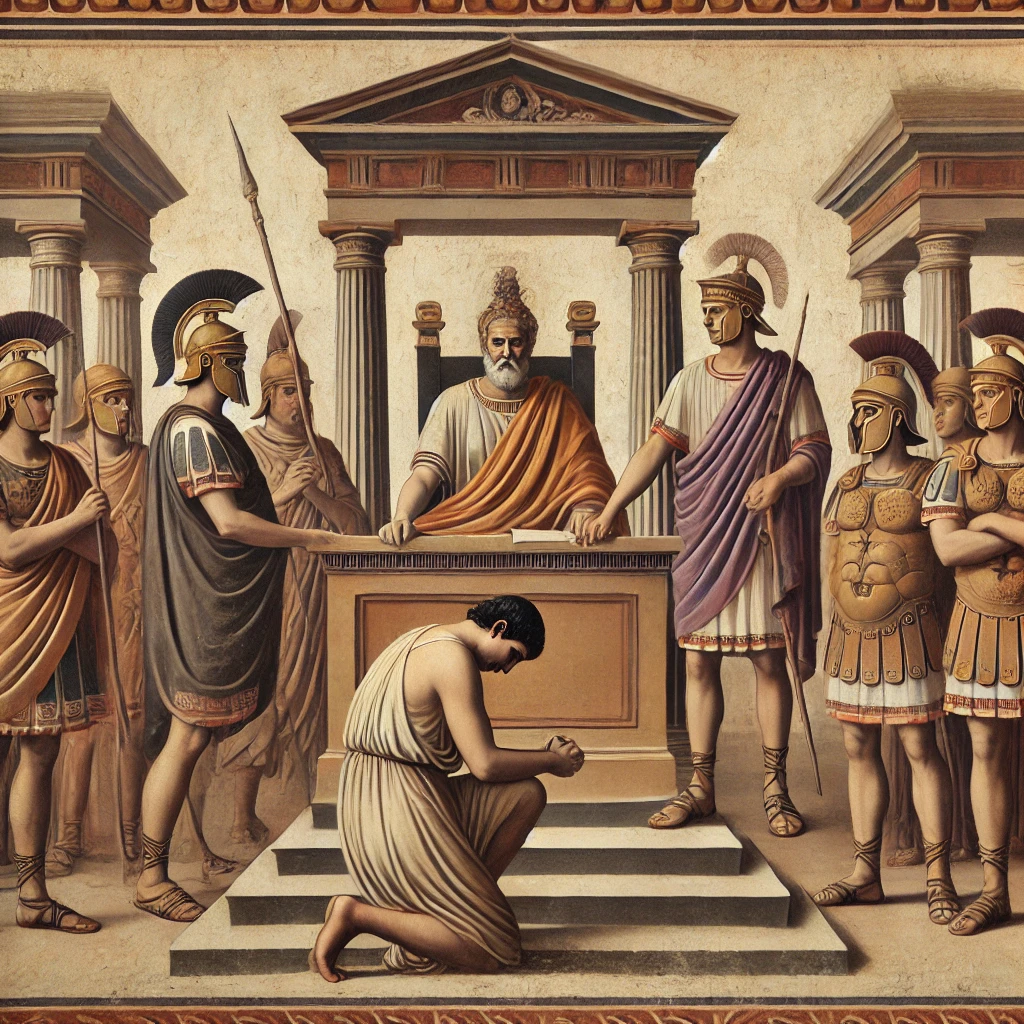
Christianity did not merely inherit Roman pacification. It sanctified it. St Ambrose, in his De officiis, argued that Christians should not kill even in self-defence. When the Emperor Theodosius ordered a massacre in Thessalonica, Ambrose demanded public penance.
The Roman state, once the supreme arbiter of violence, now knelt before a higher moral authority. The effect was not simply legal or doctrinal—it was civilisational. A new Roman was being formed: introspective, compliant, pacific. That Rome could no longer field enough soldiers from its own population is not simply a matter of demography. It is the outcome of centuries of pacification.
- Collapse and the End of Selection
The barbarian invasions of the fifth century were a reintroduction of an unpacified population into the imperial body. Frost notes, and he is right to do so, that until the fourth century, gene flow from outside the empire was limited. After that, it accelerated rapidly, as foederati were admitted en masse and later seized control of territory.
Roman civilisation had selected against the violent. Barbarian society had not. The outcome was tragic but predictable. Rome collapsed not because it was decadent or corrupt, but because its population was no longer suited to a world of violence. Prudentius, writing in 403, boasted:
No barbarian foe shatters my bars with his spear… I suffer such things no longer.7
Seven years later, Rome was sacked.
Conclusion: Reflections on Policy and Posterity
This essay has argued that the Roman state, by monopolising violence and punishing its illicit use, may have induced a process of long-term behavioural selection. This is not merely a curiosity of antiquity. It parallels, and in some ways anticipates, the processes discussed by Mrs Halcombe in her article on modern justice and its consequences.
Peter Frost deserves credit for advancing this thesis, though his historical reading is sometimes too general to capture the complexities of Roman society. Yet the essence of his argument remains sound. State institutions do not only shape the present; they may sculpt the future. If we eliminate selection against violence, we should not be surprised when violence re-emerges.
Modern states, like Rome, claim the monopoly on violence. But unlike Rome, they often decline to exercise it. The result may not be collapse—not yet—but it is certainly decay. The lessons of Rome are not merely about glory and ruin. They are about consequences, hidden and slow, that follow from decisions made in the courts, the Senate, and the forum.
- Augustine, City of God 4.4. ↩
- Galen, De anatomicis administrationibus 1.2. ↩
- Weinstock, S. “Pax and the Ara Pacis.” The Journal of Roman Studies, 50 (1960). ↩
- Liebeschuetz, W. “Violence in the Barbarian Successor Kingdoms,” in H.A. Drake (ed.), Violence in Late Antiquity. ↩
- Seneca, De Ira 1.1. ↩
- Origen, Contra Celsum 2.30. ↩
- Prudentius, Contra Symmachum 2.690–95. ↩
Selected Reading List
- Ambrose. De officiis. Translated by I.J. Davidson. Oxford Early Christian Studies, Oxford University Press, 2001.
- Arnobius of Sicca. Adversus Nationes. Translated by G.E. McGracken, Ancient Christian Writers No. 7. Newman Press, 1949.
- Augustine. The City of God against the Pagans. Translated by W.H. Green. Loeb Classical Library, William Heinemann, 1963.
- Chagnon, N.A. “Life Histories, Blood Revenge, and Warfare in a Tribal Population.” Science, vol. 239, 1988, pp. 985–992.
- Clark, Gregory. A Farewell to Alms: A Brief Economic History of the World. Princeton University Press, 2007.
- Frost, Peter. “The Roman State and Genetic Pacification.” Evolutionary Psychology, vol. 8, no. 3, 2010, pp. 376–389.
- Galen. De anatomicis administrationibus.
- Liebeschuetz, W. “Violence in the Barbarian Successor Kingdoms.” In H.A. Drake (ed.), Violence in Late Antiquity: Perceptions and Practices, Ashgate, 2006, pp. 37–46.
- Livy. Ab Urbe Condita, Books I–II. Translated by B.O. Foster. Loeb Classical Library, William Heinemann, 1957.
- Mathisen, R.W. “Violent Behaviour and the Construction of Barbarian Identity in Late Antiquity.” In H.A. Drake (ed.), Violence in Late Antiquity, Ashgate, 2006, pp. 27–35.
- Origen. Contra Celsum. Translated by Henry Chadwick, Cambridge University Press, 1965.
- Plutarch. Praecepta Gerendae Reipublicae. In Moralia, vol. X. Translated by H.N. Fowler, Loeb Classical Library, William Heinemann, 1949.
- Prudentius. Contra Symmachum, in Prudentius, vol. II. Translated by H.J. Thomson, Loeb Classical Library, William Heinemann, 1953.
- Parchami, Ali. Hegemonic Peace and Empire: The Pax Romana, Britannica and Americana. Routledge, 2009.
- Seneca. De Ira.
- Weinstock, S. “Pax and the Ara Pacis.” The Journal of Roman Studies, vol. 50, 1960, pp. 44–58.
- Williams, S., and Friell, G. Theodosius: The Empire at Bay. Routledge, 1994.
Discover more from The Libertarian Alliance
Subscribe to get the latest posts sent to your email.