I’m reading Electra for Greek A-Level—not just the required bits, I’ll add, but the whole thing. It moves with an energy that surprises me, considering the blood and psychological filth it has to carry. Still, it’s lighter going than Medea, and I find myself liking Sophocles more than I thought I would. I’m meant to prefer Euripides—obviously, I do—but Electra bounces along nicely. That’s what prompted this article.
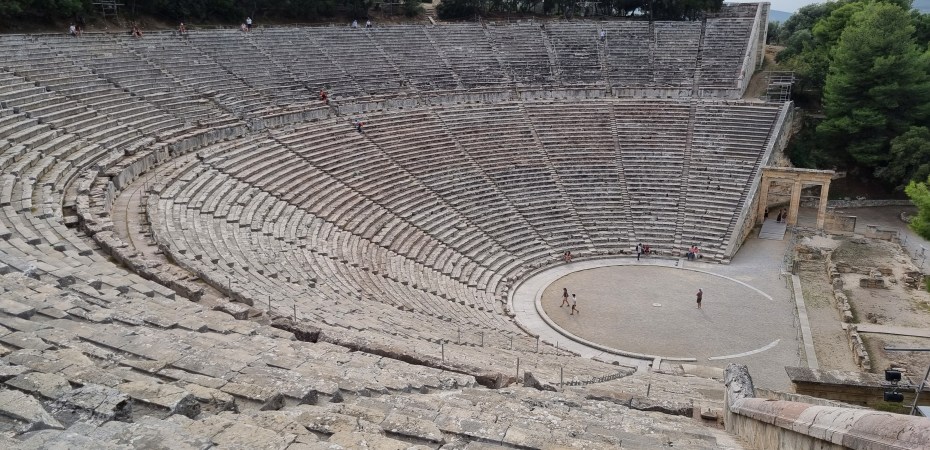
This year, my parents gave in to my urgent pleading, and arranged the family holiday in Greece. As it happened, Dr Gabb was out there at the same time, and still is there, giving a series of lectures to rich Chinese students. I made my way by bus from Argos to Epidauros, and he drove up from Kalamata. We met close by a swarm of German tourists and walked together to the finest surviving theatre from the ancient world. You’ve probably heard the cliché: you can stand in the centre of the orchestra and be heard all the way up. Well, I took turns with Dr Gabb, each of us reciting Homer while the other stood in the top row. The cliché is true. We heard each other perfectly.
I came away, though, with a further question. A voice will carry all the way up. But that was across empty stone benches. What happened in a theatre packed with 15,000 breathing and coughing spectators? Was it all a matter of voice projection? Or was there some other technology in use? I have now read a study that may explain what was actually going on in an ancient theatre.
The paper is called The Sound Effect of Ancient Greek Theatrical Masks. It was written by John Mourjopoulos and others, including an audiologist from Zurich and a mask specialist from Stockholm. This is not some pseudo-academic fluff padded out with quotes from Foucault and diagrams of power. It’s an engineering paper. They rebuilt theatre masks, measured sound radiation, and analysed the frequency response of the Epidaurus theatre using proper equipment, not anecdote. The results are astonishing, but also reasonably likely.
Everyone knows the Greeks used masks in their theatre. Most people assume they were just props—visual amplifiers of character, mood, and status. But this study shows that masks also shaped sound. They didn’t just muffle or distort the voice. They worked like acoustic filters, projecting certain frequencies and diffusing others depending on angle and distance. In other words, the mask was not a face covering—it was part of a system.
That’s what matters: the system. The study shows that voice, mask, and theatre worked together as one machine. The theatre itself—the limestone seats, the slope of the koilon, the rhythmic tiering—produced early reflections of sound that arrived milliseconds after the original voice. These reflections weren’t heard as echoes. They fused with the original sound and made it louder. Not in the vulgar sense of amplification, but in the sense of reinforcement. The brain hears the same signal twice, very close together, and perceives it as one, stronger sound.
Even more interesting is how this ties into the masks. The authors reconstructed two types: one with closed ears, and one with the ears exposed. They ran sound through a manikin’s mouth and recorded what came out at different angles. The result was a consistent boost in low-mid frequencies—especially around 250 to 1000 Hz. These are the ranges that carry vowel formants in Greek speech. They’re also the frequencies that carry best in air and contribute most to perceived loudness and intelligibility.
So the mask didn’t just channel sound forward. It boosted the frequencies that mattered, especially to listeners not sitting directly in front of the actor. In a theatre like Epidauros, which wraps halfway around the orchestra, this means the people off to the side got a sound that was clearer and more present than they would have otherwise.
The study also measured the actor’s own perception of his voice. With a mask on, the actor heard his own voice 18 decibels louder than usual. This is enormous. It’s like switching from whispering to shouting without changing effort. The authors note, quite sensibly, that actors may have needed earplugs. It’s a detail, but an interesting one. It shows that the ancient Greeks didn’t merely stumble into good theatre design. They iterated. They adjusted. They refined. In other words, they practised empirical science—not in theory, but in habit.
Some people think empirical science means wearing a lab coat and citing peer-reviewed journals. But the true foundation is trial and error. Try something. Observe. Change something. Try again. That’s what the Greeks did. They built theatres over decades, copying what worked, discarding what didn’t. They tuned sound the same way they tuned lyres. Not with equations, but with ears.
And the result was a theatre where you didn’t need mics or speakers. You just needed stone, masks, and human voice. That’s not magic. It’s intelligence—of the practical sort, not the credentialled kind. The authors of the study don’t overstate their case. They admit there are limits. They’re working with reconstructions. No complete mask has survived. The materials might not be identical. But the method is clear, and the results speak—literally—for themselves.
The data shows that intelligibility in Epidauros is excellent across all seats. The measured Speech Transmission Index remains around 0.9, even 60 metres from the source. Most modern classrooms can’t manage that. Nor can our parliament chambers. Yet some ancient Greeks working with limestone and intuition built something that still functions perfectly 2,000 years later.
That’s not nostalgia. That’s a rebuke. Our world is filled with design committees, building codes, and consultants. Yet we produce performance spaces with dreadful acoustics, schools where teachers must shout, and bureaucracies where even the microphones don’t work. The Greeks had slaves and superstition—but they had good ears. And they listened.
It’s easy to romanticise the ancients. I don’t. I know they kept their women indoors and wiped their bottoms with sponges on sticks—not that I deplore the first of these. But when it came to certain kinds of knowledge—bodily, spatial, auditory—they were not primitive. They were precise. This study shows how precise.
The paper also hints at something else: the therapeutic function of sound. Epidauros was part of a sanctuary to Asclepius, the god of healing. The theatre wasn’t just for entertainment. It was for medicine. The voice, properly tuned and delivered, was part of the treatment. If that sounds mystical, it probably is. But then, so is the idea that speaking truth has power. What the Greeks understood—maybe better than we do—is that voice and space and presence are inseparable. You can’t deliver meaning without form. You can’t move an audience without moving air.
That’s the real takeaway. They didn’t separate function from feeling. Their masks weren’t just tools. They were symbols, instruments, amplifiers. Their theatres weren’t just buildings. They were vessels of attention. And their drama wasn’t just words. It was breath made sacred.
Now, when I read Electra, I hear the lines differently. I imagine them striking stone and echoing back. I imagine the mask shaping the vowels, the cavea reflecting them, the audience leaning in. And I think how absurd it is that our schools still install ceiling tiles that eat sound and force teachers to shout over heating ducts.
There’s a kind of intelligence that modernity has buried. But it’s still there, in Epidauros, if you stand in the right place and listen.
Epidauros (SIG photographs)

Discover more from The Libertarian Alliance
Subscribe to get the latest posts sent to your email.
Related posts:
 Why I’m Fat, Fabulous, and Furious: A Response to Bryan’s Ancient-Greek Skinnyboy Delusion
 Learning Latin the Hard Way: What Ancient Greek and Modern Chinese Students Share
 A World Reconsidered: The Greek Polis and the Sino-Hellenic Turn
 Further Thoughts on Ancient Obesity
 The Party of Vomit and Ghosts: A Response to Daniel Hannan
Powered by YARPP.