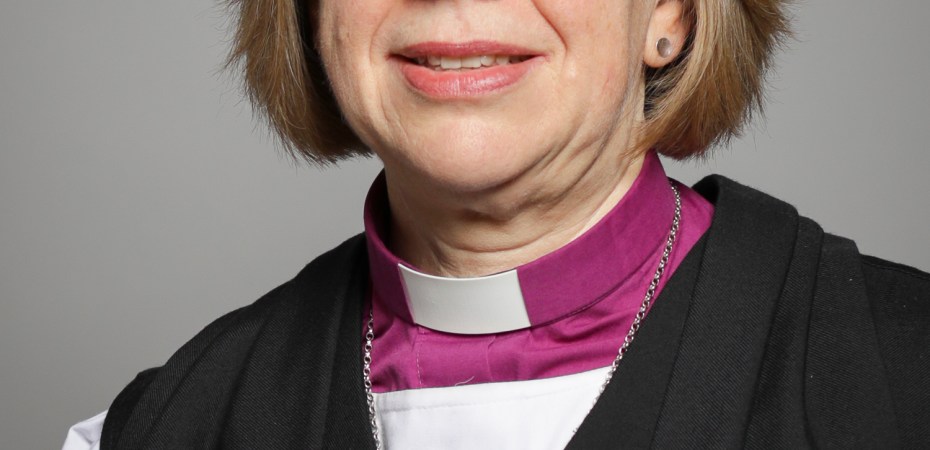
When, on the 3rd October 2025, Sarah Mullally was named Archbishop of Canterbury, the world’s press reacted as it always does to ecclesiastical innovation: with applause. Headlines spoke of “progress” and “equality.” Commentators congratulated the Church of England for joining the modern age. But the reality, seen from a Catholic perspective, is not cause for celebration. With this act, the Anglican Church has forced the question it has evaded since the sixteenth century. Either it has given up all claim to be part of the Catholic Church, or the See of Canterbury is vacant until a legitimate occupant may be ordained.
There is no middle path. The Catholic Church has always insisted that priestly ordination is reserved to men. St John Paul II’s Ordinatio Sacerdotalis (1994) merely expressed in definitive form what the Church had never doubted:
The Church has no authority whatsoever to confer priestly ordination on women, and this judgment is to be definitively held by all the faithful.
The claim is not disciplinary but ontological. The priest does not simply exercise authority; he stands sacramentally in persona Christi. Christ is the Bridegroom, the Church his Bride. Maleness is not incidental but integral to the sacramental sign. As St John Chrysostom observed when explaining why only men were chosen as apostles:
The priest stands as Christ himself; therefore he must be as Christ himself (Hom. in 1 Tim. 2).
The Orthodox, though reluctant to define by papal-style pronouncements, stand on the same ground. Their liturgy, canon law, and unbroken practice all assume a male priesthood. That universality across East and West, maintained for two millennia, is not a cultural accident. It is a testimony to divine providence.
If women cannot be ordained, then no ceremony attempting it produces a bishop or priest. It produces at most an office-holder in a national church, but not a minister in the sacramental Body of Christ. Mrs Mullally was never validly ordained as a priest. Her consecration as Archbishop of Canterbury will be a nullity. Such a ceremony, to be blunt, no more makes an archbishop than pouring water on a stone makes a baptism.
Now, you may ask what authority I have as a Catholic to pronounce on the doings of the Church of England. For my answer, I will develop the point I made above. So far as the Church of England claims to be part of the Catholic Church, even if estranged from Rome, the other branches of the Catholic Church have every right to pronounce.
Let me give the Anglican case a fair hearing. I am not comfortable with Leo XIII’s encyclical Apostolicae Curae (1896), which declared Anglican orders “absolutely null and utterly void.” That document argued that the Edwardine Ordinal fatally corrupted both form and intention, so that even subsequent attempts at correction could not restore apostolic continuity.
Many Anglicans, however, have maintained that their bishops stand in an unbroken line from Augustine of Canterbury, that valid succession continued even after liturgical reform, and that their sacraments retain objective reality. This is the core of the so-called branch theory: Rome, Orthodoxy, and Anglicanism are three branches of the one Catholic Church, severed externally but united by apostolic succession and sacramental life.
In principle, I am friendly to this view. It allows one to recognise Anglican liturgy as more than Protestant pageantry. It permits the hope that the unity of the Church is wounded but not destroyed. I cannot dismiss the Anglican claim with the ease of ultramontane polemicists. To do so would be to deny what looks, in places, like genuine sacramental vitality.
But even if we entertain the branch theory, the consecration of Sarah Mullally makes the tension unbearable. The branch theory only works if Anglicanism preserves the essentials of catholicity. A branch may have blemishes, but it must still draw sap from the same root. If Rome and Orthodoxy agree on what belongs to the essence of apostolic order, the Anglican Church cannot contradict both and still claim to be of one body.
The ordination of women is just such a contradiction. It is not a question of vestments or liturgical colour. It is a question of sacramental matter. If, as Chrysostom, Augustine, and the entire undivided Church affirm, the priest must be male to signify Christ the Bridegroom, then to ordain a woman is to alter the sacrament’s very substance.
Thus, even on the most generous interpretation, Anglicanism has crossed the boundary. It has ceased to be a Catholic branch. It has become another Protestant denomination, styling its ministry according to the desires of the age.
Two alternatives follow.
- Apostasy into Protestantism
The first is that the Church of England has abandoned its catholic pretensions. By consecrating Mrs Mullally, it has declared that it no longer measures itself by the standards of Rome or Orthodoxy. It has chosen instead to become a national Protestant church, like the Lutherans of Scandinavia or the United Methodists of America. Its orders may be meaningful to itself, but they are no longer recognisable as Catholic orders. Its sacraments may be received with devotion, but they are not the sacraments of the universal Church.
- The See of Canterbury is Vacant
The second alternative applies if one still clings to branch theory. In that case, one must judge Mrs Mullally’s consecration invalid. She is not a bishop. The line of Augustine, Anselm, and Cranmer is not continued in her. She may sit in the throne of Canterbury, but she does not occupy the See. The office is empty.
This conclusion is severe, but inevitable. As the Council of Nicaea declared in its canons, only a properly ordained bishop can occupy an episcopal chair. If the consecration itself is null, the See is vacant by fact, whatever the state may decree.
The sacramental rupture is worsened by Mrs Mullally’s moral positions. She has shown herself sympathetic to abortion rights and to the recognition of same-sex marriage.
The teaching of the early Church on abortion is clear. The Didache (1st century) commands: “You shall not murder a child by abortion nor kill what is begotten.” Every Father of the Church who speaks on the subject condemns the practice. To affirm abortion is not to update discipline but to contradict the deposit of faith.
Likewise with same-sex marriage. St Paul in Romans 1 speaks of homosexual practice as contrary to nature. The Fathers from Clement of Alexandria to John Chrysostom echo the same. For the avoidance of doubt, I do not believe that the secular authorities have any right to punish men for sleeping with each other. At the same time, their conduct is immoral according to Church teaching. A bishop who treats their unions as compatible with Christian marriage ceases to guard the flock and instead exposes it to wolves.
Thus, the Church of England has not only consecrated invalid orders. It has enthroned a moral theology at odds with the Christian consensus.
The defenders of Mrs Mullally’s consecration appeal to “listening to the Spirit.” They argue that Jesus included women, that the Church must adapt, that equality demands change. These claims may sound noble, but they reveal the rupture. They imply that tradition is disposable, that the Spirit contradicts himself, that modern ideology is the arbiter of truth.
Catholicity is not innovation but continuity. The Church develops, as Cardinal Newman taught, but it does not deny what it has always held.
Newman’s Essay on the Development of Christian Doctrine distinguished between true development and corruption. True development brings out implicit truths, harmonises with past teaching, and strengthens continuity. Corruption, by contrast, contradicts what came before, introduces novelty alien to the deposit of faith, and produces rupture. The ordination of women is no development. It does not unfold hidden truth; it overturns settled practice. It is corruption in Newman’s precise sense—a “doctrinal counterfeit” that imitates progress while destroying substance.
What, then, is the way forward for Anglicans of goodwill? They must decide whether to embrace Protestant identity or to repent of this innovation. If they embrace it, they should admit openly that they have left catholicity behind. If they repent, they must treat Canterbury as vacant and seek reconciliation with the wider Church.
I say this not with malice but with grief. For I have hoped that the Anglican patrimony might enrich a reunited Church: its liturgy, its hymnody, its reverence for Scripture. But this hope cannot survive if Canterbury enthrones a bishop who is no bishop, and who affirms what the Church has always condemned.
The consecration of Sarah Mullally is hailed by the world as progress. To the Catholic it is a scandal. Either the Church of England has abandoned its Catholic claim and embraced Protestant identity, or the See of Canterbury is empty, awaiting a true successor.
The throne of Augustine now stands vacant or corrupted. The Fathers testify against it. Newman’s test of continuity condemns it. What the age calls inclusion, the Catholic must call apostasy.

Picture: from Wikipedia by Roger Harris
Discover more from The Libertarian Alliance
Subscribe to get the latest posts sent to your email.
Any claim the C of E might have had to being catholic, were destroyed the moment it pretended to ordain the first woman as priestess. The peculiarly Anglican “branch theory” means nothing. The Church cannot be divided, hence we return to AD 1054 when the Great Schism occurred and people started going in different directions, but the majority of the Church remained intact under the four ancient patriarchates.
I’m no Christian, but this is of interest: https://chimpreports.com/church-of-uganda-rejects-appointment-of-rt-rev-sarah-mullally-as-archbishop-of-canterbury/.
The CofE, of which I am a member, has become almost entirely heretical. Yes, this woman’s ecclesiastic orders are invalid. I would argue that receiving “Holy Communion” from this woman would be a mortal sin. The idea that she will crown Prince William king makes a nonsense of everything – he is apparently thinking (although it is not his choice) of ditching the Established Church anyway. We need to declare interdict on the CofE and work out which if any of the clergymen are faithful Christians and start again. Abraham’s conversation with the Lord is quite apt: will God destroy the city (Sodom) if even 10 good men are found in it? Well, can 10 good clergymen be found in the CofE?
It will be harder and harder to find a validly ordained Anglican Minister without a detailed inquiry into who ordained him and who ordained them. The Apostolic Succession – so far as it exists – is now at least tangled. It will soon be broken.
Genesis 18:32.
[…] I don’t know Greek or Latin. I don’t want to know them. As for religion, where I grew up, the Westboro Baptist Church would’ve been a serious upgrade from the lunacy most people took seriously. So if you want a theologically literate critique of the new Archbishop of Canterbury, you can read Sebastian Wang’s essay. […]
Sebastian you present as highly intelligent.
Why then can’t you perceive that all this God is an invention of man to explain the unknown?
So it really doesn’t matter
Of course it’s a human invention, but it does matter as long as people still believe it, and some religions are objectively worse than others.
Look at at it: never mind larping as a Bishop, that’s a man larping as a woman.
The Church of England has always been a political project, so in fact there’s nothing new happening in that respect. It’s not just the Church of England that’s fallen it’s the entire British state apparatus.
The Church fell long before the Roman Catholic – Protestant split, go to Turkey and ponder on the early Orthodox Christian sites there.
There’s much work to be done, including retaking Constantinople for Christianity.
[…] hall, one can no longer speak of schism but of apostasy. It stands beside the appointment of a woman Archbishop of Canterbury as a rejection of the True Faith as evidenced by Church tradition. The very notion of sacred space […]