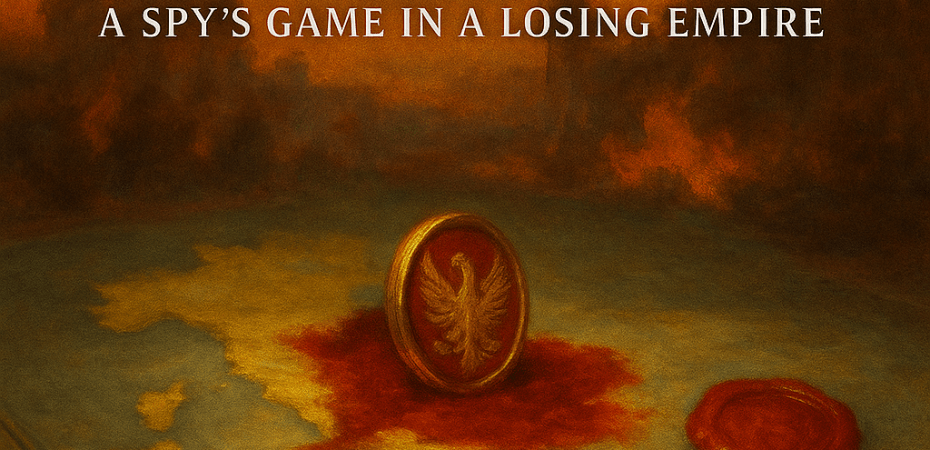
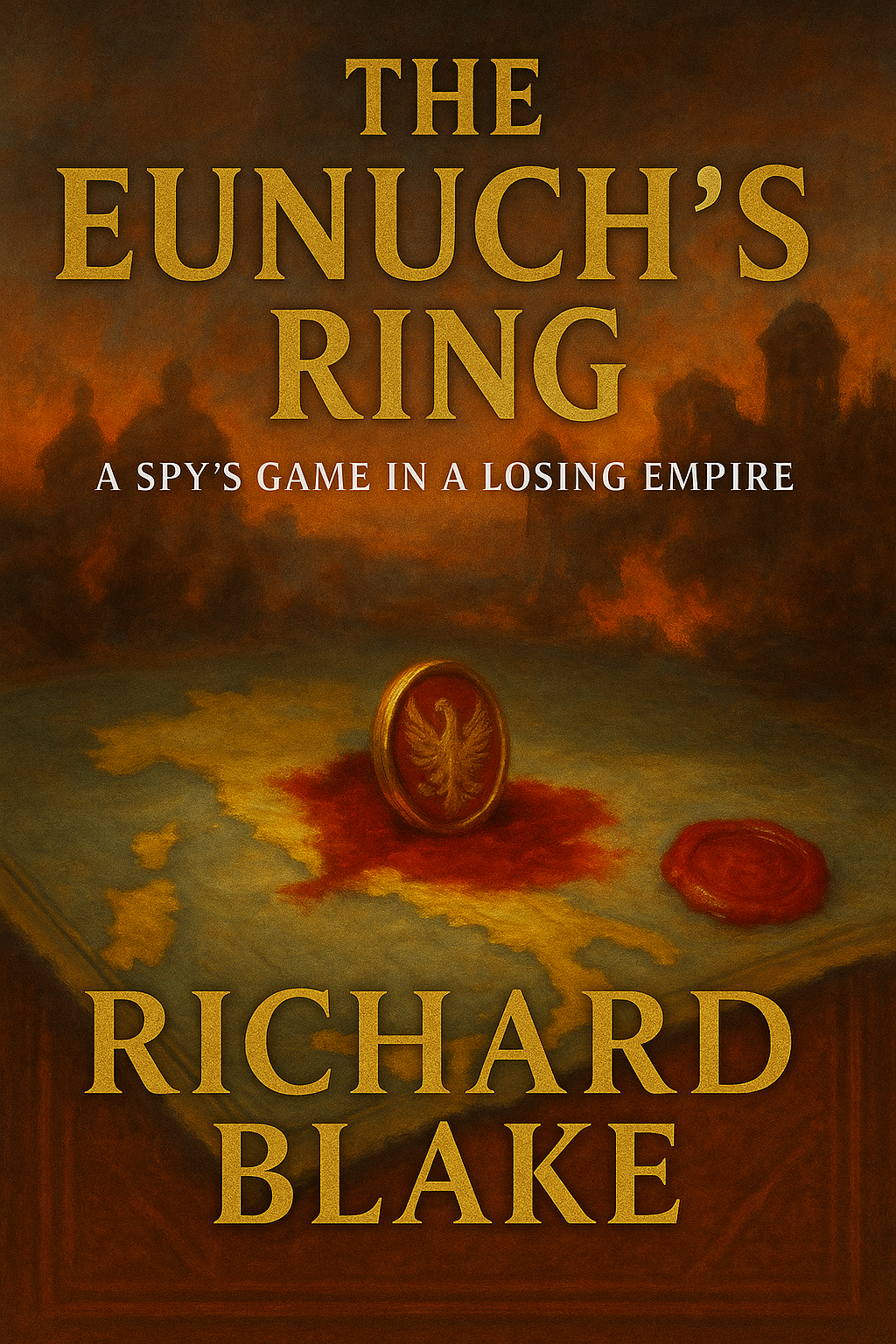
The Eunuch’s Ring
Richard Blake
Hampden Press, 2025
It would be dishonest not to begin with a confession. Richard Blake is Sean Gabb, and Sean Gabb happens to be my Greek teacher. Under those circumstances, it would be difficult for me to produce a bad review of The Eunuch’s Ring. But as it happens, no special indulgence is needed. This book earns its praise honestly.
I will begin with the premise. The protagonist is Roderic of Aquileia – “Rodi” – a young Goth in the clandestine service of Eleutherios the Eunuch, Exarch of Ravenna. Eleutherios sends him south to Benevento under the alias “Master Ediulf of Salorno.” His public role is that of a Greek tutor, hired to teach the fourteen-year-old prince Gisulf. His real mission is to find out what Duke Arechis of Benevento is doing with his army and his foreign policy, and to let the Eunuch decide what public excuse he needs to turn up and hang everyone in sight.
Benevento is ruled in the Duke’s absence by his wife, the Duchess, a pompous alcoholic, who manages to be both shrewd and grotesque, and by her ancient steward, Clementian. Other important figures in the court include:
- Gisulf, clever and feline, half-child and half-monster.
- Aripert, a vicious but handsome Lombard prince from Pavia, a year older than Rodi, with a history of “murder attempts” and half-friendship with him.
- Lucas, an intelligent carpenter’s mate who will later become crucial in organising the city’s defence.
- A papal Legate and his smooth secretary, representing Roman Catholic interests in a duchy that is still, officially at least, committed to the Arian heresy.
- Inga, a grossly fat slave girl who knows more than is good for her.
That will do for the premise. Summarising the 535 pages of the novel would take too long, and would involve too many spoilers. I will only say that Rodi wastes no time in realising that everyone is lying to everyone else. The only common interest between them is that they are all lying to Rodi.
The first murder in the novel is worth waiting for. It is so vile that you feel the shock of those standing over the body. Blake writes scenes of horror with such dry precision that they gain force from understatement. On page 49, we find this:
Scaring a cloud of buzzing flies, Clementian lifted a cloth from the still face. “Since you asks, Me Lady, I’d say he choked after his cock and balls was pushed down his throat and his lips sewn shut. I can’t see how anyone would survive that for long.”
He paused, a look of grim disgust on his face. His audience of the palace slaves groaned again in unison. He waited for silence, then, in a low and croaking whisper: “That’s assuming he wasn’t dead already from the loss of blood.”
He stepped away from the body and raised his voice. “But I’ll go with choking. That’s a horrid look on his face.”
It was a horrid look. Arms pinned behind him, Rodi looked at the body of the serving boy he’d been using. Hard to say what tubby Quintus was doing in Rodi’s bed. Harder to say why it was the teaching clothes that had vanished from Aripert’s room hitched about his waist…
“Oh, but it’s so – so vile!” the Duchess cried… “Whoever has committed this bestial act has surely forfeited all rights to humane treatment. I decree that he must be caught at once and examined, and then put to death.”
That passage captures Blake’s art: calm, controlled, appalling. He writes the early seventh century as if he had walked its streets. Benevento emerges not as the generic “dark age” city of modern historical fiction, but as a place with cracked mosaics and echoing baths where the water has stopped running. Roman marble columns prop up Lombard timber roofs. The Empire’s ghost lingers everywhere while barbarism learns to speak in passable Latin and with a lawyer’s tongue.
That moral cynicism is the book’s true centre. Blake has an entirely healthy distrust of anyone in or near power who talks about the welfare of others. The Duchess speaks of God and duty, yet every word masks pure self-interest. The Lombard princes declaim about honour while drowning their rivals in blood. What makes these people memorable, though, is not their villainy but their plausibility. Blake’s characters are driven by appetite and fear. Each is trying to survive in a world where decency is an affectation, and mercy a form of weakness. Even Rodi—supposedly our guide through the inferno—can lie and kill with professional calm. Blake’s world contains no heroes, only people clever or lucky enough to stay alive.
The historical background is equally convincing. Few novelists have captured so well the moment when Rome’s empire had not yet vanished but the Middle Ages had already begun. Benevento’s splendour is faded, yet its rot is beautiful. You can almost smell the incense mingling with sewage, and hear a choir singing off-key in a half-collapsed basilica.
Blake’s prose has always been clear and muscular, and here it reaches a cruel elegance. His sentences have a strange calmness that makes the horror cut deeper. The violence is rarely shouted; it seeps in through perfect syntax. He writes like someone who has accepted evil as a fact of history, not an interruption of it. The dialogue is lean, often funny in its cynicism. The pacing is exact: no scene lingers beyond its use, no revelation arrives too early.
I could list more virtues—the political intrigue, the economic realism, the cold eroticism—but the main point is this: The Eunuch’s Ring works. It entertains, disgusts, and fascinates in equal measure. It restores the moral gravity that most historical fiction now evades.
I am ordering copies as Christmas presents for both grandmothers. The one who supervises what I watch on Amazon Prime has already seen enough deranged Asian horror to appreciate this novel’s subtler cruelties. I may even read some of the gorier bits aloud in PSHE classes. There is a fat boy with spots and bad breath who bangs his head against the wall whenever anyone mentions the Ukraine War. The passage where a gagged prisoner is sliced apart, his softer extremities fed to wild animals, seems just right for him.
But personal amusement aside, this book deserves serious attention. It is a novel for grown-ups—about power and the thin crust of civility that separates intelligence from barbarism. Anyone who believes history is progress should read it and despair.
Discover more from The Libertarian Alliance
Subscribe to get the latest posts sent to your email.