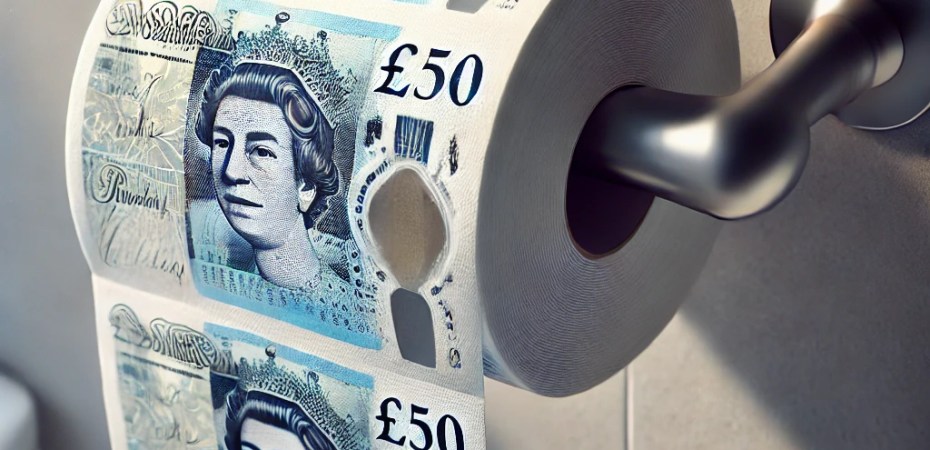
There was once a reliable body of advice on the conduct of one’s financial affairs. You saved before you bought. You paid in cash where possible, and when credit was unavoidable, you cleared the balance with all proper speed. You avoided novelties dreamt up by banks and finance houses. And you kept your expenses below your income so you might lay something aside for emergencies and for old age. This was the moral and practical code of the English middle class, and I followed it for most of my life with almost religious diligence.
I have taken almost no consumer credit in my seventy-three years. I disliked having a mortgage, and I paid off the one I had as fast as the agreement allowed. When I wanted a car, I saved the money and bought second-hand. When a computer needed replacing, I did the same. My general custom has been to keep clear of debt, to save as much as I reasonably could, and to place my savings where they might grow without undue risk. I have always taken pride in this, and would in earlier times have been widely praised for it.
Yet, if I examine the matter honestly, I cannot claim that this carefulness has made me rich. I am not poor, but I could be far wealthier than I am. Over the span of my life, the pound has gone from something battered but still admirable to an embarrassment. When my grandfather was a boy—in those magical days before the Great War—an ounce of gold was £4 5s. By January 1968, when I began to take an interest in safe investments, an ounce was £14 13s. The pound had fallen to barely a third of its 1914 value. Today, with gold at around £3000 an ounce, the pound has fallen close to a thousandth of its 1914 value—that is, it is worth about a farthing in hard money.
If you look at the official price indices, the fall has been substantial but less dramatic. The reason for this is that the scientific and technical progress of the past century has brought about a steady deflation of production costs and prices of physical goods. This has in some degree hidden the inflation. I suggest a better way of seeing what has happened is to look at the price of gold bullion. The resulting numbers are so shocking that they do not at first register: the pound of my birth was not the pound of my birthright, and that in turn was not the pound of my adolescence or middle age, nor of my present decline of life.
The consequence is plain enough: I have missed opportunities that a more relaxed view of debt and investment would have made possible. I have been prudent by instinct and habit, while the nature of the world around me has rewarded imprudence. Or perhaps it is better to say that what looks like imprudence is not imprudence at all, once inflation is taken into account. For three generations, inflation has spread like dry rot through the structure of British life. It has twisted everything out of true. It has made nonsense of common sense, and virtue of vice. It has turned what once was caution into something near foolishness.
Let me give a simple illustration. Imagine that consumer inflation is running at fifteen per cent a year—which is what it seems really to have been for several years now—and that savings accounts pay two per cent, and that a shop offers an instalment plan at twenty-five per cent. A man wants a washing machine priced at £800. If he saves carefully, he may put aside £67 a month. After twelve months, he has his £800 and a further £16 in interest. Very commendable. But the washing machine has meanwhile risen in price to £920. He is still more than a hundred pounds short. He must continue saving—or he must buy an inferior product.
Now consider that same man taking out a credit agreement. He buys the machine at the present price and agrees to repay £1000 over the year. There is £200 in interest, which would once have been considered extortionate. But that £1000 is paid in money that depreciates each month. The last instalments are paid in pounds worth far less than the first. And the machine itself is now £920 and will shortly be £1050, then £1200, then perhaps £1400 if inflation continues. For all this, the man has secured it at £800. The lender, not the borrower, is being robbed by events.
It is painful to admit, but under such conditions, buying on credit can be a rational choice. Saving is punished. Borrowing is rewarded. I say again that he logic of inflation turns the virtues of our ancestors into vices, and their vices into virtues.
This transformation extends far beyond washing machines. It concerns the whole tenor of modern financial behaviour. For three generations, inflation has made it pointless for ordinary people to save. Young men and women see house prices rising faster than they can accumulate deposits. They see savings accounts yielding interest below the rate of price increases. They see that what little they do manage to store away will be eroded before it can be used. Under such conditions, why indeed should they save? Why hold money whose value is guaranteed to fall?
Inflation does not merely encourage debt. It requires debt. It pushes people into short-term credit schemes, into four-month payment plans for shoes and mobile telephones, into a permanent cycle of obligations that would have appalled the Englishmen of 1910. It rewards the reckless and punishes the cautious. It turns the future into an abstraction and exalts the present moment. It fills the country with men and women who live from one payday to the next, from one credit limit to the next, and who regard long-term planning as an eccentric and antiquarian habit.
This new improvidence is not simply the result of human weakness. It is encouraged, almost commanded, by the monetary system under which we live. When the currency depreciates year after year, those who try to save become poorer relative to those who borrow. Men who might once have saved for their children now use instalment schemes, not for luxuries, but to bridge the fortnight between wages. Over time, entire generations lose the habits of security and foresight. They learn to live for the moment, because the moment is the only thing their monetary system has not eroded.
The Austrian economists have explained to my satisfaction how inflation distorts investment and produces the familiar alternation of boom and slump. Artificially low interest rates persuade businesses to embark on ventures that cannot be sustained. Easy money pushes up asset prices, encouraging speculation. When the inevitable correction comes, the businesses fail, the asset prices collapse, and savings—already ravaged by inflation—are further diminished by the slump.
These are the familiar macroeconomic effects. But the personal consequences are just as destructive. Inflation discourages the accumulation of capital at every level. It destroys the connection between toil and reward. It encourages men not to look forward over the curve of their lives, but sideways at their neighbours. It undermines the virtues of thrift, patience, and responsibility. It fosters a culture of short-term gratification—sometimes disguised as “self-care,” sometimes presented as harmless convenience, but in every case the same moral phenomenon: consumption divorced from production, desire severed from means.
We have become used to this. We accept as normal that the average citizen lives with multiple credit lines, that he finances everyday items in instalments, that he has no meaningful savings, and that he has little expectation of acquiring any. The entire society operates under the shadow of debt, and people are continually surprised when they discover the cost of that debt—surprised that instalment schemes accumulate fees, that missed payments trigger penalties, that even interest-free bargains turn sour the moment discipline wavers.
But none of this should surprise us. It is what happens when the monetary foundations of civilisation are deliberately weakened. Inflation weakens the connection between work and reward. It weakens the bond between present sacrifice and future benefit. And it weakens the moral stamina of a people.
I do not claim special virtue by having resisted these temptations. My thrift was born of a temperament formed in another era—one that still took saving for granted. But I am forced to recognise that I have been playing a game according to rules that no longer exist. The money I saved diligently decayed beneath my feet. The mortgage I paid off early might have been allowed to bloat and dissolve in the inflation that came after. The investments I avoided, out of a proper caution, might have protected me better than the liquid assets I allowed to be eaten by time.
I have lived prudently in an age that punishes prudence. I have missed opportunities because I did not understand how the world had changed. I have acted with restraint while the system rewarded those who borrowed, spent, speculated, and consumed. In a stable monetary order, I might have been applauded for my conduct. In this one, I have occasionally been a fool.
It is fashionable to blame these conditions on human weakness alone—on greed and indiscipline. This is unfair. People behave according to the incentives given to them. Give a man sound money, and he will save it. Give him a currency that rots in his pocket, and he will get rid of it. Give him a banking system that rewards debt, and he will take on debt. Give him a society in which prices rise faster than wages, and he will grab what comfort he can in the present.
Inflation is not merely an economic policy. It is a moral solvent. It dissolves the virtues that sustain civilisation. It corrodes trust. It subverts thrift. It replaces prudence with speculation and planning with improvisation. It is, in every sense, a corruption.
For myself, I look forward to the day when the fractional-reserve and fiat-money experiment collapses under the weight of its own falsehoods. I look forward to a return to honest money—money that can be trusted across the years and generations, money that encourages men to save and build and conduct their lives with dignity. Until that day comes, we must not be surprised that honest men are rare. In an age of dishonest money, honest conduct becomes irrational.
We have lived through three generations of inflation. The result is a society in which financial imprudence has become the prudent course. The misfortune is not that people behave this way, but that they have been put in a position where they must.
Discover more from The Libertarian Alliance
Subscribe to get the latest posts sent to your email.