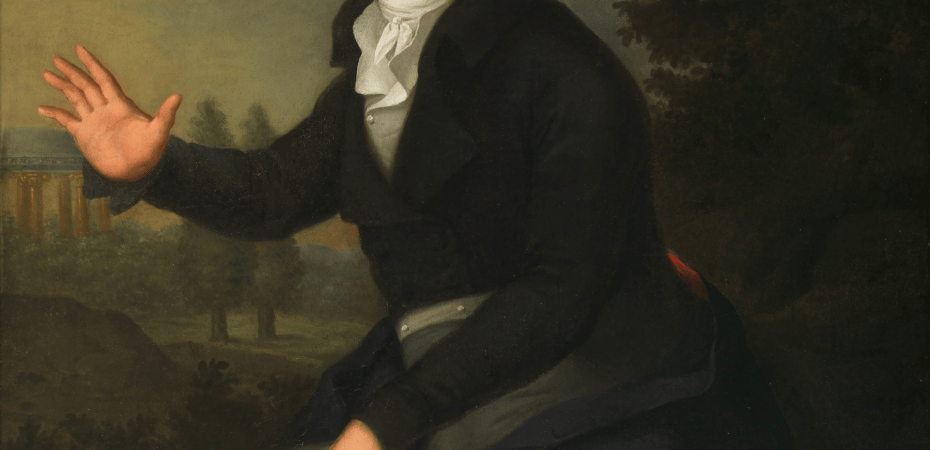
When one first hears the name of Ludwig van Beethoven, what springs to mind? For many, it is the image of the irritable genius—sullen, paranoid, prone to explosions of anger, unkempt, and isolated. The myth of Beethoven as the lonely madman at the piano is one of the strongest cultural images in Western art. Yet myths often obscure as much as they illuminate. The truth is that Beethoven’s relationships, both with patrons and friends, were richer and more complex than the caricature allows. What the surviving evidence shows is not a man incapable of friendship or decency, but one navigating the treacherous world of early nineteenth-century Vienna: a city in financial crisis, socially stratified, and politically fragile, but also the crucible of some of Europe’s greatest music.
To understand Beethoven properly, one must set aside the cartoon of the “ill-tempered loner” and look at his relationships—particularly with his aristocratic patrons such as Prince Lobkowitz, with pupils like Carl Czerny and Ferdinand Ries, and with confidants such as Dr. Franz Wegeler. In doing so, we glimpse a man capable of loyalty, generosity, and affection, even if shadowed by suspicion and quickness of temper. This picture does not deny his volatility but restores balance to our perception of him. Beethoven was not a saint, but neither was he the monster of legend.
Beethoven’s audience was, above all, aristocratic. In late eighteenth- and early nineteenth-century Vienna, the great musical patrons were princes, counts, and archdukes—men like Prince Lobkowitz, Count Razumovsky, and Archduke Rudolph. Their financial support sustained the musical life of the city and allowed Beethoven to compose works that might otherwise have been impossible. Yet their resources were not inexhaustible. Vienna in this period was in economic turmoil. The Napoleonic wars drained the Austrian treasury. Inflation spiralled out of control. Between 1800 and 1817, the cost of food and shelter rose by over 3,000 per cent, and the government resorted to bankruptcy and devaluation.
These financial crises struck not only the common people but also the aristocracy. Many of Beethoven’s patrons saw their estates reduced or encumbered with debt. Some, like Count Waldstein, diverted vast sums into military expenditure, raising regiments at their own expense. Even princes felt the weight of inflation when the paper currency in which they were paid collapsed in value. Against this background, Beethoven’s reliance on aristocratic support was precarious. It explains much of his volatility: his anger at delayed or broken promises, his constant anxiety about money, his tendency to quarrel with benefactors. A composer dependent on such a fragile economic system was bound to live in tension.
Yet here we must resist the temptation to reduce Beethoven’s quarrels to sheer bad temper. They were often reactions to genuine grievances. If a prince promised an annuity and then defaulted because of reckless spending or financial mismanagement, Beethoven’s indignation was not unreasonable. In such moments, the irritable genius was also a man defending his livelihood.
No patron looms larger in Beethoven’s career than Prince Joseph Franz Maximilian Lobkowitz. His role in the creation of the Eroica Symphony shows how far beyond the conventional bounds of patronage he was willing to go. Not only did he provide Beethoven with money—200 gulden for the Op. 18 quartets in 1799, for example—but he gave him something far rarer: access to a private orchestra. In the great hall of the Lobkowitz Palace, Beethoven was able to rehearse and test the Eroica repeatedly before its public premiere. This was no trivial courtesy. It meant Beethoven could hear the work, make revisions, and refine details in a way no composer of his standing usually could. One might even say that the Eroica, that revolutionary symphony which broke the mould of classical form, was made possible as much by Lobkowitz’s generosity as by Beethoven’s genius.
The relationship between Beethoven and Lobkowitz has been painted as one of mutual respect, almost of equals. Yet it was not without strain. In 1811, Lobkowitz promised Beethoven an annuity, only to fall into bankruptcy later that year. His estate passed into receivership, and the annuity lapsed. Beethoven was furious, and rightly so. While historians debate whether Lobkowitz’s bankruptcy was due to inflation or to profligate spending on music and other extravagances, the result for Beethoven was the same: insecurity and disappointment. His anger, in this case, was not the irrational fury of a madman, but the frustration of a man whose livelihood had once again been endangered by forces beyond his control.
Thus, the image of Beethoven raging at Lobkowitz must be tempered by context. He was not simply biting the hand that fed him. He was lashing out at a system that dangled security before him and then withdrew it without warning.
Beethoven’s pupils Carl Czerny and Ferdinand Ries provide another perspective. Both adored him, despite his moods. Czerny, who first idolised Beethoven as a child, remembered him as playful, humorous, and noble. Ries, the son of a family friend, later became not only a student but also a biographer. His accounts emphasise Beethoven’s affection and his willingness to forgive once tempers cooled. “All in all, he was a dear, good fellow,” Ries wrote, “only his variable humour and his violence where others were concerned, often did him disservice”.
These testimonies are important. They show that those who knew Beethoven best did not remember him as a monster but as a flawed yet fundamentally good man. Both Ries and Czerny acknowledged his suspicion and quick temper, but they also stressed his capacity for affection, forgiveness, and loyalty. His moods were real, but they were not the whole story.
Moreover, both men benefited from his teaching. Czerny inherited Beethoven’s pianistic discipline; Ries absorbed his intensity and later helped to preserve his reputation. If Beethoven had been truly intolerable, neither would have remained so devoted to him. Their loyalty suggests that beneath the surface volatility was a mentor of genuine warmth.
The story of Beethoven’s physicians adds another dimension. His friendships with doctors such as Franz Wegeler, Johann Schmidt, and Anton Wawruch reveal a man who, in his darkest moments of illness and hearing loss, sought comfort and companionship. With Wegeler, a childhood friend, Beethoven shared intimate confessions about his deafness—secrets he withheld from his circle in Vienna. With Dr. Schmidt, he formed such a bond that he dedicated a composition to him. Even with Wawruch, whose treatments were controversial, he maintained a relationship marked by trust and dependence.
That Beethoven quarrelled with his doctors is unsurprising. His ailments were painful and humiliating, his deafness a catastrophe for a musician. Yet that he formed lasting bonds with several of them shows again that he was not incapable of loyalty or friendship. In his doctors, he found people who listened, who sympathised, and who cared. His willingness to confide in them suggests not misanthropy but an aching desire for understanding.
Why, then, does the myth of the irritable loner persist? Partly because it is dramatic. The idea of a deaf, raging genius, cut off from the world yet creating immortal music, has the appeal of tragedy. It is the narrative of the suffering artist, amplified by Romantic biographers and perpetuated by later admirers. Anton Schindler, Beethoven’s sometime secretary, embellished and even falsified stories in order to dramatise his master’s life. Later writers repeated them. Over time, the complex man was reduced to a simple stereotype.
But the truth is more interesting. Beethoven could be irritable, yes, but he could also be affectionate. He could be suspicious, but also loyal. He could quarrel with patrons, yet honour his obligations to pupils and friends. He could lash out in anger, then seek reconciliation. His relationships show a man of depth and contradiction—human rather than monstrous.
There is also the question of whether Beethoven’s music reflects his personality. It is tempting to see the stormy passages of the Eroica or the hammer-blows of the Fifth Symphony as expressions of rage, and the serene slow movements as glimpses of tenderness. Yet music is not autobiography. To conflate the two is to risk oversimplification. What one can say is that Beethoven’s music embodies a vast emotional range. That range parallels the testimonies of his friends: a man capable of fury, yes, but also of humour, playfulness, and profound compassion.
Indeed, to play Beethoven is to encounter both extremes. The slow movement of the Hammerklavier speaks of depths of sorrow and resignation; the finale of the Seventh Symphony bursts with joy. A man who could write both was no mere misanthrope. He was a man who had lived through struggle and disappointment, but who also glimpsed beauty and joy. His music testifies not to one mood but to the fullness of human experience.
In the end, what emerges from the evidence is not the caricature of the irritable loner but the portrait of a complex man. Beethoven was capable of anger, suspicion, and volatility. But he was also capable of affection, loyalty, and nobility. His quarrels with patrons reflected genuine economic insecurity. His friendships with pupils and physicians reveal bonds of trust and care. His reputation as irritable is not false, but it is incomplete.
As with so many myths, the truth is subtler. To see Beethoven only as the raging genius is to miss the humanity that underlies his art. He was difficult, yes, but he was also loved. He inspired loyalty, affection, and admiration. And his music, which remains one of the greatest treasures of Western civilisation, is not the product of a monster but of a man—flawed, vulnerable, human, and yet touched by genius.
Bibliography
Baumol, William, and Hilda Baumol. “Maledizione! Or the Perilous Prospects of Beethoven’s Patrons.” Journal of Cultural Economics 26, no. 3 (2002): 167–184. http://econpapers.repec.org/article/kapjculte/v_3a26_3ay_3a2002_3ai_3a3_3ap_3a167-184.htm.
Kerman, Joseph, Alan Tyson, and Scott G. Burnham. “Ludwig van Beethoven.” Grove Music Online. http://www.oxfordmusiconline.com/subscriber/article/grove/music/40026.
Moore, Julia V. Beethoven and Musical Economics. Ann Arbor: ProQuest Dissertations Publishing, 1987.
Nohl, Walther, and Frederick H. Martens. “Beethoven’s and Schubert’s Personal Relations.” The Musical Quarterly 14, no. 4 (1928): 553–562. http://www.jstor.org/stable/738519.
Schindler, Anton. The Life of Beethoven. Edited by Ignace Moscheles. Boston: Oliver Ditson Company, 1841.
Schweisheimer, Waldemar. “Beethoven’s Physicians.” The Musical Quarterly 31, no. 3 (1945): 289–298. http://www.jstor.org/stable/739163.
Sonneck, O. G., ed. Beethoven: Impressions by his Contemporaries. New York: Dover Publications, 1967.
Volek, Tomislav, and Jaroslav Macek. “Beethoven’s Rehearsals at the Lobkowitz’s.” The Musical Times 127, no. 1716 (1986): 75–80. http://www.jstor.org/stable/964559.


1804 portrait of Beethoven with a lyre-guitar by Joseph Willibrord Mähler
Discover more from The Libertarian Alliance
Subscribe to get the latest posts sent to your email.