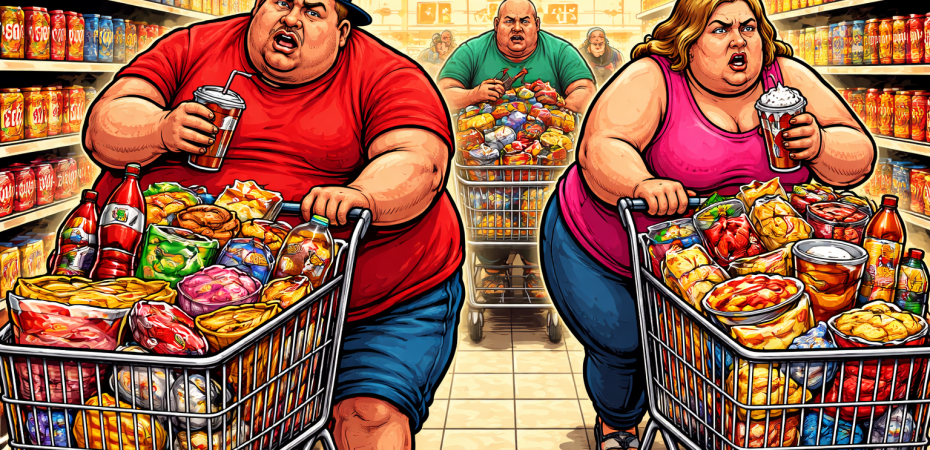
Bryan Mercadente has forwarded this article from The Independent: “Lung cancer warning for foods which make up ‘half the average diet’ after new study.” He did so with a degree of enthusiasm that is, even by his standards, morbid. He appears to have read the headline less as a public-health warning than as a kind of actuarial prophecy, in which the ranks of the overweight and aesthetically displeasing are at last to be thinned by a hostile universe. This is, I think, a childish reaction. It does him little credit. Perhaps I am writing this article as a friendly way of preventing what would otherwise be a long and uncharitable gloat. The article itself is more sober than Bryan’s actual response—certainly more so than the response he is contemplating—and the underlying study deserves something closer to cautious attention than ghoulish delight.
The article reports on a cohort study linking high consumption of ultra-processed foods to an increased incidence of lung cancer. The data come from the American PLCO screening trial and were published in Thorax, a respectable respiratory journal. The headline figure—that those in the highest bracket of ultra-processed food intake were 41 per cent more likely to develop lung cancer than those in the lowest—sounds alarming, and is clearly intended to be so. The article does at least perform the ritual genuflection to methodological caution, noting that this is an observational study, that correlation is not causation, and that smoking remains the overwhelmingly dominant risk factor.
Still, there is a broader narrative here, and it is one that modern journalism finds irresistible. Ultra-processed food has become the dietary equivalent of original sin. It is blamed for obesity, diabetes, heart disease, depression, anxiety, and now lung cancer—a disease long regarded, correctly, as the signature punishment of smokers. The implication is not merely that these foods are unhealthy, but that they are quietly lethal in ways we are only just beginning to understand. In this sense, the article fits neatly into an existing moral framework: industrial modernity produces convenience; convenience produces degeneration; degeneration produces death.
There are, however, several reasons to resist the temptation to turn this into a morality play.
First, the magnitude of the effect needs to be handled with care. A 41 per cent increase in relative risk sounds dramatic, but lung cancer remains relatively uncommon among non-smokers. Even small errors in adjusting for smoking intensity and duration, or social class could inflate the apparent role of diet. The authors themselves concede that smoking, while adjusted for statistically, may not have been captured with sufficient granularity. Given that smoking habits correlate strongly with diet and education and income, residual confounding is not a minor technicality but a central problem.
Second, the category of “ultra-processed food” is conceptually messy. It lumps together sugary drinks, processed meats, breakfast cereals, ready meals, and packaged bread—foods with very different compositions and biological effects. To say that “ultra-processed foods” cause cancer risks reifying a classification system rather than identifying a mechanism. The article gestures towards possible explanations—chemical contaminants such as acrolein, altered food matrices, packaging materials—but these remain speculative. At present, we are dealing with statistical association plus a list of plausible-sounding hypotheses, not with a demonstrated causal chain.
Third, there is a danger here of confusing public health advice with social contempt. Bryan’s reaction—though unusually explicit—is not unique. Much contemporary health reporting slides easily into a tone that treats illness as a form of moral failure. The obese are not merely unhealthy; they are irresponsible. The consumers of processed food are not merely constrained by cost, time, or habit; they are complicit in their own destruction. When such people fall ill, there is a barely suppressed sense that they had it coming. This is not science; it is puritanism with a BMI chart.
None of this is to say that ultra-processed food is harmless, or that reducing its consumption would be a bad idea. On the contrary, diets dominated by industrial food products are plainly inferior to those based on fresh ingredients, and the epidemiological evidence linking ultra-processed foods to a range of chronic diseases is growing. Advising moderation, cooking more, and relying less on packaged convenience foods is sensible, old-fashioned advice, and the article is right to emphasise it.
What the study does not justify—and what the headline tempts readers to believe—is that we have discovered a new, independent dietary cause of lung cancer comparable to smoking. We have not. At most, we have identified another weak risk marker embedded in a broader pattern of unhealthy living. Treating it as anything more than that risks overstating the science and encouraging precisely the sort of hysterical or vindictive reactions that Bryan so enthusiastically supplies.
In short, this is an interesting and credible study, reported with reasonable accuracy by The Independent, but it does not overturn existing knowledge, nor does it license fantasies of cosmic retribution visited upon the ugly and the fat. Bryan will not soon be released from the horror of those wet smears left on the chairs in his classroom. The proper response is neither panic nor pleasure, but the dull, unfashionable one: cautious interpretation, and an unwillingness to confuse statistical associations with moral verdicts.
Further Reading
- The original lung cancer study:
“Association between ultra-processed food consumption and lung cancer risk: a population-based cohort study” (published in Thorax, July 2025)
https://thorax.bmj.com/content/early/2025/07/19/thorax-2024-222100
(Full PDF also available: https://thorax.bmj.com/content/thoraxjnl/80/11/810.full.pdf) - BMJ press release on the lung cancer study:
https://bmjgroup.com/higher-ultra-processed-food-intake-linked-to-increased-lung-cancer-risk/ - The 2024 BMJ umbrella review linking ultra-processed foods to 32 health harms:
“Ultra-processed food exposure and adverse health outcomes: umbrella review of epidemiological meta-analyses”
https://www.bmj.com/content/384/bmj-2023-077310 - Global lung cancer statistics (GLOBOCAN 2020: ~2.2 million cases and ~1.8 million deaths):
“Global Cancer Statistics 2020: GLOBOCAN Estimates of Incidence and Mortality Worldwide for 36 Cancers in 185 Countries” (published in CA: A Cancer Journal for Clinicians)
https://pubmed.ncbi.nlm.nih.gov/33538338/
(Data accessible via the Global Cancer Observatory: https://gco.iarc.fr/ ) - Prostate, Lung, Colorectal and Ovarian (PLCO) Cancer Screening Trial (the dataset used in the lung cancer study):
Official NCI overview: https://prevention.cancer.gov/research-areas/networks-consortia-programs/plco
Trial data access system: https://cdas.cancer.gov/plco/

Discover more from The Libertarian Alliance
Subscribe to get the latest posts sent to your email.
Related posts:
Powered by YARPP.
Sebastian has put his finger on something here. The Superman of the Sixth is a thinly disguised morality campaigner. (The type is often called Puritan, but I doubt if he has experienced grace abounding to the chief of sinners).
Bryan believes as firmly as every social reformer from Mary Whitehouse to Polly Toynbee that the lower orders are fat, ignorant and stupid because of bad habits and poor upbringing. Too much sugar, too much screen time, too little gym. Confounding factors? He reads Hippocrates in Greek but he gets his science third hand from the Independent, once a great newspaper but now a freesheet.
It is now too late for him to become a PPEist and a Guardian columnist, but after his studies in Classics and Plumbing at Cambridge a promising future as an influencer lies before him. If he can think of and sell a new variant of The Power of Positive Baaing or the Five Habits of Highly Effective Sheep, he may yet have it made.
I tend to see this as a question of human flourishing. If we understand human nature as the integration of rationality with our biological foundations, then choices that knowingly undermine long‑term health run counter to that nature. In that sense, the moral “ought” is derived from the normal, healthy functioning of what we are — the “is” of human nature understood in its full, rational form.
Calhoun’s “Universe 25” experiments are relevant here. Although rodents are not humans, his work illustrates how environments that remove meaningful structure, challenge, and adaptive pressure can drift toward behavioral entropy — a gradual loss of purpose, resilience, and social coherence. It’s a reminder that abundance alone doesn’t guarantee well‑being.
For humans, the task is to counteract that entropic drift by shaping conditions that support growth, responsibility, and the full expression of our rational capacities. Evolution — whether through natural pressures or through the intentional ways we design our cultural, educational, and technological environments — plays a central role in determining whether we move toward greater flourishing or toward stagnation.
The real challenge is to cultivate conditions that strengthen our capacities rather than allow them to atrophy.
[…] Sebastian thinks he has saved me from another excuse for gloating, the newspapers are full of handwringing again. A study shows that a few weeks of ultra-processed […]