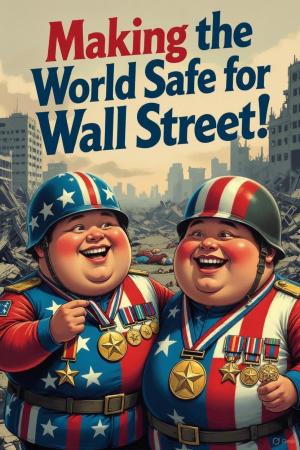
In the early hours of January 3rd, 2026, the United States launched a series of coordinated military strikes across Venezuela, culminating in the abduction of President Nicolás Maduro and his wife. American forces, operating under cover of darkness, attacked both civilian and military targets in Caracas and the surrounding states, before spiriting the Venezuelan leader out of the country in what President Donald Trump triumphantly labeled a “brilliant operation.” The operation, carried out by Delta Force and supported by naval and air assets, was clearly planned in advance, with no declaration of war and no pretense of legitimacy under international law. It was nothing more than piracy with jets.
Will anyone really be distracted by the fraudulent legal veneer hurriedly applied after the fact? Charges of narco-terrorism and whatever else comes out of Washington are as threadbare and predictable as they are laughable. The Southern District of New York has become little more than a global kangaroo court, issuing politically expedient indictments to justify any act of American aggression abroad. The real objective, as always, lies not in law enforcement but in resource seizure. Venezuela sits atop the largest proven oil reserves on Earth—an inconvenient fact for a U.S. regime whose currency is collapsing under the weight of its own corruption and unsustainable debt. Washington’s long-running sanctions regime failed to topple Caracas, and so now the mask has fallen. This was never about drugs. It was always about oil.
Any discussion of “democracy” or “human rights” is pure hypocrisy from a country that has spent the last quarter-century bombing civilians and looting the wealth of entire nations. From Baghdad to Tripoli, from Kabul to now Caracas, the same script repeats itself: demonize the leader, fabricate charges, unleash military force, then extract the resources. If any other country on Earth behaved as the United States does, it would be branded a rogue state. The truth is that the United States is a rogue state—run not by a legitimate government but by a criminal syndicate masquerading as one. Its wars are not waged in defense of liberty, but in pursuit of plunder.
What January 3rd revealed beyond doubt is that the American regime no longer bothers to respect even the pretense of law. There was no Congressional declaration of war. There was no U.N. authorization. There was not even an honest attempt at negotiation or diplomacy. Instead, American forces launched unprovoked attacks on sovereign territory, killed unknown numbers of civilians, destroyed vital infrastructure, and abducted the sitting president of a foreign nation. The response from Washington’s allies—muted and equivocal—only underscores how far the so-called “rules-based international order” has decayed into a smokescreen for empire.
Venezuela had no weapons pointed at the United States. It did not invade Florida. It did not sanction Washington or fund death squads in Chicago. The only “threat” Venezuela posed was its refusal to hand over its natural resources to foreign corporations and its insistence on maintaining a degree of political independence from Washington’s control. That, in the eyes of America’s rulers, is the gravest crime of all.
But we can at least now be clear about who rules America. The country is no longer governed by any meaningful democratic process. The executive branch has fused with the intelligence agencies, the military, and the financial cartels to form a unified machine of coercion and theft. Elections are largely irrelevant. Policy is dictated by the needs of global capital and enforced by the guns of the Pentagon. The people have no say. The law has no teeth. Treaties are scraps of paper to be ignored at will. To negotiate with such an entity is to negotiate with the wind.
Those who continue to believe that the American state operates under the same set of rules as other nations must finally face the reality: this is not a state among states. It is an empire, behaving exactly as empires always have—rapacious, lawlessly violent. The only difference is the scale, and the increasingly unhinged justifications offered to excuse its crimes. A state that cannot provide clean water in its own cities somehow claims the right to govern Venezuela. A nation whose cities are wracked by poverty and social collapse presumes to bring “order” to the Global South.
The abduction of Maduro marks a new stage in America’s imperial decline. Unable to sustain its global dominance through soft power or economic innovation, it now reverts to raw force. Like a wounded animal, it lashes out at weaker prey, not out of strength but desperation. The dollar is crumbling. The debt is unpayable. The Chinese are racing ahead. The world is watching. Venezuela, in this context, is not just a victim of aggression—it is a warning to the rest of the world. No treaty will protect you. No law will shield you. If you possess something the empire wants—oil, minerals, strategic ports—you are a target.
The United States has made clear it respects no boundaries, no sovereignty, and no system of justice except its own brute power. Any country that fails to recognize this reality will meet the same fate Venezuela now endures.
The empire is dying—but it will try to burn the world before it falls.

Discover more from The Libertarian Alliance
Subscribe to get the latest posts sent to your email.
Related posts:

Powered by YARPP.
[…] 3 January, 2026 Len D. Pozeram The Bandit Empire Strikes Again: America’s Criminal Invasion of Venezuela […]
The author writes in the style of a Rothbard acolyte, and I say that with some familiarity, having been in that camp myself in the sixties. He repeats the central error that marked Rothbard’s career: treating all uses of force outside one’s borders as though they were morally identical. This collapses the concept of rightful sovereignty into a posture of abstention. Prohibiting all intervention would itself require intervention; moral signaling has never restrained a predatory state.
The U.S. operation in Caracas did not target civilians but regime loyalists who benefited from Maduro’s coercive nationalization of the drug trade. He did not liberalize the market; he created a state‑protected cartel enforced by violence, producing windfall profits for the regime and escalating bloodshed for ordinary people. His internal repression generated regional destabilization and mass displacement.
If one invokes “international law,” the only version with genuine moral standing is the Jus Gentium, the law of nations common across civilizations and closely aligned with Jus Naturale. Under that standard, Maduro’s routine violations fall squarely within universally prohibited conduct. Credible reporting indicates he was preparing to invade a neighbor to expand his monopolies over drugs and oil. That is not rightful government. It is predation.
This is where neo‑libertarianism diverges from classical libertarianism. Rothbard was always a neo‑libertarian in the sense that he redefined the non‑aggression principle into a categorical prohibition on “intervention,” enabling him to support Strom Thurmond in 1948 and later align with both the New Left and the Old Right — neither libertarian. The Old Right itself was susceptible to manipulation; several of its organizations were infiltrated and subsidized by the German embassy during the Second World War. A movement defined by non‑intervention rather than non-initiation of force could be vulnerable to any foreign power that benefits from American paralysis. Rothbard amplified that vulnerability.
Mises understood that institutions, incentives, and the structure of power determine political outcomes. A dictator who seizes industries by force is exercising sovereignty in the Sumner Maine sense — claiming ownership of all within his domain and demanding immunity from revolution or intervention — but he is not exercising rightful rule. The article’s accompanying graphic, which relies on dehumanizing imagery, reflects the rhetorical habits of statist propaganda rather than libertarian argument.
The same logic applies to oil. Nationalization — the forcible seizure of infrastructure built and funded by Western firms — is treated as legitimate so long as it is anti‑Western, while privatizing the same stolen and degraded property is denounced as “theft.” Arresting a thief is not theft. Restoring stolen property to productive use is not imperialism; it is a precondition for markets, property rights, and voluntary exchange.
Maduro was not merely Chávez’s successor but his enforcer. Together they produced conditions approaching those of North Korea: famine, repression, and a mass exodus that included violent offenders deliberately released from prisons. Many entered the United States and contributed to gang violence. This constitutes indirect aggression, not a hypothetical concern.
The operation in Caracas does not justify open‑ended commitments. It removed a regional predator. If Venezuela is to recover, it will do so through markets, property rights, and the freedom to produce, not through the decrees of a strongman.
Those who cheer for the collapse of the liberal order should recall what occurred when the Greco‑Roman system fell. The mobs who bayed for its destruction created the conditions that led to the centuries of Dark Ages that followed.
Be careful what you wish for.