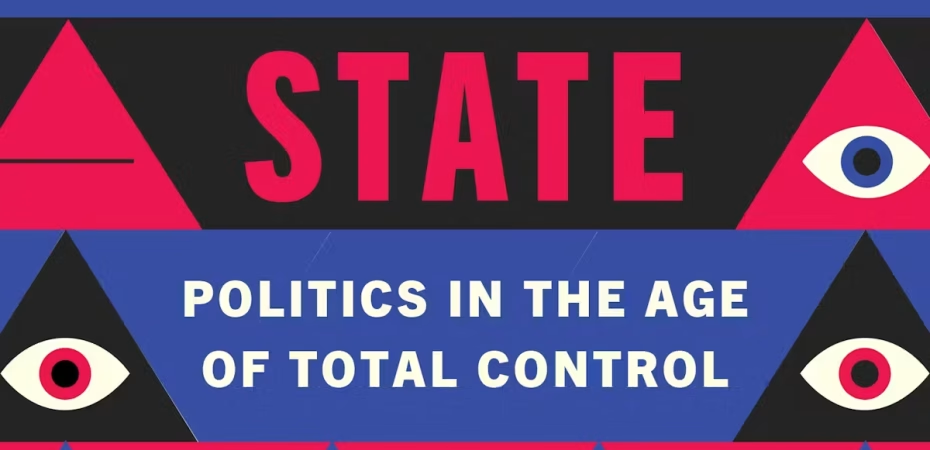
The Information State: Politics in the Age of Total Control
Jacob Siegel
Henry Holt & Company, New York, 2026
Hardcover, 336 pages
ISBN-10: 1250363128
ISBN-13: 978-1250363121
There are books that arrive too early, books that arrive too late, and books that arrive at precisely the moment when denial has begun to crack but evasion remains the dominant instinct. The Information State belongs firmly to the last category. It is not a speculative warning about where Western democracies might go. It is a sober reconstruction of where the United States already went, and how quietly, bureaucratically, and self-righteously it did so.
Jacob Siegel’s central claim is not subtle and does not need to be. After 2016, America’s governing class concluded that democratic outcomes could no longer be trusted. Rather than persuade the electorate, it set out to manage it. Rather than defeat its opponents, it reclassified them as security threats. What followed was not a breakdown of institutions, but their smooth and enthusiastic repurposing.
As one reviewer summarises with admirable bluntness: “Yes, they waged war on us.” That is not rhetoric. It is a literal description of how the language, structures, and powers of the post-9/11 security state were redirected inward once Donald Trump’s election demonstrated that mass democracy could still produce the “wrong” result.
Siegel identifies the psychological turning point with clarity. Trump’s victory, he writes,
“meant that politics had become war, as it is in many parts of the world, and tens of millions of Americans were the enemy. With Russian active measures having supposedly penetrated the Internet, anything said online could be attributed to Moscow.”
Once this premise was accepted, everything else followed naturally. If politics is war, then dissent is sabotage. If speech is a weapon, then censorship becomes defence. If voters are vulnerable to “information attacks,” then managing their perceptions becomes a matter of national security rather than consent.
One of the book’s great strengths is its organisation. Siegel does not rely on insinuation or tone. He builds his case institution by institution, statute by statute, memo by memo. Agencies proliferate inside other agencies. Task forces embed themselves in private companies. NGOs function as cut-outs. Journalists become conduits. What emerges is not a conspiracy in the cartoon sense, but something more disturbing: a converging class interest among people who all believe themselves indispensable.
Siegel captures the epistemic breakdown of the Trump era with particular precision:
“One of the most disorienting aspects of the conspiratorial mania that overtook America’s elites in response to the rise of Donald Trump was the sheer scale of expert consensus behind views that were, on their merits, utterly deranged.”
The importance of that passage lies in what it reveals about modern authority. Individual claims no longer need to withstand scrutiny if they are sufficiently numerous and sufficiently endorsed. As Siegel observes, “Any given charge about Trump’s ties to the Kremlin might fall apart under scrutiny, but there were so many… that their totality seemed to outweigh their individual merits.” Truth was replaced by volume.
The book’s core chapters deal with the transformation of counter-terror infrastructure into a domestic political weapon. The Countering Foreign Propaganda and Disinformation Act of December 2016 is treated not as a technical footnote, but as a constitutional hinge. By expanding the Global Engagement Center and empowering it to coordinate government, media, NGOs, and technology firms, the Obama administration created what Siegel accurately describes as an apparatus for enforcing a party line.
“By creating a mechanism to enforce a party line on matters related to fighting disinformation and defending ‘US interests,’ the agency effectively created an official government office for coordinating the resistance to Trump.”
The result, Siegel notes with dry understatement, was that “the government was not only divided but at war with itself.” This internal war was not fought openly in Congress or the courts, but covertly through information control: selective leaks, curated intelligence assessments, algorithmic suppression, and reputational destruction.
The Intelligence Community Assessment of January 2017 is dissected in devastating detail. Presented as a neutral consensus, it was in fact, Siegel writes,
“a selectively curated political document that deliberately omitted contrary evidence to create the false impression that the Russian collusion narrative was an objective fact.”
That is an extraordinary accusation, but Siegel supports it with methodical care. Intelligence was not merely politicised; it was weaponised. When Jeh Johnson designated US election systems as “critical national infrastructure,” placing thousands of local jurisdictions under federal oversight, Siegel correctly identifies it as “a coup he had been angling to accomplish for months.” Power shifted decisively, and almost no one objected.
Equally chilling is Siegel’s account of the censorship-industrial complex that followed. The creation of CISA, the embedding of FBI personnel inside Twitter, the activities of Hamilton 68, and the grotesque deception of Project Birmingham all point in the same direction. Organisations claiming to combat disinformation engaged in it as routine practice, confident that their moral branding would protect them from exposure.
Siegel’s sociological summary is worth quoting in full:
“Groups like the Anti-Defamation League, counterterrorism veterans, trust and safety officials, countering violent extremism experts, social scientists, political operatives, FBI agents, millennial journalists, and CIA officers all rubbed shoulders on the counter-disinformation party bus housed inside the social media companies.”
This was not a rogue operation. It was a professional ecosystem. Its aim, Siegel writes with brutal clarity, was “not to appeal to public opinion, but to control it.”
No serious review of this book can avoid the media’s role, and Siegel does not allow it to. Journalists did not merely fail; they collaborated. Conflicts of interest were ignored. Intelligence sources were laundered into headlines. The case of Renee DiResta and the Stanford Internet Observatory—complete with intelligence links, revolving doors, and privileged access to platform executives—was met not with scrutiny but silence. The press, having styled itself as the last defence of democracy, proved itself unworthy of the role.
By the time Siegel reaches the Hunter Biden laptop affair, the reader is no longer shocked, only grimly confirmed. A true story was suppressed across major platforms during an election campaign, justified by a fabricated intelligence letter, and defended by the same media that claims to fear authoritarianism. As the reviewer notes, “It’s still hard to believe that this happened in America.” Yet it did, and almost no one paid a price.
Siegel ends without false consolation. Elon Musk’s purchase of Twitter and subsequent disclosures have exposed some of the machinery, but the structure remains intact. His final judgement is unsparing:
“Russiagate was not a tragedy but a crime against the country. Disinformation was both the name of the crime and the means of covering it up.”
That crime, he argues, lay in erasing the boundary between war and politics, foreign and domestic, public and private. Once that line is crossed, democracy survives only as a ritual, performed atop an administrative state that no longer answers to the people it governs.
The Information State is not a book about Donald Trump. It is a book about what happens when elites decide that consent is optional. Alan Bickley would recognise it immediately for what it is: a careful, damning record of institutional cowardice, written with restraint and intellectual seriousness. Where not denounced, it will be ignored or misrepresented. It will also endure.
Discover more from The Libertarian Alliance
Subscribe to get the latest posts sent to your email.
Related posts:
 The Tobacco Ban: Another Step towards the Total State
 “Brit Cards” – The Keystone of Our Total State
Powered by YARPP.
[…] Article (book review) by Marian Halcombe. […]