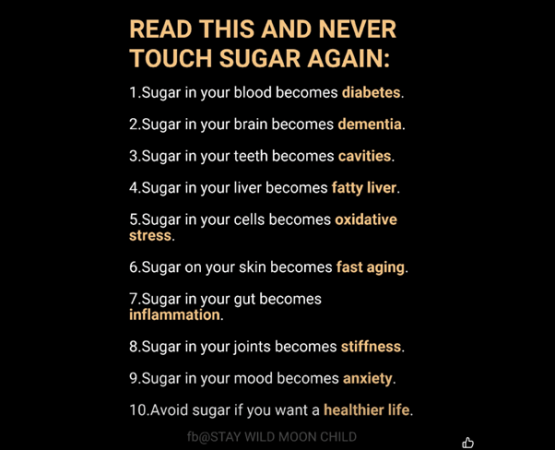
A Facebook meme currently circulating under the command “Read this and never touch sugar again” presents itself as health advice, but it is more accurately read as a moral sermon rendered in the vocabulary of biology. Each line follows the same incantatory formula: sugar enters a part of the body and is said to “become” a disease. Sugar in the blood becomes diabetes. Sugar in the brain becomes dementia. Sugar in the joints becomes stiffness. The repetition is deliberate, the language absolute, and the implied conclusion unmistakable. Sugar is not merely something to be moderated; it is a universal contaminant from which health demands total abstinence.
The meme persuades because it is not wholly false. Excessive consumption of added sugars, particularly in ultra-processed foods and sweetened drinks, is associated with insulin resistance, fatty liver disease, dental decay, chronic inflammation, and metabolic stress. These associations are well established. What the meme does, however, is to turn association into identity and risk into inevitability. Sugar does not “become” disease in the manner that ice becomes water. Human pathology does not operate through simple transformations, but through long and conditional processes shaped by behaviour, environment and genetics, and often a long time.
This confusion is already evident in the meme’s opening claim that sugar in the blood “becomes diabetes.” Persistently elevated blood glucose is indeed the defining feature of type 2 diabetes, but it is the endpoint of a gradual deterioration involving insulin resistance, pancreatic strain, liver fat accumulation, and often sustained caloric excess combined with physical inactivity. Sugar does not transmute into diabetes, and still less does it do so instantly. Type 1 diabetes, which is autoimmune and unrelated to sugar intake, disappears entirely from view. The slogan displaces physiology with moral warning.
Much the same applies to the claims about dementia, anxiety, joint stiffness, inflammation, and ageing. There is evidence that poor metabolic health increases dementia risk, that blood-sugar volatility can affect mood, and that glycation damages connective tissue. None of this warrants the language of direct conversion employed by the meme. Correlation is treated as causation, and probability as fate. Biology is flattened into a cartoon.
At this point, defenders of the meme often appeal to examples rather than arguments. Bryan Mercadente is one such example. He lives very nearly according to the meme’s prescriptions. He avoids sugar almost entirely, eats simply, and subjects his body to regular and often strenuous physical exertion. Undeniably, he looks good. This fact gives the meme a surface plausibility. The visible result appears to confirm the doctrine.
Yet this observation proves far less than its admirers suppose. Bryan almost certainly looks good because of a convergence of factors rather than a single dietary prohibition. His genetics are favourable. His physical exertions are sustained and serious. His habits are disciplined. Add to that he is young: youth is forgiving of mistakes in ways that middle age is not.
It is also true that there is some truth in the meme. Reducing added sugar often means avoiding ultra-processed food, lowering caloric excess, and stabilising blood glucose. These effects matter. What does not follow is that the meme is therefore true in any absolute sense. Many people avoid sugar and look unwell. Many others consume moderate amounts and remain healthy. Individual variation is decisive, and the meme has no conceptual space for it.
This distinction is central. Simplified rules can function tolerably well for particular individuals while remaining conceptually false. Ascetic dietary regimes often succeed not because their explanatory theories are correct, but because they impose order, reduce excess, and eliminate genuinely harmful modern foods by proxy. Sugar elimination can operate in this way. It disciplines behaviour. It narrows choices. It removes obvious sources of caloric abuse. None of this justifies the metaphysical claim that sugar is a universal toxin whose presence necessarily produces disease.
What the meme ultimately offers is not nutrition science but purification theology. Sugar is cast as a modern sin, omnipresent and corrupting, from which redemption comes through abstinence rather than judgement. This framing is emotionally satisfying, but intellectually careless. It erases the distinction between added and natural sugars, ignores quantity and context, and displaces the far more important questions of overall diet, physical activity, sleep, and metabolic health.
A serious critique therefore ends with restraint. There is truth in the meme, but it is partial, exaggerated, and badly expressed. Reducing added sugar is sensible. Treating sugar as a universal poison is not. Health is achieved through sustained habits, physical exertion, and an acceptance that human biology does not submit to slogans. The meme is effective propaganda. It is not serious medical guidance.
Additional Reading
For readers who wish to pursue the subject seriously rather than rhetorically, the following works repay careful attention. Robert Lustig’s Fat Chance and Metabolical offer a forceful critique of added sugar and metabolic dysfunction, arguing from endocrinology rather than slogan. Gary Taubes’s The Case Against Sugar provides a polemical but historically grounded account of how sugar came to dominate modern diets. Kevin Hall’s controlled feeding studies on ultra-processed foods, published in Cell Metabolism, are essential for understanding why food form often matters more than macronutrient labels. Stephan Guyenet’s The Hungry Brain explains appetite regulation and why single-nutrient villains repeatedly fail. The Harvard T.H. Chan School of Public Health’s Nutrition Source essays on added sugar give a cautious mainstream synthesis, while the World Health Organization’s guidelines on sugar intake illustrate what official public health bodies actually claim, which is far less dramatic than the meme would have it.

Discover more from The Libertarian Alliance
Subscribe to get the latest posts sent to your email.
A person who regularly exercises vigorously can consume sugar at a greater rate than a sedentary person, assuming that fats do not block sugar uptake. Generally there is enough sugar in whole fruit to provide all that is necessary. One or two pieces of fruit per day is plenty. The sugars are released slowly, allowing the body time to process them. Whole fruit contains fiber which has health benefits. This means there is no need to add sugar. Artificial “sugars” tend to be worse than natural sugars. Carbs are converted to sugars, limit consumption of carbs to that necessary to digest animal protein. Avoid potatoes. Grains should be avoided unless organically grown with no glyphosate and ideally fermented and sprouted.
Processed foods tend to be lower quality. Ideally, meats, fruits and vegetables should be fermented, which is a good process. This adds beneficial bacteria, gives a longer shelf life, and helps by predigesting.