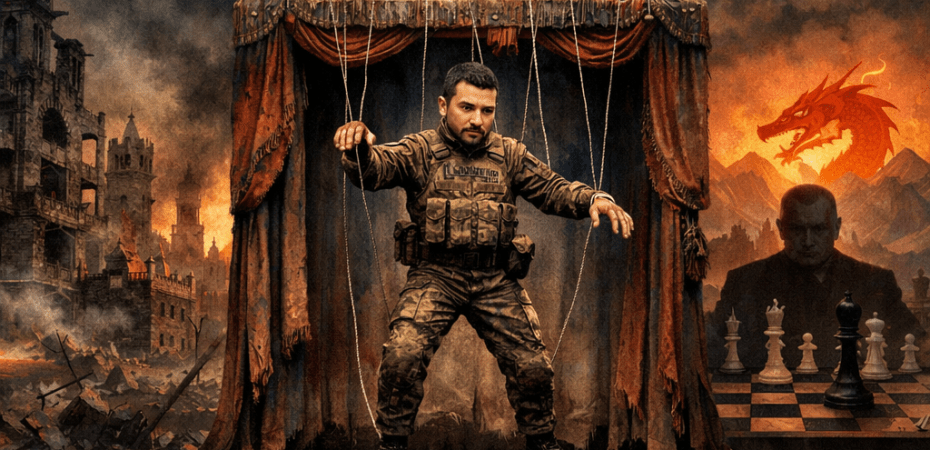
The war in Ukraine is widely presented as a sudden rupture in the international order, a shocking eruption of violence caused by an unprovoked Russian invasion. Yet anyone willing to examine the documentary record—rather than the endlessly recycled talking points of Western media—quickly discovers that this conflict was not only predictable, but intentionally cultivated over more than three decades. Indeed, the evidence strongly suggests that the war was not an unfortunate failure of diplomacy, but rather the successful execution of a long-standing American strategic design, aimed first at crippling Russia and ultimately at obstructing the rise of China.
The story properly begins in 1990, at the end of the Cold War, when the Soviet Union agreed to withdraw its military forces from Eastern Europe and to acquiesce in the reunification of Germany. This historic concession was made only after explicit assurances from senior Western officials that NATO would not expand eastward. U.S. Secretary of State James Baker famously told Mikhail Gorbachev that NATO would move “not one inch eastward,” a pledge that was echoed by West German Foreign Minister Hans‑Dietrich Genscher and others. These assurances were not casual or offhand remarks. They are documented in memoranda and transcripts now published by the National Security Archive at George Washington University, drawing on declassified U.S., German, and Soviet records (National Security Archive, “NATO Expansion: What Gorbachev Heard,” 2017).
Yet almost immediately after the Soviet collapse, Washington reversed course. Throughout the 1990s and 2000s, NATO expanded relentlessly toward Russia’s borders, eventually absorbing fourteen new member states. This expansion was neither accidental nor defensive. In a 1997 New York Times op‑ed, George Kennan—the principal architect of Cold War containment—warned that NATO enlargement would be a “fateful error” that would inflame Russian nationalism and poison relations for generations (New York Times, Feb. 5, 1997). Henry Kissinger offered similar warnings. These voices were not ignored because they were wrong, but because their conclusions conflicted with Washington’s emerging imperial consensus.
At the same time, NATO expansion functioned as an enormous transfer of wealth to the American military‑industrial complex. New member states were required to abandon Soviet-era equipment and standardize their forces around NATO systems, effectively mandating the purchase of U.S. weapons. Lockheed Martin, Raytheon, Boeing, and Northrop Grumman were among the principal beneficiaries. “Collective security” thus became a euphemism for permanent military dependency and guaranteed arms sales.
As NATO crept eastward, Washington also dismantled the arms-control framework that had stabilized U.S.–Russian relations for decades. The United States withdrew from the Anti‑Ballistic Missile Treaty in 2002, from the INF Treaty in 2019, and from the Open Skies Treaty in 2020. Each of these withdrawals removed guardrails designed to prevent miscalculation and nuclear escalation. The cumulative effect was to transform Eastern Europe into a forward operating zone for U.S. power projection, with missile defense systems and large-scale NATO exercises conducted ever closer to Russian territory.
Ukraine, however, was the decisive prize.
In 2014, after Ukrainian President Viktor Yanukovych declined an EU association agreement that would have imposed IMF austerity and instead pursued closer economic ties with Russia, the United States threw its weight behind a mass protest movement that rapidly escalated into a violent overthrow of the elected government. Assistant Secretary of State Victoria Nuland later acknowledged that Washington had spent approximately $5 billion cultivating Ukrainian political institutions and civil society groups prior to the coup. Even more revealing was a leaked phone call between Nuland and U.S. Ambassador Geoffrey Pyatt, in which she discussed—weeks before Yanukovych’s removal—who should lead the next Ukrainian government, dismissing European objections with the remark “f the EU.” The recording was published by The Guardian and other outlets in February 2014 (Guardian, Feb. 4, 2014).
The post-coup government in Kiev quickly adopted policies hostile to Ukraine’s Russian-speaking population, including moves to marginalize the Russian language and glorify nationalist factions with openly fascist roots. Armed conflict soon erupted in Donbas and Luhansk, regions with large ethnic Russian populations that rejected the authority of the new regime. According to United Nations figures, approximately 14,000 people were killed between 2014 and 2021, the vast majority in eastern Ukraine. Western media routinely erased this history, presenting the conflict as if it began only when Russia finally intervened.
Russia repeatedly sought a negotiated settlement. The Minsk I and Minsk II agreements, signed in 2014 and 2015 with the involvement of Germany and France, provided for a ceasefire, withdrawal of heavy weapons, and political autonomy for Donbas within Ukraine. Moscow supported these agreements. Kiev signed them—and then refused to implement their political provisions. Years later, former German Chancellor Angela Merkel admitted publicly that the Minsk process had largely been used to “buy time” for Ukraine to build up its military. Her remarks were reported widely in German and international media in late 2022, effectively confirming that the peace process had been conducted in bad faith from the start.
The election of Volodymyr Zelensky in 2019 initially raised hopes for peace. He ran on a platform explicitly promising to implement Minsk and end the war. Yet once in office, he quickly reversed course. U.S. officials, including Nuland herself, continued to exert direct influence over Ukrainian policy. Zelensky soon abandoned his peace pledges and aligned fully with Washington’s agenda.
Crimea, endlessly cited as evidence of Russian expansionism, was a direct consequence of the 2014 coup. Russia moved to secure its Black Sea Fleet base at Sevastopol, fearing—correctly—that NATO intended to absorb Ukraine and seize control of this strategic asset. Crimea’s population, overwhelmingly ethnic Russian, voted by large margins to rejoin Russia. The referendum was dismissed outright by the West, despite the absence of violence and despite the West’s own selective invocation of self-determination in other contexts.
By 2021, Russia concluded that diplomatic efforts had failed. Moscow formally demanded binding security guarantees, including a halt to NATO expansion and the removal of offensive systems from Eastern Europe. These demands were rejected without serious negotiation. The U.S. response was dismissive, even contemptuous. Yet internal U.S. government communications had long acknowledged the danger. In a 2008 diplomatic cable released by WikiLeaks, then–U.S. Ambassador to Russia William Burns warned that Ukrainian NATO membership represented the “brightest of all red lines” for the Russian elite and public alike (WikiLeaks, Cable 08MOSCOW265).
Even after Russia’s invasion in February 2022, the war could still have ended quickly. Negotiations between Russia and Ukraine in Istanbul in March and April produced a draft peace framework. Israeli Prime Minister Naftali Bennett later stated publicly that both sides were prepared to compromise and that a deal was close. In a 2023 interview, Bennett said that Western leaders—particularly the U.S. and U.K.—chose to block the agreement rather than allow the war to end. Shortly thereafter, British Prime Minister Boris Johnson traveled to Kiev and urged Zelensky to abandon negotiations, a fact later reported by multiple outlets and acknowledged by Ukrainian officials.
This decision only makes sense when viewed within a broader strategic framework. The United States increasingly regards China, not Russia, as its principal rival. Yet Washington understands that confronting China directly requires first neutralizing Russia as a strategic partner and potential ally. A prolonged war in Ukraine accomplishes precisely that: it drains Russian resources, severs Russia’s ties with Europe, and locks Moscow into permanent confrontation with the West. It also forces Europe—especially Germany—into deeper dependence on the United States, a process dramatically accelerated by the destruction of the Nord Stream pipelines, an act of industrial sabotage investigated by journalist Seymour Hersh and widely suspected to involve Western intelligence services.
Thus, the Ukraine war is best understood not as a tragic accident or moral crusade, but as a calculated move in a larger geopolitical chess game. Ukraine itself has been reduced to a battlefield and a bargaining chip, its population sacrificed to imperial strategy. Russia was provoked, cornered, and finally forced to respond. And China remains the ultimate target, with Washington buying time through bloodshed.
None of this required hindsight. The warnings were issued repeatedly, the documents were public, and the consequences were obvious. What is remarkable is not that war came, but that so many continue to pretend it was unforeseeable.
The real scandal of Ukraine is not that Russia reacted to an existential threat, but that the Western political class deliberately manufactured that threat—and now insists on rewriting history to conceal its own responsibility.
Primary and Reputable Sources Cited in the Article
National Security Archive — NATO Expansion: What Gorbachev Heard
The most comprehensive record of Western assurances to Gorbachev that NATO would not expand “one inch eastward.” Includes scans of original documents and meeting memos.
George Kennan’s 1997 Op‑Ed in The New York Times: “A Fateful Error”
Kennan warns that expanding NATO would provoke unnecessary confrontation with Russia.
https://www.nytimes.com/1997/02/05/opinion/a-fateful-error.html (requires login or archive)
Archived version (Wayback Machine): https://web.archive.org/web/20220101102956/https://www.nytimes.com/1997/02/05/opinion/a-fateful-error.html
Victoria Nuland’s Leaked Phone Call (“F the EU”) — Published by The Guardian
Reveals the U.S. selecting post-coup leadership in Ukraine before Yanukovych’s removal.
https://www.theguardian.com/world/2014/feb/06/us-ukraine-russia-eu-victoria-nuland
YouTube mirror of the leaked call:
https://www.youtube.com/watch?v=WV9J6sxCs5k
UN Human Rights Monitoring Mission — Casualty Figures in Donbas (2014–2021)
UN estimate: 13,000–14,000 deaths in the Donbas region before Russia’s 2022 invasion.
UN Monitoring Mission main page:
Merkel Admits Minsk Accords Were a Delay Tactic — Die Zeit Interview (Dec 2022)
Angela Merkel acknowledges Minsk was meant to buy time for Ukraine to arm itself.
https://www.zeit.de/2022/51/angela-merkel-russland-fluechtlingskrise-bundeskanzler (German original; paywall may apply)
WikiLeaks — “Nyet Means Nyet”: Burns’ 2008 Cable on NATO and Ukraine
Then-U.S. Ambassador (now CIA Director) William Burns warns NATO expansion to Ukraine crosses Russia’s “brightest of red lines.”
https://wikileaks.org/plusd/cables/08MOSCOW265_a.html
Archived PDF from WikiLeaks Mirror:
https://file.wikileaks.org/file/cable/2008/02/08MOSCOW265.html
Naftali Bennett Interview — Russia-Ukraine Peace Deal Sabotaged (Feb 2023)
Bennett says West “blocked” peace deal.
Full interview (Hebrew w/ English subtitles): https://www.youtube.com/watch?v=qK9tLDeWBzs (relevant segment around 4:40:00)
Summary from Politico: https://www.politico.eu/article/naftali-bennett-israel-russia-ukraine-peace-talks/
Boris Johnson’s Visit to Block Peace Talks — Ukrainska Pravda
Ukrainian officials report Johnson discouraged negotiations in April 2022.
https://www.pravda.com.ua/eng/news/2022/05/5/7344206/
Supplement: Zelensky adviser Arestovych confirms deal was close, but UK/U.S. intervened
https://unherd.com/2024/01/oleksiy-arestovych-zelenskyys-challenger/ (recent interview where Arestovych discusses the near-agreement)
Seymour Hersh — Nord Stream Pipeline Sabotage (Feb 2023)
Pulitzer-winning journalist reports U.S. covert operation blew up Nord Stream pipelines.
https://seymourhersh.substack.com/p/how-america-took-out-the-nord-stream
Direct link to article:
https://seymourhersh.substack.com/p/how-america-took-out-the-nord-stream

Discover more from The Libertarian Alliance
Subscribe to get the latest posts sent to your email.
“NATO enlargement would be a “fateful error” that would inflame Russian nationalism…”
So what?
“… and poison relations for generations.”
Relations with what? An anachronistic empire of murders and gangsters who have consistently waged a fanatical ideological war against its own people, the West, freedom, morality, causality and existence itself for more than a century?
The entire argument [above] seems to rest on the notion that Mother Russia itself has some sort of existential legitimacy.
It doesn’t.
“NATO enlargement would be a “fateful error” that would inflame Russian nationalism…”
So what?
“… and poison relations for generations.”
Relations with what? An anachronistic empire of murders and gangsters who have consistently waged a fanatical ideological war against its own people, the West, freedom, morality, causality and existence itself for more than a century?
The entire argument [above] seems to rest on the notion that Mother Russia itself has some sort of existential legitimacy.
It doesn’t.