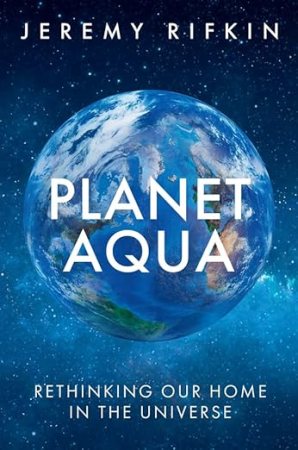
Jeremy Rifkin. Planet Aqua: Rethinking Our Home in the Universe. Polity, 2024. ISBN 978-1509563739. 360 pages.
Jeremy Rifkin’s Planet Aqua is the latest hysterical addition to the climate doomsday genre—a fevered, overwrought fantasy that demands we discard thousands of years of civilisation because he’s discovered that the Earth contains water. If that seems an absurdly reductionist summary, it is only because the book itself deserves nothing more. With the pomp of a prophet and the intellectual rigour of a palm reader, Rifkin insists that humanity has fundamentally misunderstood its own planet, and that our entire social, economic, and political structures must be rebuilt in deference to what he grandly calls “the rewilding hydrosphere.”
According to Rifkin, we’ve been living a lie. We believed we inhabited a land planet, whereas in reality, we’re adrift in some cosmic Atlantis. With all the gravitas of a man who’s just deciphered the Rosetta Stone, he informs us that fresh, salt, and frozen water shape our existence more than we ever imagined. This is, of course, the sort of observation that might dazzle a particularly dense goldfish but should surprise no one with a basic grasp of geography.
Not content with merely stating the obvious, Rifkin leaps into full-blown messianic fervour. The climate crisis, he warns, is no longer about greenhouse gases but about the revolt of the hydrosphere. We must now orient every aspect of our lives—governance, economy, even our concept of time and space—around this watery epiphany.
The book is packed with the sort of nonsensical verbiage that has made Rifkin a darling of bureaucrats and business leaders who enjoy nodding sagely while understanding nothing. He proposes “omnipresent distributed water internets” and “ephemeral pop-up 3D printed communities,” as if these phrases mean anything beyond a desperate attempt to sound innovative. He demands the demolition of dams, the abandonment of traditional farming, and—inevitably—the granting of legal rights to rivers, so they too can sue us for crimes against water.
There is also the usual parade of trendy alarmism. Unless we radically overhaul our relationship with water, Rifkin warns, we face a future of deadly hurricanes, apocalyptic droughts, and ecological Armageddon. This is, of course, the same prophecy that has been regurgitated since the 1970s, always with the deadline conveniently far enough away to allow continued book sales.
Beyond the drivel, the real agenda emerges. Rifkin’s Planet Aqua is yet another ideological battering ram for the corporate-backed environmentalist movement, designed to push the so-called “Blue Economy” as a new frontier for rent-seeking elites. The European Union is already salivating over this concept, using it as justification for ever greater centralisation and interference. Rifkin is simply playing his part, providing the pseudo-intellectual justification for another round of state-backed plunder.
At its core, the book is a thinly veiled push for further regulations, higher taxes, and increased control over ordinary people’s lives. The elites who embrace these ideas, meanwhile, will continue to fly their private jets to climate summits and build seaside mansions while telling the rest of us that rising sea levels are an existential threat.
Planet Aqua is yet another entry in the long tradition of alarmist environmental literature—long on hysteria, short on substance. Rifkin’s watery revelations are neither new nor profound. What is new is the extent to which he is willing to reframe the climate debate in purely hydrological terms, hoping that a fresh coat of blue paint will keep the panic train rolling.
If you enjoy reading books that make grandiose, unsubstantiated claims while laying the groundwork for yet more state interference in your life, then Planet Aqua is for you. Otherwise, I suggest spending your time on something more useful—like watching the rain.
Discover more from The Libertarian Alliance
Subscribe to get the latest posts sent to your email.