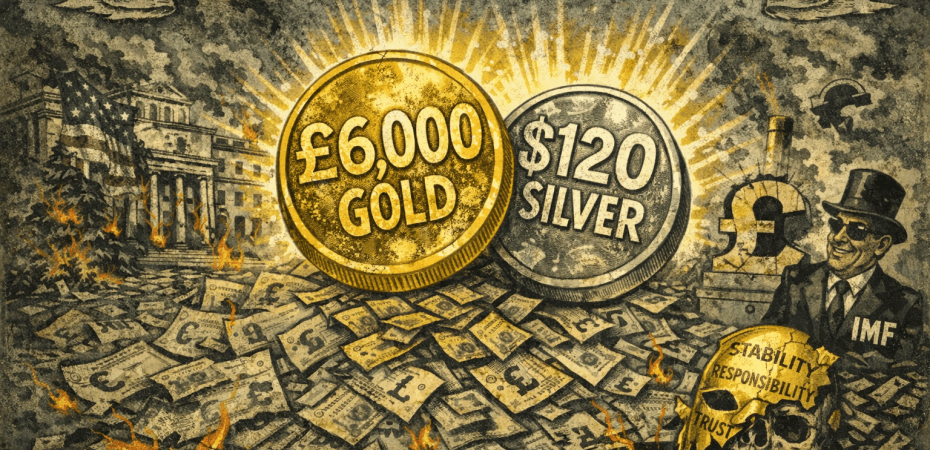
The recent surge in gold and silver prices is widely described as a response to “geopolitical uncertainty,” or “temporary dollar weakness.” These explanations are not wrong, but they are superficial. They resemble the explanations offered by official Soviet economists for bread queues in the late 1980s: technically accurate in isolated particulars, yet carefully designed to obscure the deeper reality.
What we are witnessing is not a speculative rush, nor a panic born of sudden fear. It is the market’s gradual recognition of a long-planned and now openly unavoidable process: the staged collapse of Western currencies under the weight of unpayable sovereign debt.
Gold and silver are not rising because something has gone wrong. They are rising because everything is proceeding according to plan.
As I said a few days ago, writing on British debt repudiation, the central argument was stark but unavoidable: modern Western states have accumulated obligations that cannot be honoured in real terms. The choice is not between repayment and default, but between explicit default and implicit default. Politicians will never choose the former. They will always choose the latter. Inflation is the polite term for this process. Debasement is the accurate one. Repudiation is the economic reality.
When a state finances itself by issuing debt that can only be serviced through currency expansion, it is already defaulting. The default is merely disguised by nominal payments made in money of declining purchasing power. The bondholder is paid in full, but paid in something worth less each year. The pensioner receives his promised income, but discovers that it no longer buys what it once did. The tax base rises in money terms while real wages stagnate. This is not a failure of policy. It is the policy. Gold and silver are responding not to fear of collapse, but to the recognition that collapse is being administered deliberately and with broad institutional consent.
Perhaps the clearest evidence that the gold rally is structural rather than speculative lies not with retail investors or hedge funds, but with central banks themselves. Official institutions are not buying gold because they are nervous. They are buying gold because they understand their own balance sheets. The World Gold Council’s data showing nearly 300 tonnes of net central-bank purchases in 2025 is not an anomaly. It is the continuation of a trend that began quietly after the 2008 financial crisis and accelerated after the weaponization of the dollar system in the 2010s. The lesson absorbed by non-Western states was simple: reserve assets that can be frozen or politically constrained are not reserves at all.
Gold, unlike US Treasuries, carries no counterparty risk. It cannot be cancelled by sanction, diluted by legislation, or repudiated by court order. It is therefore the natural refuge for institutions that still think in decades rather than quarters. The particularly heavy buying by countries such as China, Turkey, Kazakhstan, and Poland is revealing. These are not states preparing for war or crisis. They are states repositioning themselves for a post-dollar monetary order in which Western paper claims are no longer assumed to be risk-free. Central banks, unlike journalists, do not talk. They move.
Much commentary focuses on short-term movements in the Bloomberg Dollar Spot Index or weekly fluctuations in exchange rates. This misses the point. The dollar’s problem is not cyclical weakness, but structural overreach. The post-war dollar system rested on an implicit bargain. The United States provided security, trade access, and a relatively predictable global framework. In return, the rest of the world financed American deficits by holding dollar assets. This arrangement allowed the US to run chronic fiscal and trade imbalances without immediate penalty. That bargain is breaking down.
American public debt now exceeds levels that would have been considered catastrophic in any previous era. Political polarization has rendered serious fiscal reform impossible. The Federal Reserve’s independence is increasingly theoretical, constrained by the need to keep the Treasury solvent. Meanwhile, the dollar’s use as a geopolitical weapon has transformed it from a neutral medium into a conditional privilege. From the perspective of foreign governments, this is intolerable. From the perspective of markets, it is unsustainable.
Gold benefits not because it yields income or pays dividends, but because it sits outside this system altogether. Its rise is the mirror image of declining confidence in the promise that dollar liabilities will retain real value over time. Silver’s rise follows the same monetary logic as gold’s, but with additional force from the real economy. Unlike gold, silver is not merely a store of value. It is an indispensable industrial input, increasingly essential to energy transition technologies, electronics, and advanced manufacturing. Demand is rising for reasons entirely unrelated to monetary fear. Supply, meanwhile, remains constrained by years of underinvestment and declining ore grades.
This dual role makes silver uniquely volatile. It is both a monetary metal escaping fiat debasement and a strategic resource caught in supply scarcity. When investors are priced out of gold at $5,000 an ounce, silver becomes the obvious alternative: tangible, liquid, and historically undervalued relative to gold. The gold-to-silver ratio, grotesquely distorted over recent decades by financialization and paper trading, is now correcting. That correction is not complete.
The insistence that gold and silver might be in a “bubble” reflects a misunderstanding of what bubbles are. Bubbles are characterized by leverage and unrealistic expectations of future cash flows. Gold has none of these. It offers no yield, no growth story, and no technological promise. It merely preserves purchasing power across regimes. What has changed is not gold, but money. When analysts project $6,000 or even $6,600 gold, they are not forecasting exuberance. They are translating expanding sovereign liabilities into future currency units. The real value of gold has not exploded. The measuring stick has shrunk.
Seen this way, gold’s rise is conservative rather than radical. It is the least imaginative response possible to a system drowning in debt.
Western governments will not announce default. They will not repudiate their debts in law. They will instead honour them in money that steadily buys less. This allows political systems to survive while economic reality is transferred, invisibly and regressively, onto savers and wage-earners.
Gold and silver are the exit doors from this arrangement. They are not instruments of protest. They are instruments of withdrawal.
When historians look back on this period, they are unlikely to describe it as an age of monetary crisis. They will describe it as an age of monetary pretence, in which collapse was carefully managed, responsibility endlessly deferred, and reality acknowledged only by those who quietly exchanged paper promises for metal.
The mask of stability has not yet fully fallen. But it is cracking. And gold and silver are shining through the fractures.

Discover more from The Libertarian Alliance
Subscribe to get the latest posts sent to your email.


My 2007 book, To Save America: How to Prevent Our Coming Federal Bankruptcy, predicted the current sovereign debt crisis in the USA. It is outdated, so I do not suggest you spend money buying it. I mention it as it gives me some background on the subject. In recent months I considered writing a current book about sovereign default and decided that it is becoming so obvious and so many other good people are writing about it that another contribution from my pen is not needed. For libertarian partisans in the USA and elsewhere we always should have and certainly should now distance ourselves from the parties of failure, the Republicans and Democrats in the USA, and be clear that the policies of ruin, of the warfare state and the welfare state and the nanny state, are not libertarian policies. Bravo to the author and all who stand for liberty and reason.