
Gregory Lauder-Frost, head of the Traditional Britain Group, is a friend. Though a conservative of strong views, he has never excluded those who do not share his views from his conferences, and he has been kind enough to welcome me as a speaker, even when what I said was not welcome to the audience. For this reason, I did think at first to say nothing when I read his recent post on Facebook. On reflection, though, what he said in his post does raise matters that I think are worth discussing. These are matters of strategy in our common war against the managerial state.
I will begin with his post, which contains a letter to his Member of Parliament and a recommendation for others to follow his example:
I write to you as my Member of Parliament to say that I am completely opposed to the Labour Party’s continuing class warfare against the hereditary element in the House of Lords which might also be read as an attack upon our monarchy. It seems to me that if the hereditary peers are to be banned from taking their seats in the House of Lords (which was erected as their House) that a legislative amendment is required to remove the barring of them from standing in elections as Members of Parliament. Will you support this? Please could you take this up with the Minister concerned.
The occasion is the final removal of the hereditary peers from the House of Lords, completing what began under Tony Blair. Mr Lauder-Frost sees in this an act of class warfare, and perhaps even an attack on the monarchy. I will say nothing about his suggestion that the law should be changed so that hereditary peers can stand for the House of Commons. This is entirely reasonable. Also, because it no longer greatly matters who is elected to the Commons, it will almost certainly be agreed. Where I will disagree is with his view that the old order still somehow exists and that he and his friends can, by arguing firmly enough, preserve it against leftist attacks from the outside.
I will agree that the hereditary principle is, or was, a good one. It formed part of a structure that limited power by dispersing it. I will also agree that, if you remove enough of these elements, the whole begins to look less like a constitution and more like an administrative system. But this is where Gregory’s argument collapses.
We are no longer in a situation where the removal of one more element alters the nature of the system. That alteration has already taken place. The old constitution—what used to be called, without irony, the Ancient Constitution—has been broken or repurposed or replaced over several decades. Until about 1960, the forms still existed, together with much of the substance. By the end of the century, the substance had gone. What remains is a set of institutions that exist in fragments and that carry familiar names while serving unfamiliar ends.
The Lords is now being completed as what it has long been becoming: a chamber of patronage and ideological reliability. The less discreditable names in its remaining composition include Doreen Lawrence and Neil Kinnock. The others are best not mentioned.
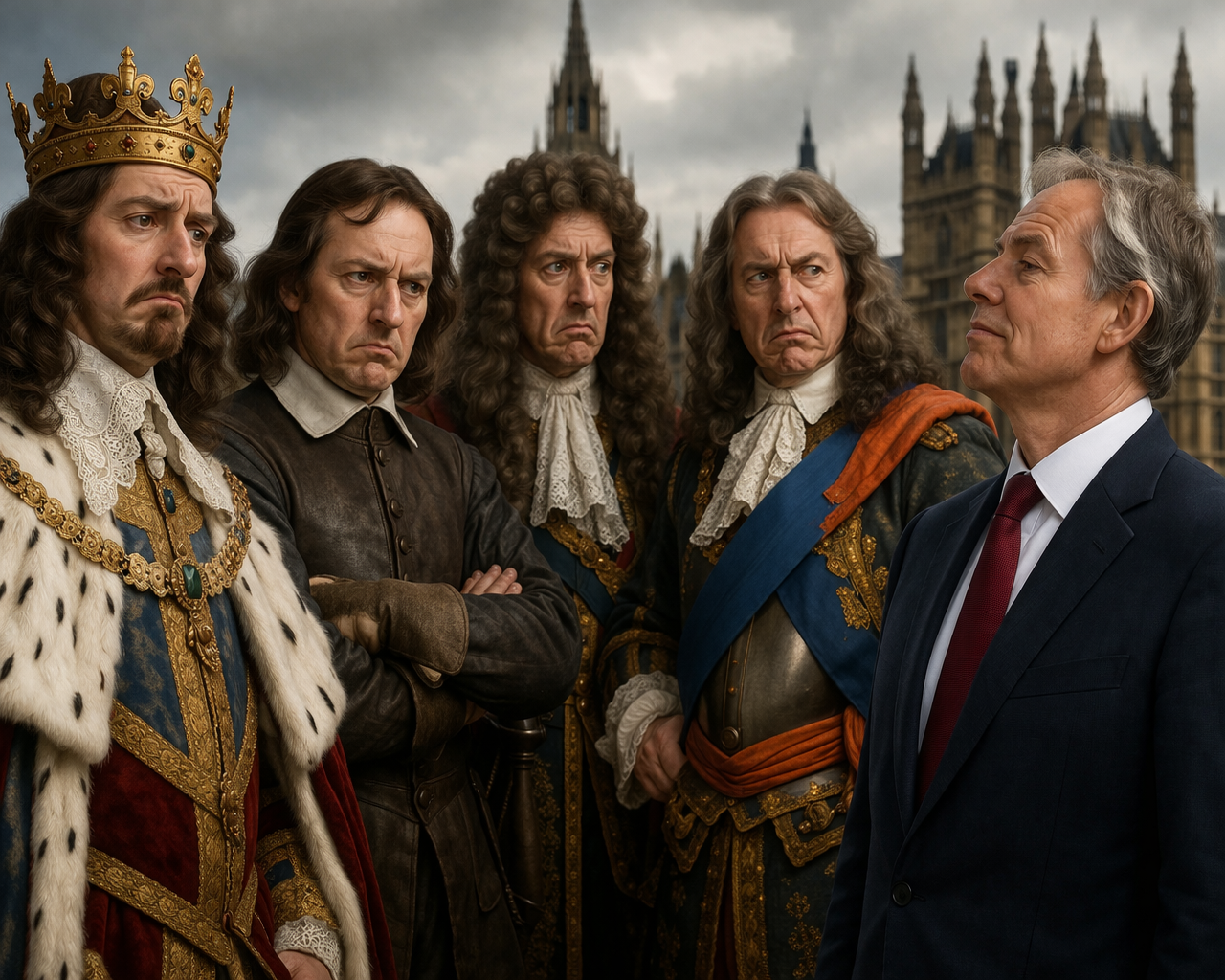
The same transformation has occurred elsewhere. The Church of England blesses the present order of things with all the enthusiasm it once gave to Charles I. The monarchy has adjusted itself with equal smoothness. Charles III does not resist. He accompanies. He speaks the language expected of him. In short, the monarchy is no longer an obstacle to the present system. It is one of its instruments.
This is why Gregory’s central claim fails. The removal of hereditary peers does not delegitimise the monarchy. That would require a monarchy still resting on its former basis. What we have instead is an institution that survives because it is useful to those who matter. It lends continuity to what would otherwise look like a series of abrupt and unattractive changes. It provides a sense of tradition to a regime that has little interest in tradition itself. It is not being attacked. It is being used.
The hereditary peers, in this context, were not a supporting pillar. They were a reminder. Their continued presence suggested that something of the old order might still be intact. Their removal does not weaken the Crown. It removes an illusion about the Crown.
This is why this protest feels misplaced. It treats a late and minor adjustment as if it were a decisive moment. It assumes that the system can be corrected by appeal to its earlier principles. It imagines that a polite letter might recall an arrangement that no longer exists.
The truth is harsher. There are no remaining safeguards from the older order. The institutions that once limited power have either been dissolved or absorbed. The system we now inhabit is not neutral ground. It is organised and flexible, and increasingly confident in its purposes. It is not trying to preserve the past. It is managing what it allowed of this to remain.
To be a conservative in the old sense—one who defends what exists because it has grown over time—is therefore to defend a structure that has already been emptied out. It is to speak a language that no longer corresponds to reality. It is, in effect, to become the modern equivalent of a Jacobite. There were still men after 1745 who spoke of restoring the Stuarts. They maintained loyalties that were now merely quaint. They kept alive a vocabulary of legitimacy that had lost its object. Their cause was not wicked. It was simply finished.
The same applies here. The order Mr Lauder-Frost wishes to defend is not under threat. It is gone.
His specific complaint—about the final expulsion of hereditary peers from “their” House—is therefore misdirected. It is the complaint of a passenger on a sinking ship who notices that the lavatories have begun to overflow. He is not wrong. He is merely concerned about one incidental detail of a general catastrophe.
What follows from this is not despair, but a change of perspective. If the old constitution cannot be restored, it cannot be conserved. If it cannot be conserved, the political task is no longer conservative. It becomes something else—call it traditionalist, call it reconstructive, call it what you please. It requires thinking about institutions not as they were, but as they might be remade.
This is where conclusions begin to grow uncomfortable. The monarchy, as it now exists, is part of the present arrangement. It does not stand outside it. It does not correct it. Any serious attempt to recover self-government would therefore have to consider whether that arrangement, including the Crown, can serve any good purpose, or whether it must be set aside. If what we now need looks like a Cromwellian republic, that is what we should want.
That is not a conclusion that would have been entertained fifty years ago. It is, however, one that follows naturally once the illusions are stripped away. We are not living through the decay of an old order, but through its replacement. The monarchy survives because it is useful to what replaced it. The Lords are being adjusted to suit the same purpose. Nothing essential is being destroyed because nothing essential remains to destroy.
Gregory writes as if the constitution were still there to defend. It is not. What he defends is its memory, and what he opposes is the clearing away of its last visible traces. If an honourable mistake, this is still a mistake. It is also a mistake. If we are to be free again, and masters in our own house, we must begin from the recognition that we are not that now.
The first step in any recovery is to stop pretending that what has been taken from us is still there.
Discover more from The Libertarian Alliance
Subscribe to get the latest posts sent to your email.


Depends on whether you think hereditary is an essential basis of human civilisation (not just desirable). If you think it is, then monarchy seems inevitable due to the need to resolve/neutralise competing claims amongst elites (something that is probably provable mathematically). Republics fail for this reason. Even Ancient Greece wasn’t strictly a republic in the modern sense.