I have being following Bryan Mercadente and Reginald Godwyn’s writing on gold with close interest. I will now add my own pennyworth from an American perspective to the discussion. If you strip away the polite language of central banking and look instead at the underlying mechanics, the conclusion is not subtle. The dollar is not merely weakening; it is being methodically hollowed out. What remains is the shell of a currency whose credibility depends on habits that are already breaking.
I write this not as a theorist but as a small businessman. I run a small but moderately popular motel. I deal in cash flow, maintenance costs, wages, and the steady arithmetic of keeping a business alive. In such a position, you notice things earlier than the economists who live in spreadsheets. Over the past few years, the pattern has become unmistakable. My costs rise relentlessly. Energy, insurance, repairs, labour—none of these respond to official inflation figures. They move according to reality, and reality is that the purchasing power of the dollar declines year by year. At the same time, the currency in which my customers pay me is produced in quantities that would once have been regarded as financial insanity.
The reason is simple. The government cannot reduce its spending. It cannot meaningfully increase its revenue. It therefore borrows. When borrowing becomes too expensive, the central bank intervenes—not openly, but through the familiar machinery of “liquidity provision” and “market support.” The effect is the creation of new money to absorb the debt that no one else wishes to hold. This is not a temporary expedient. It is now the system.
Consider the structure. Debt expands faster than income. Interest payments consume an ever larger share of revenue. As older debt matures, it must be refinanced at higher rates, increasing the burden still further. Eventually, the state borrows not for new spending, but to service existing obligations. At that point, the distinction between solvency and insolvency becomes rhetorical. In practice, the adjustment comes through the currency. Higher interest rates would bankrupt the government. Lower rates require intervention. Intervention requires money creation. Money creation reduces purchasing power. Reduced purchasing power drives higher nominal spending, which requires further borrowing. The circle is complete. What is remarkable is not that this process is occurring, but that so many continue to treat it as sustainable.
In my own business, the implications have become impossible to ignore. When I price a room, I must consider not what the dollar is worth today, but what it will be worth when I replace the carpets, repair the plumbing, or pay next year’s insurance. The answer is always the same: less. That is why I have begun to think seriously about altering the basis of exchange.
I already hold a substantial quantity of gold and silver. That accumulation was once a hedge, a form of insurance against unlikely scenarios. It is now becoming something more practical. I find myself wondering—not idly—whether it would be wiser to accept payment in silver rather than in a currency whose long-term value is visibly deteriorating. This is not eccentricity. It is adaptation.
Precious metals possess a property that fiat currencies lack: they cannot be created in unlimited quantities at the discretion of a central authority. Their supply is constrained by physical reality. Their value is not dependent on political promises. For thousands of years, that has been sufficient.
You do not need to believe in imminent collapse to see the direction of travel. A currency does not become worthless overnight. It declines, steadily, then more rapidly, until confidence breaks. At that point, what was once money becomes paper. The phrase “toilet paper status” is crude, but not inaccurate. A currency that can be produced without limit, and must be produced without limit to sustain the system that issues it, cannot retain its value indefinitely. The mathematics forbids it.
It is sometimes argued that the dollar is different—that its reserve status, its military backing, and the inertia of global finance will preserve it. These may delay the outcome. They cannot prevent it. Confidence is not a permanent asset. It erodes when reality contradicts the narrative for long enough. Even now, the signs are visible. Investors prefer short-term debt to long-term commitments. Foreign buyers hesitate. Central banks accumulate gold. These are not random developments. They are rational responses to a system that is becoming visibly unstable.
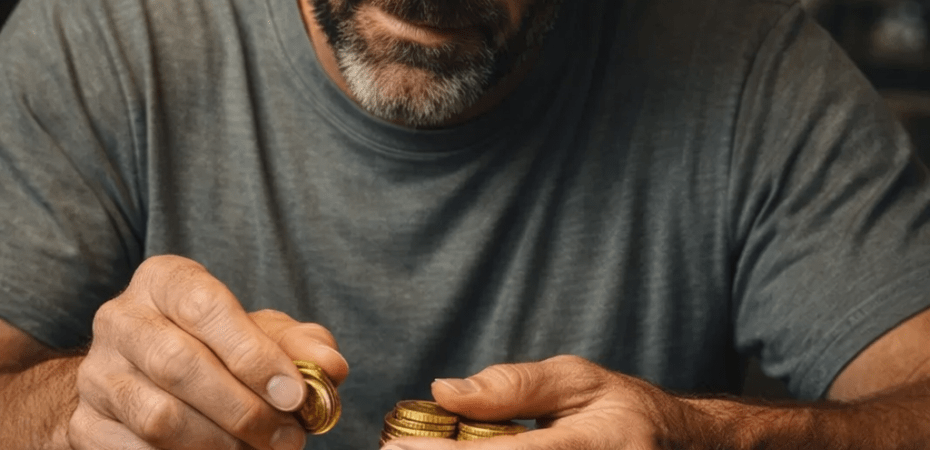
As for myself, I take precautions of a more immediate kind. Unlike with Mercadente and Godwyn, my holdings of precious metals are physical, and they are secure. I have no intention of relying on promises when the structure that underwrites those promises is under strain. No ETFs for me—no trusting to the Royal Mint. As an American, I take the Second Amendment very seriously. The private quarters of my motel are equipped in ways that would cause alarm in Britain. While my guests watch Fox News in their rooms, I stack gold coins and keep a Colt Magnum .457 within easy reach.
The broader point, however, is not personal security but monetary survival. To remain fully exposed to fiat currency in these conditions is to accept a gradual confiscation of wealth. It is to trust that a system which cannot balance its books will nonetheless preserve the value of its obligations. History offers little support for such confidence.
By contrast, to hold gold and silver is to step partially outside that system. It is not a path to sudden riches. It is a refusal to participate entirely in a process that ends, inevitably, in devaluation.
If the choice is between a currency that must be debased and metals that cannot be, the decision is not difficult. The only question is how long one waits—and whether one prefers to act quietly, or in the company of a crowd that has finally realised what has been happening all along.

Discover more from The Libertarian Alliance
Subscribe to get the latest posts sent to your email.
Related posts:



Powered by YARPP.