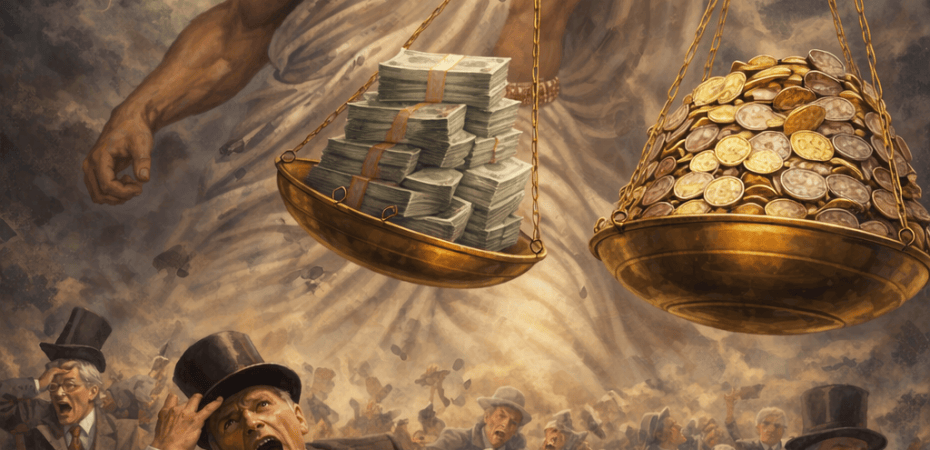
The past month in the bullion markets has been a useful reminder that gold and silver are not polite assets for polite times. They do not drift upwards like a savings account with better manners. They lurch, they punish, they seduce, they frighten the weak hands out of their positions, and then they carry on as if nothing has happened. If one insists on watching the price every morning, one will end by either selling at the worst moment or developing the kind of nervous condition for which your present residence offers expert care.
In sterling terms, the recent pattern has been plain enough. Gold had been pressing hard towards the £4,000 level and briefly traded above it, reaching around £4,074, before falling rapidly into the £3,400s and then recovering to the high £3,700s and £3,800s. Silver, more excitable and more savage, surged towards the high £80s per ounce, almost touching £88, then fell into the £50s in what felt like a trapdoor opening beneath the floorboards, and then clawed its way back into the mid-£60s. The newspapers, doing what newspapers do, treated the correction as a morality tale about “hype”, “safe havens”, and the “Warsh effect”, as if the world’s monetary architecture had been jolted by a single appointment rather than by decades of fiscal and institutional decay. But the fall itself deserves a closer look. The speed and violence of the drop did not resemble a gradual shift in investor sentiment. It resembled a mechanical liquidation. Prices did not ease down in an orderly manner. They collapsed through levels as though bids had simply disappeared. This invites a suspicion that the decline was not merely a correction, but a deliberate operation.
My own belief is that the collapse in bullion prices reflected manipulation by actors who knew in advance that war was coming in the Middle East. Those with foreknowledge of a geopolitical shock had every incentive to drive prices down first, accumulate positions cheaply, and then profit from the inevitable rise once the news broke. Anyone who has watched bullion markets over the past two decades knows that this sort of manoeuvre is not theoretical. Sudden downward spikes, large volumes of paper metal dumped into thin markets, and temporary collapses in price have become familiar features of the system. If one possessed reliable knowledge that a major war was imminent, one would wish the market price of gold and silver to be as low as possible beforehand. One would sell aggressively, trigger margin calls, frighten weak holders into liquidation, and then quietly buy what they had been forced to abandon. Viewed in that light, the past month’s behaviour looks less like panic and more like preparation.
When the war began, the expected reaction followed. Bullion rebounded sharply. Yet something curious has happened since. Despite the dramatic geopolitical news, prices have not continued their ascent. They rebounded strongly, but they have not entered the kind of explosive rally that accompanies a long and escalating war.
Markets are imperfect forecasting devices, but they do reveal collective expectations. The fact that bullion has stabilised rather than surged suggests that traders do not anticipate a prolonged regional conflict. In other words, the rebound may have priced in the initial shock, but the absence of a second surge implies that markets expect the fighting to remain limited or short-lived. This does not mean the markets are correct. Financial history is littered with confident miscalculations. But the current behaviour of gold and silver does suggest that the consensus expectation is not yet one of a drawn-out Middle Eastern catastrophe. If that expectation proves wrong, the reaction in bullion will likely be violent.
The truly important consequence of this war has not yet appeared in the economic statistics. Wars in the Middle East almost inevitably lead to disruptions in oil supply and transport. Even modest disruptions push energy prices upward. When oil rises, everything rises. Energy is embedded in every stage of modern production and distribution: mining, fertiliser, shipping, plastics, manufacturing, transport, electricity generation. The result is a supply shock.
This kind of inflation is not driven primarily by consumer demand but by rising costs throughout the production chain. Businesses must charge more because their inputs cost more. Workers demand higher wages because the cost of living rises. Governments, facing rising costs and political pressure, accommodate the increase by expanding the supply of money. This is the crucial step. Central banks and treasuries do not normally respond to rising prices by tightening monetary conditions enough to crush the inflation. Doing so would trigger recession and political upheaval. Instead, they allow the money supply to expand so that the higher prices can be paid.
In other words, price inflation is accommodated by monetary inflation. And when inflation is accommodated, gold and silver eventually rise. The adjustment is rarely immediate. Markets move in stages. But the logic is relentless. A rising price level combined with expanding money supply leads, sooner or later, to higher prices for scarce monetary metals.
This brings us to the deeper point. Gold and silver have not been rising because of one war, one election, or one central banker. They have been rising because the global monetary system has reached a point where honest money is politically impossible. Western states have accumulated debts that cannot realistically be repaid in sound currency. Servicing those debts requires interest rates that would cripple their economies. The result is a permanent temptation to inflate. Inflation allows governments to reduce the real value of their debts without formally defaulting. It transfers wealth quietly from savers to borrowers, from citizens to the state. No press conference announces this policy. It is simply how the system functions. Once this becomes widely understood, people behave differently. They begin to search for assets that are not somebody else’s liability. They want wealth that cannot be diluted by decree.
That is what bullion represents. Gold and silver are not promises. They are things. They have no issuer. They have no balance sheet. They cannot be printed by a treasury or created by a bank. Their supply increases slowly and at great cost. For thousands of years they have functioned as monetary anchors precisely because they resist manipulation. None of this means that bullion prices will move smoothly. It means the opposite. Gold is volatile. Silver is feral. Silver’s recent behaviour illustrates this. It surged, collapsed, and rebounded within weeks. That is not abnormal. Silver has always been the more volatile monetary metal because its market is smaller and more sensitive to speculative flows. The informed investor treats this volatility not as a reason to panic but as a warning against leverage. Leveraged positions are what cause the violent swings. Margin calls force sales regardless of the underlying fundamentals. The patient holder, who owns metal outright, is not affected in the same way. He watches the storms pass.
The deeper lesson of the past month is not about a single price movement. It is about the character of the world we now inhabit. We are entering a period of unusual geopolitical and financial uncertainty. The old certainties of the post-Cold War era are dissolving. Great-power rivalry has returned. Supply chains are fragmenting. Governments are becoming more intrusive. Financial systems are increasingly used as instruments of political power. In such a world, the traditional concept of a “safe asset” becomes questionable. Government bonds depend on government solvency. Bank deposits depend on bank solvency. Pension promises depend on political decisions made decades in the future. Bullion depends on none of these things. Gold and silver are therefore not merely commodities. They are forms of financial insurance.
A British saver thinking about the next decade should begin with one simple assumption: the purchasing power of sterling will continue to decline. This does not require hyperinflation or dramatic currency collapse. A slow erosion is sufficient. Four or five percent inflation maintained over many years steadily destroys the value of savings. The rational response is to diversify into assets that cannot be diluted by monetary policy. Property once served this role, but it has become heavily entangled with taxation and other forms of political hostility. Equities can perform well but are vulnerable to financial repression and market manipulation. Precious metals remain the simplest and most historically reliable refuge.
That does not mean placing every penny into bullion. It means holding a meaningful portion of savings in a form that lies outside the financial system. Physical gold should form the core of that position. Silver can play a useful supplementary role, particularly during phases when monetary anxiety drives the gold-to-silver ratio downward. The key principle is to avoid leverage and to accumulate gradually, especially during periods of price weakness. The correct response to the recent decline was not panic. It was accumulation.
In a more than usually uncertain world, precious metals remain the only universally recognised safe haven for savings. They are not perfect assets. They generate no income. They fluctuate in price. They occasionally endure brutal corrections. But they possess one quality that modern financial assets increasingly lack. They do not depend on trust. Gold and silver function whether governments behave responsibly or irresponsibly, whether banks are solvent or insolvent, whether currencies are stable or debased. They simply exist. In an age when almost every financial instrument is somebody else’s promise, that simple fact may turn out to be the most valuable characteristic of all.
None of this is financial advice, of course, and you should consult someone properly licensed by your government before doing anything so reckless as acting in your own interest. But if you want the underlying truth in plain English, it is this: a state that cannot afford honest interest rates cannot afford honest money. Gold and silver are not magic. They are merely what remains when one stops believing in polite fictions.

Discover more from The Libertarian Alliance
Subscribe to get the latest posts sent to your email.
Related posts:
 Gold, Silver, and the Managed Demolition of Western Money
 Going for Gold
 Going for Gold: A Note of Caution to Bryan
Too Soon, Not Too Wrong: Gold and the Meaning of a Fall
Going for Gold: A Note of Caution to Bryan
Too Soon, Not Too Wrong: Gold and the Meaning of a Fall
 Britain’s Debt is a National Scam: A Case for Repudiation
 Repudiating Britain’s National Debt: An Inevitable Reality Already Unfolding
 Hyperinflation: Engineered Crisis or Convenient Catastrophe?
 The Budget that Cannot Yet Be Written
Powered by YARPP.
Thank you for your excellent analysis. Rising oil prices create the political incentive for monetary expansion, and that expansion produces inflation.
All my junior gold miners remain in positive territory, so I can’t pair capital losses with capital gains. I’ll hold them through the expected third‑quarter correction. My oil titles should provide the capital for buying more junior gold miners when they reach the expected bottom.
A two‑tier financial system would be more flexible and stable. Stablecoin issuers could accept fiat currency and use it to purchase Treasuries, which would back their promise to pay in dollars issued to the recipients intended by the original sender. Dollars are promises to pay in real assets held by the federal government, including land, silver, and gold; but instead of a fixed price, they could be redeemed at current market prices. Interest from the Treasuries purchased with USD by Stablecoin could be used to purchase gold coins. This would back a separate issuance of notes by Stablecoin, redeemable in a fixed amount of gold, giving savers a genuine safe haven and an alternate form of currency. US federal obligations and other spending would be in USD. Payments to Social Security and VA pension recipients could be inflation‑adjusted through COLAs, which understate the real rate of inflation.
[…] have being following Bryan Mercadente and Reginald Godwyn’s writing on gold with close interest. I will now add my own pennyworth from an American perspective […]