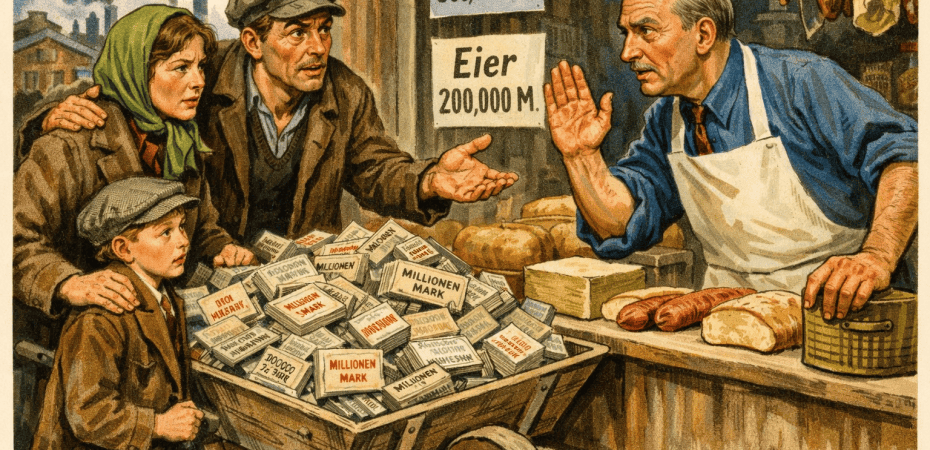
Let us dispense with polite economic euphemisms and lay bare what’s unfolding before our eyes. Inflation is not some mysterious weather system, inexplicable and random. It is not a natural phenomenon, but a political weapon, one that has been deployed repeatedly by ruling elites to fleece the unsuspecting public. And like all weapons, it comes with collateral damage—mainly borne by the middle and working classes.
It’s crucial to begin with the historical understanding of what inflation actually is. The 1983 Webster’s Dictionary correctly defined it as an increase in the amount of currency in circulation, leading to a sharp decline in its value and a corresponding surge in prices. But in recent decades, the official definition has been quietly massaged and rewritten. Now, outlets like Investopedia refer to inflation simply as “a rise in average prices”—a description of a symptom, not the cause.
Why was the definition changed? Because acknowledging the root cause—deliberate currency debasement—would indict the very institutions responsible. It would make explicit that governments, aided by central banks, are the culprits, not passive observers. This is not academic quibbling—it’s about obfuscating blame and normalizing theft.
John Maynard Keynes understood this all too well. In The Economic Consequences of the Peace, he stated bluntly:
By a continuing process of inflation, governments can confiscate, secretly and unobserved, an important part of the wealth of their citizens.
This wasn’t a warning—it was a blueprint. Since the publication of Keynes’ work, virtually every Western government has adopted inflationary policy as standard operating procedure. Nixon’s infamous declaration in 1971 that “we’re all Keynesians now” marked the final divorce of the U.S. dollar from gold, removing any anchor of restraint.
What followed was the unrestricted proliferation of fiat currency, a process deliberately designed to fund empire, war and Wall Street bailouts—all at the expense of savers and workers.
But while inflation is a slow erosion, hyperinflation is a monetary detonation—a phase change that happens suddenly and devastatingly. And history shows that once it begins, it cannot be contained.
We are often told that hyperinflation is an accidental rarity, and impossible in the “advanced” economies of the West. This is a lie. In truth, hyperinflation is the inevitable endpoint of unchecked monetary debasement—a disaster invited by elites who believe they can manage the fire, only to watch it consume the system. It has occurred only under fiat systems, without exception. The first modern case occurred in Revolutionary France (1789–1796), and over 27 other episodes have followed—all in fiat regimes. These events occurred under capitalist, socialist, and communist governments—because the form of government doesn’t matter when the underlying monetary structure is rotten.
Once a political class finds that it can print wealth into existence, it never voluntarily stops. Debt piles up, interest payments spiral, and the only way out becomes monetization—printing more to pay the interest on what was already printed. This is not a bug; it is the system’s logical conclusion.
There are always winners in hyperinflation. But they are not average citizens. They are the politically connected, the insiders, the banking class, the hedge funds, and the corporations with early access to credit and real assets.
The losers? Everyone else. The average middle-class saver, who faithfully trusts the currency and keeps his savings in a fixed-term account at 2%, wakes up one morning to find his wealth evaporated. Meanwhile, those who knew what was coming—or were part of the decision-making process—have already rotated their assets into precious metals, hard commodities, and politically protected equities.
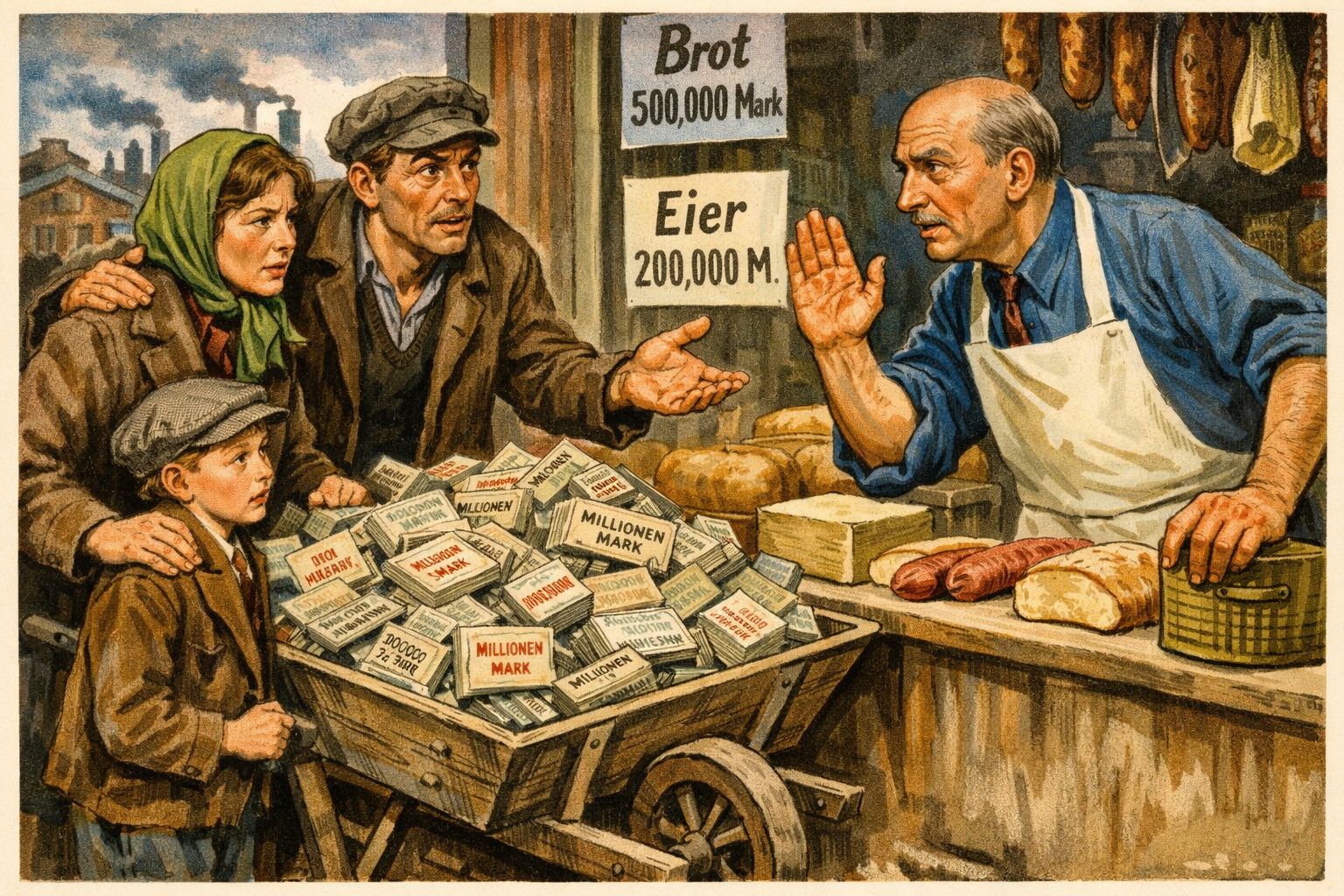
This isn’t speculation—it’s historical pattern. In Weimar Germany, inflation became hyperinflation almost overnight. One day you could buy a loaf of bread with a few marks. Weeks later, it took a wheelbarrow full. At the peak, inflation reached 16,579,999%. By then, it was too late for the “little people.” The elites, of course, had long since moved their assets to safety.
Do we really believe the central banks and Treasury officials of today are unaware of this history? Or is it more likely that they are walking the same path, eyes open, confident that they will weather the storm they themselves are stoking, while the masses are left to burn?
If you believe hyperinflation is a distant possibility, you are already at risk. The time to act is before the dam breaks. Do not leave your wealth in bank accounts yielding 2% while real inflation is running at 15% or more—masked by falsified CPI statistics and media propaganda. You are being robbed in real time.
Precious metals—gold and silver—have no counterparty risk. They are not someone else’s liability. They cannot be inflated away by a printing press. Likewise, shares in companies tied to commodities—energy, food, metals—are positioned to rise with every downward lurch of the currency.
The most dangerous thing you can do right now is nothing. Waiting for “official confirmation” of hyperinflation is like waiting for an earthquake to be declared after the building collapses. By the time the government admits the crisis, it will already be too late to act. The signs are all there—ballooning sovereign debt, endless fiscal deficits, aggressive rate cuts at the first hint of market pain, and continued quantitative easing dressed up in Orwellian terminology. The global financial system is a powder keg. And the people lighting matches are not ignorant—they are arrogant.
They believe they can control the outcome. They believe they will escape the consequences. History says otherwise. But unless you take steps now—outside the system, outside fiat, and outside government reach—you may not get another chance. There is no cavalry coming. There is only preparation, or devastation.
Choose wisely.
NB—Mr Pozeram runs a motel in America. He is not a financial adviser. You must take his article as a personal opinion. Always consult someone licensed by your government before making an investment, and do remember that investments can go down as well as up.
Discover more from The Libertarian Alliance
Subscribe to get the latest posts sent to your email.
Related posts:
 Britain’s Debt is a National Scam: A Case for Repudiation
 Repudiating Britain’s National Debt: An Inevitable Reality Already Unfolding
 Gold, Silver, and the Managed Demolition of Western Money
 Going for Gold
 Going for Gold: A Note of Caution to Bryan
Too Soon, Not Too Wrong: Gold and the Meaning of a Fall
Going for Gold: A Note of Caution to Bryan
Too Soon, Not Too Wrong: Gold and the Meaning of a Fall
 The Budget that Cannot Yet Be Written
 The Long Betrayal: How Modern Monetary Policy Became a Machine for Ruin
 Britain’s Youth Exodus: Labour’s Crime, Conservative Guilt
Powered by YARPP.
Frankly, given Mr Pozeram’s success as a motelier in rural Wisconsin, which has brought him stellar connections at the state level, I would be inclined to take his financial tips seriously. Especially when you consider the amount of jet-setting he does across North America on behalf of The Libertarian Alliance, which must set him back even when you account for the air miles and the cheaper rate in economy class. I will put aside that he looks like a character out of an S. H. Courtier novel.